English, Recent Publications

Journal for the Study of Judaism 42.3

JSJ 42.3 (2011) has just been published online.  And now, on to some of the spoils:

Margaret H.Williams, “Image and Text in the Jewish Epitaphs of Late Ancient Rome.”

This paper aims to establish for the first time the relationship between the verbal and visual elements of the Jewish epitaphs from 3d/4th-century C.E. Rome. A close analysis of the approximately 500 usable inscriptions leads to the conclusion that, the Jewish character of most of the images notwithstanding, the key operative factor at every social level was Roman memorialisation practice. The study thus throws considerable light on the acculturation of Rome’s Jews in Late Antiquity. Two appendices, in which all the symbols that occur are listed individually and by cluster, complete the study.

Fergus Millar, “A Rural Jewish Community in Late Roman Mesopotamia, and the Question of a “Split” Jewish Diaspora.”

This paper emphasises the significance of Syriac evidence for the history of the Jewish Diaspora, and then focuses on an episode in the Syriac Lives of the Eastern Saints by John of Ephesus, which records the demolition by the local Christians of the synagogue of a Jewish community established in a village in the territory of Amida. The significance of this story is explored in two inter-related ways. Firstly, there is the relevance of Syriac-speaking Christianity which, like Judaism, was practised on both sides of the Roman-Sasanid border. Secondly, the article suggests that the presence of Jewish communities in those areas of the Roman empire where Syriac or other dialects of Aramaic were spoken complicates the recently-proposed conception of a “split” Jewish Diaspora, of which a large part was unable to receive rabbinic writings because it knew only Greek. But for Jews living in areas where Aramaic or Syriac was spoken, there should have been no major linguistic barrier to the reception of the rabbinic learning of either Palestine or Babylonia.

I’ve been waiting for some work on John of Ephesus and some interfacing between Syriac Christianity and Sasanian Jewry.

There are also a slew of reviews, including one of Yehudah Cohn’s Tangled up in Text.  In addition, there is a very extensive “Books Received” section.

Standard
Around the Web, English, Technology

Websites on Manuscripts and Websites as Manuscripts

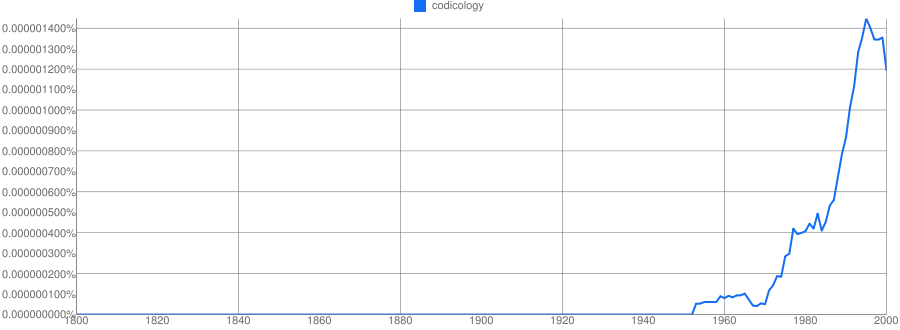
A Google ngram of the use of the word codicology throughout history. Notice how the graph parallels the work of Prof. Beit-Arié (Hattip- Shamma Friedman).

Recently, while casually surfing the web, I came across “a hilariously unsuccessful for-profit online education project” known as Fathom.com, which ran during the internet bubble. In a time when forecasts floated around saying that “distance education” would be “a $9 billion industry by 2003”, Columbia University and other formal and informal institutions of higher learning banded together to “provide high quality educational resources to a global audience through the Internet.” Although the site hasn’t been updated in a few years and a lot of the links are broken, its courses are still up (now for free), and include some in Jewish Studies. To my great delight I came across one entitled “An Introduction to Hebrew Manuscripts“, co-authored by an all-star cast made up of the art historians Joseph Gutmann and Evelyn M. Cohen; the former JTS librarian and professor of Medieval Hebrew Literature and Jewish Bibliography Menahem Schmelzer; and the preeminent codicologist Malachi Beit-Arié. Beit-Arié, who is professor emeritus at Hebrew University, a member of the Israeli Academy of Sciences and Humanities, and past director of the JNUL, is currently at work on a project to create an online database of codicological information collected by the Hebrew Palaeography Project. The “study of books as physical objects” is quite an important field to be familiar with when approaching the Talmud and I immediately read through the seminar’s four sessions.

course images

Prof. Christine Hayes teaching a Yale Open Course. Prof. Hayes now assigns her online lectures to her current Intro to the Old Testament students.

Yet while reading about the different ways in which Jews have transmitted knowledge on paper I could not help but think of how I was learning all of this from a format which had in itself become passé. Within a decade of its publication, the really excellent seminar had already fallen by the way side as its medium fell out of use. Online learning still exists, but in slightly different formats, through the extremely successful iTunes University and Academic Earth. Except for podcasts like Prof. Michael Satlow‘s series “From Israelite to Jew“, most online courses nowadays are video or audio recordings of actual university courses. Both iTunesU and Academic Earth really have a huge amount of valuable information (with some overlap), but only a limited amount of Jewish Studies courses, which is why I was surprised to see that Fathom even had a Jewish Studies section on its site. A couple of years ago my friends and I discovered Prof. Christine Hayes’ online course “Introduction to the Old Testament (Hebrew Bible)” and we were bothered that we could find practically no other full courses in Jewish Studies. Yeshiva University has a few academic lectures available on iTunes U and the Orthodox adult education organization “Torah in Motion” also has a number of academic lectures available for a dollar or two each. In Hebrew, the Youtube channel of Hebrew U has a few lectures worth watching, like Prof. Avigdor Shinan’s Introduction to Aggadic Literature and videos of the last World Congress of Jewish Studies. Still, this is scarce when compared to both the plethora of other courses available in the humanities and the amount of money which goes into Jewish Studies in the academy. When the number of potential listeners is also taken into account, it is pretty surprising that more Jewish Studies courses or guest lectures aren’t available online.

Perhaps students of Jewish Studies would do well to take the cue from Prof. Beit-Arié and try and curate a website based database that brings together links to the various free courses available online. Such a collection would not only make finding what is already available easier, but might convince more institutions to take part in online learning.

Standard
English, Recent Publications

Some new articles from off the beaten track

My new RAMBI RSS feed is the gift that keeps on giving. Here are some new and not so new titles from off the beaten track that caught my eye:

Stephen J. Pfann, “ Abducted by God? : The process of heavenly ascent in Jewish tradition, from Enoch to Paul, from Paul to Akiva,”  Henoch 33.1 (2011): 113-128.

Pfann’s aricle appears in a special issue of Henoch devoted to “Enochic Traditions and Mediatorial Figures in Second Temple Judiasm and Their Legacy in Early Christianity, Rabbinic Judaism, and Islam, curated by Jason M. Zuraswski, University of Michigan

Anders Hultgård, “La religión irania en la antigüedad: su impacto en las religiones de su entorno – judaísmo, cristianismo, gnosis” in Biblia y Helenismo; el pensamiento griego y la formación del cristianismo (Antonio Piñero ed.; Córdoba: El Almendro, 2007), 551-593.

Admiel Kosman, “ Über die geistige Liebe in der talmudischen Literatur : die Liebesgeschichte von Akiva und seiner Partnerin neu gelesen,” in Jüdischer Almanach (2010): 26-45.

Standard
English, Technology

Hebrew Manuscripts Galore

And now for some more good digitization news from Israel.
Yisrael Dubitsky of the National Library of Israel announces:

We are delighted to announce that The National Library of Israel’s online catalogue now includes more than 2000 linked records to freely available digitized Hebrew manuscripts online (post-dating the Dead Sea Scrolls) from institutions around the world. These represent many more Judaica records than are currently available through either the Digital Scriptorium,  the Catalogue of Digitized Medieval Manuscripts  or similar digitized manuscript aggregators.

The link for the National Library of Israel catalog is http://jnul.huji.ac.il/heb/aleph500.
Find your MS under כתבי יד or Manuscripts, and if there is a digital image, you will find a link – if they have it!

Standard
English, Readings, Recent Publications

New Iranica Antiqua and a Hebrew Inscription on Ahura Mazda’s Tunic

For Talmudists interested in the Bavli’s Sasanian context, a new edition of Iranica Antiqua is always a reason to celebrate. Volume 46 (2011) has just been published, and it does not disappoint. It contains a slew of interesting articles on Sasanian Iran, including:

Maciej Grabowski, “Ardašīr’s Struggle against the Parthians: Towards a Reinterpretation of the Fīrūzābād I Relief”

The proposed reinterpretation of the Fīrūzābād I relief is based on the assumption that we deal with a particular iconographic synopsis of the events that occurred during Ardašīr’s war against the Arsacids (c. 220-228). The concept of iconographic summary of several historical events may be traced back to the Achaemenid period (Bīsotūn relief), and may also be observed in the triumph reliefs of Šāpur I. It is thus suggested that each of the three equestrian combat scenes depicted on the Fīrūzābād I relief recalls one of three major stages of Ardašīr’s struggle against the Parthians. Information from textual sources combined with iconographic observations permit to develop a hypothesis concerning the identity of some of the depicted personages, and thus to reveal proper historical context of each scene. New terminus post quem for the Fīrūzābād I relief is also proposed, this being the year 228 which most probably marks the end of the last phase of the war.

Brucno Overlaet, “Ardashir II or Shapur III? Reflections on the Identity of a King in the Smaller Grotto at Taq-i Bustan,”

Two Sasanian kings are depicted on the back wall of the smaller grotto at Taq-i Bustan near Kermanshah (Iran). They are identified by inscriptions as Shapur II (309-379 A.D.) and his son Shapur III (383-388 A.D.). However, the details of the crowns and the design of the relief oppose this idea. It makes it likely that the figure identified as Shapur III is in fact Ardashir II (379-383 A.D.), the immediate successor and (half)brother of Shapur II. It is suggested that the identifying texts were added when Shapur III came to power.

Jamsheed K. Choksy, “Friends and Friendships in Iranian Society: Human and Immortal”

Constructs, permutations, functions, and bases of friends and friendships in society and sociopolitical hierarchies are analyzed within the context of religiosity in Iran and Iranian regions of Central Asia.

Michael B. Charles, “The Sassanian ‘Immortals”

The Sassanian Persians are generally regarded as having maintained an elite cavalry unit called the ‘Immortals’, the formation of which was inspired by Achaemenian practice, thereby demonstrating continuity between the two dynasties, as per the general scholarly view. This article assembles all the pertinent evidential material from the Greco-Roman sources in order to present a comprehensive critique of this position. It emerges that references to Sassanian Immortals in sources emanating from the Mediterranean world may owe more to classicizing fancy than to historical reality, and particularly a desire to approximate late-antique wars against Persia with those waged by the West against Achaemenian kings.

Bruno Overlaet, “Hidden in Plain Sight: The Hebrew Inscription on Ardashir I’s Rock Relief at Naqsh-i Rustam,”

The relief of Ardashir I at Naqsh-i Rustam is the first Sasanian investiture scene with the two protagonists on horseback. They are identified by a prominent trilingual inscription on the horses as Ardashir I and Ahura Mazda. A Hebrew inscription remained unobserved since the 19th century, however. It is chiselled on the folds of Ahura Mazda’s tunic.

The final article in particular caught my eye. Who might have written a Hebrew inscription hiding in on the folds of Ahura Mazda’s tunic at Naqsh i Rustam? Unfortunately, I was disappointed to find that the piece contains no readings of the Hebrew inscription in question. In fact, aside from a clear photograph on the final page, the article reads more like a notice than a work of actual scholarship.

I contacted Shaul Shaked Schwarzmann University Professor emeritus here at the Hebrew University, who was kind enought to relay the following, tentative remarks:

1. A faint inscription above the main one. I am indicating doubtful readings by parentheses, and editorial supplements by square brackets.

(בניה) שמואל הכהן
[ב]רו(ך)

2.

(חש?) רברבה חסן בן חסן בן (ס)הל באלחסן מזאר
שנת
אלשג סמן
טוב
מן חלון

The date 1303 is naturally Seleucid, i.e. 992 CE. The translation of inscription 2 is:

… (?) … Hasan son of Hasan son of Sahl Bu-l-Hasan, visit
of the year
1303. Good
Omen.
From Hulwan.

The beginning of the inscription is hard to make out, and I doubt whether רברבה is the correct reading. An alternative reading of the beginning of this inscription could be:

הזר ברכה (Persian-Hebrew:) A thousand blessings.

The trouble is that the last one letter looks distinctly like bet.

The two inscriptions could have been engraved at the same time, probably by two different hands. These are obviously inscriptions of the type of “Jimmy was here”. With luck we may be able to identify one of these two persons. The date is perfectly compatible with the Islamic-period names and, I believe, with the shape of the script.

Standard
English, Recent Publications, Reviews

Gafni Continues the Debate

A further chapter in the Gafni-Goodblatt debate, and for that matter in the ongoing “Stam Wars,” has recently been published in the journal Jewish History.   In a detailed and important review of Jeffrey Rubenstein’s trilogy- Talmudic Stories, The Culture of the Babylonian Talmud, and Stories of the Babylonian Talmud, Isaiah Gafni comes out fighting.  Gafni acknowledges that scholars like Rubenstein and his predecessors have changed the rules of writing the history of the “Talmudic era” irrevocably, but that does not mean he will accept Rubenstein’s approach whole-cloth, or go along entirely with the latter’s proposed ceasefire for the Gafni-Goodblatt debate.

Anyone who cares about the direction of research into the Talmud’s anonymous layer should read the review itself, so I will not summarize it here.  I will say that Gafni’s main argument is that while he is willing to cede that reworked, originally Palestinian rabbinic stories in the Bavli often reflect Babylonian concerns, he is not prepared to admit that these concerns are always late, or “stammaitic.” In this he takes up an argument put forth by Yaakov Elman in a review of Rubenstein’s The Culture of the Babylonian Talmud, published in 2006 in the Journal of Religion.  Gafni offers numerous examples, expands the claim, and adds further arguments as well.

Last May, Prof. Gafni spoke at a conference organized by Uri Gabbay and me (and hosted by Scholion at the Hebrew University of JerusalemEncounters by the Rivers of Babylon: Scholarly Conversations between Jews, Iranians and Babylonians.  There he added ever more examples to rebut Rubenstein, some of them quite compelling.  Gafni’s article from the conference will hopefully appear in the proceedings of the conference, which hopefully will be published soon.

Standard
Around the Web, English, Guest Posts, Technology

Some Less-Well-Known-but-Useful Electronic Resources- Guest Post by Richard Hidary

iPad Screenshot 2

Screenshot of the Accordance app for iPad.

This guest post is by Talmudblog friend Richard Hidary, who runs the extremely helpful website rabbinics.org.

1. ובלכתך בדרך is a free iPad and iPhone app with lots of rabbinic and halakhic works and much more, just search for “onyourway” in the app store.

2. Accordance is not only a fantastic Bible program, and probably the best Dead Sea Scrolls program, but also has some useful rabbinic texts. It runs on Mac and now has a fantastic iPhone and iPad app. It runs suitably on a PC with a Mac emulator. It includes all the scrolls in Hebrew and English and all of the Biblical scrolls in order of Tanakh or in manuscript order (you can pull up the MT and Dead Sea Bible side by side and scroll them together). Modules are also available for the Mishnah according to printed editions, Neusner’s translation of Mishnah, and Kaufman ms. with all punctuation. The best feature is that all these texts are grammatically tagged – useful for easy grammatical analysis and sophisticated searching.

3. Neusner’s translation of the Yerushalmi is available on CD-ROM. It is available at SBL for a discounted price. You can copy it to your hard drive – it’s just a pdf and is very easy to use.

4. Mikraot Gedolot Haketer, which has published only a few books, has made available all of Tanakh and all of the included commentaries on CD-ROM. The software is only for sale at their office in Bar-Ilan and they only accept cash and do not ship. However, if you can get there or send someone, this fine collection of texts is well worth the 490NIS.

5. Jastrow’s dictionary is available on HebrewBooks but also in an easy to use interactive format here. The dictionary is also available as an add in on the iPad app iTalmud where you can touch any word of the Bavli and jump instantly to the dictionary. Unfortunately, the program doesn’t know the root of the word and so usually takes you to the wrong place.

6. Saul Lieberman’s works are available here: Tosefta Kifshuta/Tosefet Rishonim/ Al HaYerushalmi

8. The Steinsaltz Talmud of the daf yomi is posted daily here. You can also go back a few hundred days to get previous dapim from Yevamot and on. There did once exist a CD-ROM of the entire Steinsaltz Talmud but I haven’t been able to locate a copy in any library or in any store (this site advertizes it but doesn’t sell it – I already checked). Does anybody know more about this?

10. On rabbinics.org one can find my Version Editor macro for lining up manuscripts, perfect to use in conjunction with the new http://www.lieberman-institute.com/. The Macro is free, but please share your charts so that we can together create a database of texts for use of the general community.

Also on the rabbinics.org site, I have begun to post Hebrew dissertations. Many people at Israeli Universities have fantastic research hidden in master’s and PhD theses that never get published. If you fit into that category, or know someone who does, and would like to make your work available, please send a pdf to me at rhidary [at] yu.edu.

Rabbi Dr. Richard Hidary is an assistant professor of Judaic Studies at Yeshiva University, Stern College for Women and an assistant Rabbi at Sephardic Synagogue in Brooklyn.

Standard
English, Postscripts

Postscript – Rabbi Raphael Halperin

This past Saturday, a most eccentric, traditional Talmudist named Rabbi Raphael Halperin passed away at the age of 87.  In modern Israel, he is probably most recognized as the head of a major chain of optical stores whose (literally) ear-piercing, glass-shattering ads can be heard, approximately, every 2.5 minutes on Israeli radio.  Halperin was not an academic Talmudist, nor was he an important Talmudist, but he sure was a splendidly strange and colorful-bird of a Talmudist. I remember the shock, horror, and admiration when I discovered his multi-volume encyclopedia of rabbis “from creation (literally!) until our day,” “Atlas Etz Hayim.”  In some of the books were pictures of Halpern as a young body builder, or as a champion wrestler, while on other pages he appeared in a dashing suit and fedora behind the Hazon Ish. I also remember feeling that he stole my thunder, as I wanted to one day produce a comprehensive book of that sort for classical rabbinic sages. Little did I know then that Halpern was himself reinventing the wheel.  The Jerusalem Post has a richly detailed and colorful obit.

As strange as his personal odyssey may seem, particularly for someone who became a kind of symbol for a type of harediism, Halperin’s biography actually hearkens back to a day when the ultra-orthodox world in Israel was, to put it one way, far less black and white.

He should rest in peace.

Update: Eddy Portnoy has this brief portrait over at Tablet.

Standard