English, Guest Posts, Reviews

Simcha Emanuel’s “Responsa of Rabbi Meir of Rothenburg and his Colleagues”- Review by Pinchas Roth

Simcha Emanuel, Responsa of Rabbi Meir of Rothenburg and his Colleagues: Critical Edition, Introduction and Notes (Jerusalem: World Union of Jewish Studies, 2012)

Review by Pinchas Roth

The thirteenth century has a reputation for being a little boring. Coming after the roaring twelfth century –  the era of Maimonides, Rabenu Tam and Ra’abad of Posquières – it may not have been a period of intensely creative Talmudic interpretation. But the second half of the 13th century was certainly a heyday for responsa (she’elot u-teshuvot). Two major rabbinic figures emerged during this period, and between the two of them, they wrote perhaps 4,000 teshuvot. Rabbi Solomon ibn Adret (Rashba) of Barcelona was the preeminent decisor for the Jewish communities of Iberia and Southern France, and he fielded questions from as far afield as Austria and even the Crusader stronghold of Acre. Rabbi Meir ben Baruch, better known as Maharam of Rothenburg, was also a prolific respondent who became the ultimate rabbinic authority throughout Germany. He continued to respond to Halakhic questions even after his imprisonment in Ensisheim (Alsace) in 1286.

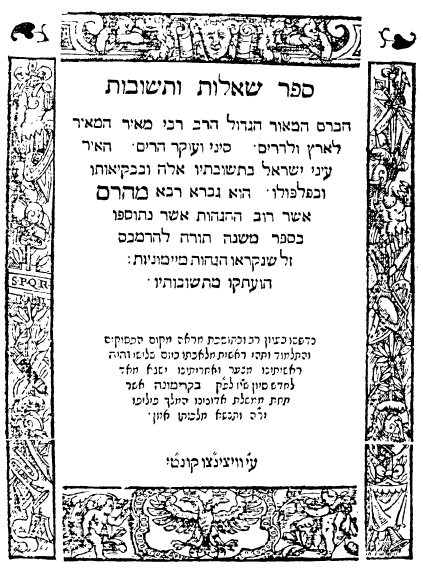
Simcha Emanuel’s MA thesis from 1987 was devoted to a bibliographic analysis of the four printed collections of Rabbi Meir’s responsa (Cremona 1558; Prague 1608; Lemberg 1860; Berlin 1891, and also Teshuvot Maimoniyot). Of his many publications since then, it is worth mentioning two particularly significant ones. In the index of responsa from France, Germany and Italy, published by the Institute for Jewish Law at the Hebrew University in 1997, Emanuel included a series of lists providing parallels to every published responsum of Maharam. That is, for each of the responsa published in the four aforementioned collections, the list provides parallels throughout the printed literature of medieval Halakhah. In 2000, Emanuel published an article titled ‘Teshuvot of Maharam that are not by Maharam’ – passages in the Prague edition of Teshuvot Maharam that have no real connection to Maharam and were arbitrarily included by the editor.

This is the backdrop against which to appreciate Simcha Emanuel’s new book. First, by the numbers: two volumes, 1251 pages. 501 responsa, published from thirteen manuscripts. As the title implies, not all of the responsa can be attributed to Maharam, and they include new responsa by a number of authors both well-known and otherwise (many responsa are unidentified). In light of Emanuel’s study from 2000, this should come as no surprise, since all the medieval collections of Maharam’s responsa include work by others. For example, number 134 was apparently written by the unfortunate R Yaakov Savra, the first known rabbi in Krakow.

The book consists of three sections. First, each of the thirteen manuscripts is described in loving detail. Every attempt is made to explicate the date and location in which the manuscript was produced, and a great deal of information about the travails that each manuscript experienced is provided. For one poignant example – Emanuel identifies Solomon Hirschell as one of the previous owners of Sefer Sinai, a manuscript now in the Berlin Jewish Museum. He also points to the glosses from this same manuscript copied by Hirschell’s father, Rabbi Zvi Hirsch Berlin, into his copy of the Cremona edition.

The second part of the book is the main section, containing the responsa themselves. Emanuel added only minimal footnotes, most of which provide textual information without delving into the Halakhic or historical significance of the new texts. By doing so, he has left ample room for historians and other scholars to pick the fruits of his labour. Historians are already plowing through the edition, finding richly suggestive material.

The third section of the book may seem, to the reader, somewhat redundant. It contains a survey of the complete contents of each of the manuscripts utilized for the edition. The edition includes only new responsa that have not been previously published, but the final section provides details about every responsum in these manuscripts – where else it is found, in print and in manuscripts, and additional information it contains (usually, the poetic beginning or ending of the responsum that was often cropped in printed editions). The significance of this section is in the data it provides for scholars searching for all the textual witnesses of any given responsum. Generations of editors have neglected this kind of labour-intensive cataloguing, preferring to focus their efforts on the new and unfamiliar.

The absence of lists like this is sorely felt by anyone doing textual work on medieval responsa, especially collections that are found in multiple manuscripts like those of Rashba. Rashba’s responsa were recently republished in two separate editions, with dozens of newly published texts. But much of the manuscript work that went into these editions was wasted, since the new editions contain no information about which manuscripts contain the hundreds of responsa that have already been published. For someone interested in textual variants, or in the additional information found in manuscripts such as the addressees of the responsa, these new editions are frustrating and tantalizing rather than helpful. Hopefully, Simcha Emanuel’s work will set a new standard, and editors will begin to provide full documentation about the sources they used. Not only identifying the manuscripts accurately (a point on which editors are beginning to improve), but also providing full information about those manuscripts, and about all the details they contain, even when those details seem trivial.

The scholarly community should be grateful to Simcha Emanuel for providing a flood of new primary sources for the study of medieval Ashkenazic Halakhah, and for placing a high bar for future editors to aspire to.

Pinchas Roth is a graduate student in the Talmud Department at Hebrew University, Jerusalem.

Standard
English, Readings

One pesuk, two pesuk, three pesukim more…- Guest Post by Michael Satlow

In the Babylonian Talmud, authority comes in variety of flavors.  Sometimes a tradition, heard from and cited in the name of a teacher, carries the day.  At other times, logic wins.  The behavior of a rabbi, the opinion of an expert, or the common practice of a community sometimes drive a discussion about law or ethics.  But the trump, as anyone who has spent any time with the Bavli knows, is the Bible, especially the Torah.  While it is certainly true that rabbis often turn and twist biblical verses as origami masters might, it is always better to have a verse on one’s side.

How, though, did the rabbis of late antiquity “know” the Bible?  Did they have the whole thing memorized?  Did they consult scrolls?  Did their versions look like ours?  Did they gravitate toward certain verses or sections, or steer clear of others?  If so, why?

For me, these questions arose quite incidentally about a year ago in the context of an informal Talmud reading group.  I figured that at least the empirical questions were easy to answer.  Somebody, somewhere, must have compiled a list of the biblical verses in the Talmud and counted them up in various ways.

If such a study exists, though, I still cannot locate it.  There are tools that indicate where in the Talmud a particular verse is discussed, but no charts, tables, and graphs that I could find helped very much when it came to quantifying the Talmud’s use of the Bible.  So as a side project I began to assemble the data.

This turned into a more involved undertaking than I anticipated, but it is very close to completion.  My crack research team – my son Dani Satlow and Elijah Petzold, a very talented Brown undergraduate – has now logged every biblical verse cited in the Bavli in a spreadsheet.  The method for doing this was not perfect: we went copied the indices of each of the tractates published in the Schottenstein edition of the Talmud.  We corrected obvious errors (mainly typos) as we went, but I suspect that the indices contain additional mistakes that are now incorporated into our spreadsheet (while undoubtedly introducing new ones of our own).  Nevertheless, given the mainly quantitative goals of the project and the large numbers present, these errors should not significantly distort the results.

My next step is to figure out good ways to use this data (which I will make freely accessible, probably by the end of the semester), and here I welcome your advice.  The three top questions on my list are:

  • What is the most commonly cited verse in the Talmud?
  • Are there verses, chapters, or books that the Talmud never cites?
  • What is the density of biblical citations per tractate?

What would you like to know?

I generated the above image using Wordle, with random text from the beginning of the Talmud.  Wordle might itself be useful for research; perhaps a future post on that.

Michael Satlow is a professor of religious studies and Judaic studies at Brown University and has been a mentor and sounding-board for the New Talmud Blog from the beginning.  This post was crossposted from his own blog, Then and Now.

Standard
Announcements, Book Club, English

Updates Regarding the TBBC

As announced a few weeks ago, starting February 6th we’ll be discussing Zvi Septimus’ article “Trigger Words and Simultexts: The Experience of Reading the Bavli,” in Barry Scott Wimpfheimer, ed. Wisdom of Bat Sheva: In Memory of Beth Samuels (Jersey City, NJ: Ktav, 2009). Thanks to Barry, Zvi and other friends of The Talmud Blog, we’ve been able to make a PDF of the article available here for anyone who wishes to take part in the discussion.

Our two main respondents will be Dr. Dina Stein of Haifa University and Itay Marienberg-Milikowsky, who is a PhD candidate in Ben Gurion University’s Department of Hebrew Literature. With the article now easily accessible online, we hope that you will respond as well.

Standard
Book Club, English

Clearing out the Living Room

As the Talmud Blog’s first Book Club winds down, we are happy to present you with the author’s response to the discussion. His words will only make sense if you first read the comments, and his response appears here and not down there so as not to confuse the “author” and “reader” functions. Although you may be tempted to put down your coffee cups and saucers and clear out of our virtual living room, please do not take this as a hint to end the discussion!

We also wish to announce that the Book Club’s next book will be Talya Fishman’s Becoming the People of the Talmud: Oral Torah as Written Tradition in Medieval Jewish Cultures  (a very recent recipient of the National Jewish Book Award). The club will be open in about two months time. But in the meantime we will inaugurate the ‘Book’ Club’s first discussion of an article – Zvi Septimus’ “Trigger Words and Simultexts: The Experience of Reading the Bavli,” in Barry Scott Wimpfheimer, ed. Wisdom of Bat Sheva: In Memory of Beth Samuels (Jersey City, NJ: Ktav, 2009).  Zvi’s paper at this past year’s AJS conference created quite a stir, and his research, first set out in his recently filed dissertation, is to my mind at the cutting edge of the application of critical literary theory to the reading of the Bavli. We plan on talking about the article on Febuary 6th, and Zvi has agreed to ‘update’ his argument and respond to your comments and questions.

And now, for Ishay Rosen-Zvi’s response:

I was thrilled to read the discussion, the praises, the critique and especially the analysis. The engagement is serious and thorough, and this is ultimately the most that an author can hope for: fostering a serious discussion. It is also a delight to enter into such discussion without the need to first clarify misrepresentations (well except maybe Eva’s suggestion that I “spared certain passages from the reader that might have evoked a different impression”, which calls for substantiation).

As for Eva’s arguments about the place of dialectic approach to the yetzer in rabbinic literature and the possible distinction between “yetzer” and “yetzer hara” in this context, I have detailed my arguments in the book and it’s up to the reader to be more or less convinced. Let me just say that I was very surprised to find out what I did. I entered into this project as part of my interest in rabbinic sexuality, and especially the famous rabbinic “dialectic of desire”, and was quite shocked not to find all this in the rabbinic sources, especially, as I try to show in the book, in their earlier stratum.

Persian sources? Sure (after all this is Shai Secunda’s blog, and one has to be a mannerly guest). Their absence from the book is due to my old (old-old) schooled principle not to engage sources which I cannot read in their original language (I tried to be totally straight forward about that in the introduction). But I must add that the secondary literature I did read (and I read quite a lot) gave me the impression of much more generic similarities than the ones I found in the Patristic sources, where I could identify not just phenomenological parallels but specific traditions, images and idioms. The Persian equivalent is still to be shown. Eva: I hope you will pick up the gauntlet.

I believe Amit is right that this book ultimately strives to show how foreign the rabbis are to us, and to resist (and correct) the temptation to read our own post-Freudian conceptualization of self and personality into these sources. Rafael notes the same phenomenon but with a discontent (the famous Freudian discontent?). ‘What is the ultimate goal of such an enterprise?’ he asks.  Well, my most honest answer is that this is what the history of ideas is about. Can it make any change? It might, as any historical research, first and foremost by contextualizing, historicizing and thus de-essentializing, our own most basic conceptions about ourselves (our “selves”). I believe this is what Foucault means when he says that showing the Person (or the Author, or Sexuality, or Humanities) was born sometime (and not very long ago) means that it can also, sooner or later, die.

Does rabbinic ontology, anthropology and cosmology matter? To whom? Is the only way to make history relevant through recruiting the past to became “a usable past”? I do not believe so, and have tried to make my point, especially with regard to gender studies, in several places (see for example “Misogyny and its Discontents”, Prooftexts 25 [2005], pp. 198-208). But this leads us way beyond the scope of my book to the most basic questions  about Humanities and their “usefulness”; questions that admittedly become more and more acute in our anti-intellectual atmosphere, especially (if I may) in today’s Israel. But that’s, I guess, for another club to discuss.

Standard
Announcements, English

The Book Club

Over the next few weeks the Talmud Blog will be launching some exciting new ventures.  One of these is “The Book Club” – a space where a recent and significant book in the field will be discussed by readers of the Talmud Blog. Each Book Club discussion will be lead by a different discussion leader, and later on in the discussion the book’s author will have an opportunity to weigh in as well.  We will announce the name of the book six weeks in advance in order to give people time to read the book carefully.  When possible, we will try to arrange a discount to purchase the book (though often the most affordable way to read academic books is at your local academic library).  The only rules for participation are reading the book before commenting and observing the Talmud Blog’s normal commenting etiquette.

The first Book Club meeting at the Talmud Blog will discuss Ishay Rosen-Zvi, Demonic Desires: “Yetzer Hara” and the Problem of Evil in Late Antiquity (Philadelphia, 2011).  Readers receive a 20% discount by using the code P2B8 when shopping at the UPenn website.  We hope to open space for discussion on December 15, 2011, which will be accessible as a tab on the main menu.

Looking forward to this exciting endeavor!

Standard
English, Guest Posts, Ruminations

A Moving Target- Guest Post by Chaim Saiman

The View from There

As part of the Talmud Blog’s efforts to foster dialogue between and beyond the various academic fields in which rabbinic literature is studied, we present to you “The View from There” a series by scholars from beyond classic academic talmud study.  The following explanation of the legal-theoretical approach to halakha (and the legal nature of rabbinic literature) grew out of a recent conversation between Shai and Chaim Saiman.

The old saw is that in the academy they tell you what Abayye wore while in yeshiva they tell you what he said. There is no doubt that what he wore and what he said are related and influence each other—they must. Indeed, to a large extent you can’t really understand what he said without understanding the world in which he said it, especially if what Abayye “wore” includes the entire social and intellectual world that he lived in.

Here is the issue: Most people are not interested in what Abayye the man said. The more sophisticated you are about the composition of the Bavli, the harder it is to sustain that notion anyway. My academic Talmudist friends tell me that we know very little about the chain of events from Abayye the man and his words to the text that made its way into the Bavli. As a lawyer and legal scholar interested in halakha and the cultural/intellectual world it reflects and produces, I tend to study what he said (if there was a “he”) as filtered through a tradition of interpretation, mediated through the stam/savoraim/rishonim/aharonim, as well as academic Talmudists. Each of these abstractions in turn simply masks thousands of other personalities with specific localized histories, influences and agendas. Thus to make any sense of halakha and its protracted development we would have to understand not only what Abayye wore, but what Rashi, Tosafot etc., “wore” as well. Such a project is not only nearly impossible, I am not even sure it is desirable. Besides, at some point don’t all these influences and counter-influences, histories, and counter-histories, agendas and counter agendas regress towards some kind of mean?

In the end, most of us study something like “the moving average” of the interpretation of particular statements. Now it is true that some scholars (generally historians) are more interested in examining the inflection points of that trend, and others (traditional conceptual readers, i.e. lamdanim, and legal theorists) are more interested in analyzing the broad sweep, each with their own set of conceptual categories. Further, while legal theorists acknowledge that taking note of and recovering past inflection points can be influential in shaping present ones—this is true precisely because we assign normative weight to materials of the past. But it is a long step from here to the claim that one can recover the true social meaning of any of these texts in their “native” context—especially since this is invariably done with an eye to the present.

The process of law involves making normative arguments about the present by appeal to sources of authority from the past. While we allow rules of the past to make normative claims on the present, the price they pay for this honor is that they are filtered though the present interpretive assumptions. True, present assumptions can and often do contain contain a healthy dose of historicism, but since law incurs normative demands, the history will always be infused by the normative needs of the now. Hence a standard legal argument for position “X” would be that X is superior to Y because (i) its normatively superior; (ii) is produces better results; (iii) it represents a more coherent understanding of the governing legal materials; and (iv) X was classically understood to be the correct answer in the period A before the Z’s (influenced by B) shifted the understanding to Y. A lawyer has no qualms making the historicist argument of number (iv), but in conjunction with other forms of argument, and always with an eye to the present normative question. “History” is simply another form of normative legal argument, and its salience is in part determined by how well it fits into the tradition of interpretation.

Perhaps another way to think about this is to bracket the “history” part of this question entirely. Take the very clear and important shift in interpretive assumptions that has taken place in US law before our very eyes: from the liberal purposivist method of statutory interpretation of the 60’s and 70’s, to the conservative textualism that now reigns supreme.

Even living in this culture, and being well-positioned to understand its legal and political dynamics, we can tell at least 10 different stories about why this took place, from the reductively materialist, to the wildly idealist; from returning to the Founder’s view of separation of powers, to the takeover of the judiciary by conservative ideologues determined to entrench the interests of the propertied elite. And each of these narratives will be shaped in part by whether we think the shift from purposivism to textualism is a good or bad thing, and as part of an overall argument of whether we should continue or abandon the current interpretive modality. The question of what motivates legal and political decision-making is hotly contested even when all the “facts” are known: why then, do we think that we can find a few lines from the Bavli, a few from the Digest, and tell a story about what is “really” happening underneath?

I am writing this in stronger terms than I actually believe, but I think it’s worth putting front and center when we consider the interrelationship between legal theory, traditional conceptual and source critical approaches to the Talmud. Thoughts?

Chaim Saiman teaches contracts, statutory interpretation and Jewish law at Villanova  Law School.  He is currently at work on a book tentatively titled Halakhah: The Rabbinic Idea of Law.

Standard
English, Guest Posts, Readings

Medicine and the Redaction of the Talmud- Guest Post by Michael Satlow

Ancient forms of pain "relief".

One of The Talmud Blog’s goals is to create a forum for scholarly discussion. This guest post by Michael Satlow is an attempt to start a conversation. Readers are invited to engage in it by writing in the comments section below.

Have gum disease? Boils? Abscesses? Anal  sores? An ear ache? A swollen eye? Insect stings? Check out the Bavli for a remedy.

The Babylonian Talmud is full of medical advice. Enough advice, in fact, for Julius Preuss to fill a fat tome entitled Biblisch-Talmudische Medizin that he published in 1911 (translated by Fred Rosner as Biblical and Talmudic Medicine. Rosner has several other books on the topic as well). The advice frequently strikes us as suspect. Is it really true that burning a century old reed tube (hardly easy to come by as it is) filled with salt in one’s ear is the best and most efficient cure? Where can I get the fat of a goat that has never given birth? Will my insurance cover it?

Joking aside, I recently stumbled on one of the longer extended discussions of medicine in the Bavli, at Avodah Zarah 28a29a (where all the examples cited above can be found). The passage is as fascinating as it is tedious, and despite Preuss’s magnum opus – itself also both fascinating and tedious – I am sure that there is much more scholarly work to be done on this passage and those like it. Where did they get this information? What was their understanding of medicine? What did they do when the cures failed to work?

On this reading of the passage, though, I was struck by a much more technical and abstruse question: How can it be reconciled with contemporary theories of the redaction of the Talmud? Nearly all scholars today agree that there was at least one – and perhaps more – stages of redaction of the Bavli. The redactors, the theory goes, worked from collections of tannatic and amoraic sayings, the latter usually conveyed in pithy sentences.  The redactor(s) pieced these sayings together and connected them with the distinctive argumentative style known as stam. These redactors, the stammaim, added additional material as well, such as aggadah.

My question, in short, was how such a theory – and especially the theory of transmission – can account for a passage such as Avodah Zarah 28a-29a. Many of the cures are attributed to amoraim, predominantly Babylonian. Were these cures transmitted along with the amora’s short statements, to be reconstituted by a redactor in the form of this sugya? If so, what would these (hypothetical) transmission booklets have looked like?

To further complicate matters, there are two traditions in the sugya that record an amora saying, “I did all [of these cures], and I wasn’t healed until a certain merchant told me….”  In the first case, Abaye seems to respond to cures reported in the names of Rav Aha the son of Rava and Mar bar Rav Ashi. In the second, Rav Pappa seems to respond to cures reported by Rav Aha the son of Rava (again) and Rav Ashi. Could Rav Pappa really be responding to Rav Ashi? The same literary form of the two comments suggests the work of a redactor, but how extensive was the intervention?

How might we explain the redaction history of the passage?

Michael Satlow is a professor of religious studies and Judaic studies at Brown University. In addition to writing for his own blog, Then and Now, Prof. Satlow is an adviser to The Talmud Blog. 

Standard
English, Events, Guest Posts

The Burning of the Talmud in Rome on Rosh Hashanah, 1553- Guest Post by Menachem Butler

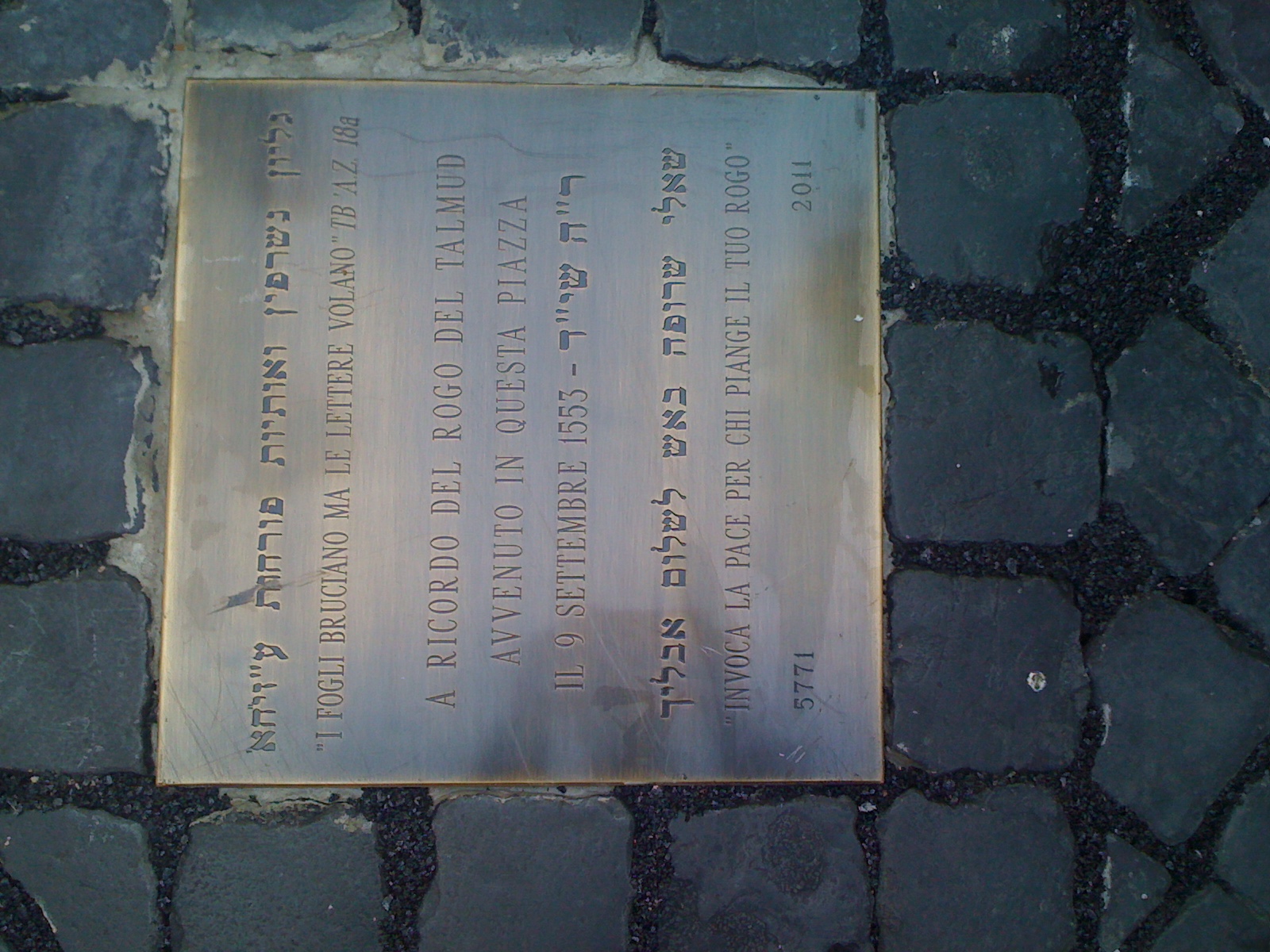
Last Monday I received a most fascinating email from Chief Rabbi Riccardo di Segni, MD, of Rome, with a picture of a plaque unveiled just the previous afternoon in the market place of Rome to commemorate when, in 1553, the Inquisitors confiscated every copy of the Talmud in Italy; the search took about nine days. On Rosh Hashanah 5314 (9 September 1553), the Talmud and many other Jewish books were burnt in the Campo dei Fiori. Throughout the remainder of the sixteenth-century, a complete edition of the Talmud could not be found anywhere in Italy. Chief Rabbi Riccardo di Segni described this event as “the beginning of the persecution of the Jewish printed book, after that of manuscripts.”

The idea for this plaque placement came after the Boyarin family of Berkeley, California, toured Italy a half-dozen years ago. As Prof. Daniel Boyarin described in remarks delivered at an event celebrating the completion of Rabbi Adin Steinsaltz’ Talmud translation into Italian at the Campo dei Fiori in November 2010, the idea was conceived “[f]ive years ago when we walked in this beautiful place, [and Chava Boyarin] observed the statue in memory of Giordano Bruno’s martyrdom here, and remarked that there was no memorial for the wagon-loads of Talmud manuscripts and books burnt here in 1553.”

Professor Daniel Boyarin’s entire remarks are transcribed below and a recording is available here. At the event last year, it was announced that a permanent plaque would be affixed at that location in time for this year’s Rosh Hashanah, 458 years after the Talmud was burnt at that very location. Chief Rabbi Riccardo di Segni sent me the picture below of the plaque that now rests on the street of the marketplace in the Campo dei Fiori.

Chief Rabbi Riccardo di Segni told me that in the week since the plaque has been affixed, many tourists and local residents have passed through the marketplace and have stopped to learn about the event that took place at that very location in 1553. “Many tourists who casually crossed the square yesterday were Jewish,” he wrote to me. “One of them told me that he was a young boy who escaped from Berlin in 1938, so he knew what burning of books means, and he was deeply moved by this commemoration. After 458 years, we remember.”

As you can see in the picture, the text of the plaque is in Italian, with two quotations in Hebrew. The first is a quote from the Talmud (Avodah Zarah 18a), which offers the Talmudic account of the martyrdom of R. Hannaniah b. Teradyon. The second passage is from the elegy, Sha’ali Serufah ba-Esh, composed by Rabbi Meir ben Baruch, Maharam of Rothenburg, upon seeing the wagons of Talmudic manuscripts and commentaries burnt in a Paris marketplace in 1242. Sha’ali Serufah ba-Esh is among the most powerful elegies read on Tisha be-Av within Ashkenazic communities worldwide.

The Talmudic account of the martyrdom of R. Hannaniah b. Teradyon, who was burnt alive while wrapped in a Torah scroll, has been described by Moshe David Herr, “Persecutions and Martyrdom in Hadrian’s Days,” Scripta Hierosolymitana 23 (1972): 85-125, esp. 110-119 (Hebrew); Gerald J. Blidstein, “Rabbis, Romans, and Martyrdom: Three Views,” Tradition 21:3 (Fall 1984): 54-62; Daniel Boyarin, Dying for God: Martyrdom and the Making of Christianity and Judaism (Stanford: Stanford University Press, 1999); and Daniel Boyarin, “A Contribution to the History of Martyrdom in Israel,” in Daniel Boyarin, Menachem Hershman, Shamma Friedman, Menahem Schmelzer, and Israel M. Ta-Shma, eds., Atarah Le-Hayim: Haim Zalman Dimitrovsky Jubilee Volume (Jerusalem: Hebrew University Magnes Press, 1999), 3-27 (Hebrew); Joseph Dan, “Narrative of the Ten Martyrs: Mysticism and Martyology,” in Hana Amit, Aviad Hacohen, and Haim Beer, eds., Mincha le-Menachem: A Collection of Essays in Honor of Rabbi Menachem Hacohen (Tel-Aviv: haKibbutz haMeuchad, 2007), 367-390 (Hebrew), and broader on The Ten Martyrs, see Jan Wilhelm van Henten, “Jewish and Christian Martyrs,” in Marcel Poorthuis and Joshua Schwartz, eds., Saints and Role Models in Judaism and Christianity (Leiden and Boston: Brill, 2004), 163-181; and Ra’anan S. Boustan, “The Hagiographic Vita of a Priestly Rabbinic Martyr: The Figure of Rabbi Ishmael in The Story of the Ten Martyrs,” in Martyr to Mystic: Rabbinic Martyrology and the Making of Merkavah Mysticism (Tübingen: Mohr Siebeck, 2005), 99-148.

For scholarly discussions on the 1553 burning of the Talmud in Campo dei Fiori, see Avraham Yaari, The Burning of the Talmud in Italy (Tel-Aviv: Abraham Zioni, 1954; Hebrew), reprinted in Studies in Hebrew Booklore (Jerusalem: Mosad ha-Rav Kook, 1958), 198–234 (Hebrew); Kenneth R. Stow, “The Burning of the Talmud in 1553, in Light of Sixteenth-Century Catholic Attitudes Toward the Talmud,” Bibliothèque d’Humanisme et Renaissance 34:3 (September 1972): 435-449; Kenneth R. Stow, Catholic Thought and Papal Jewry Policy 1555-1593, Moreshet Series, vol. 5 (New York: Jewish Theological Seminary of America, 1977), 49-50, 54-59; as well as the more-recent scholarship by Amnon Raz-Krakotzkin, “Censorship, Editing and the Reshaping of Jewish Identity: The Catholic Church and Hebrew Literature in the Sixteenth Century,” in Allison Coudert and Jeffrey S. Shoulson, eds., Hebraica Veritas?: Christian Hebraists and the Study of Judaism in Early Modern Europe (Philadelphia: University of Pennsylvania Press, 2004), 125-155; Amnon Raz-Krakotzkin, “The Burning of the Talmud,” in The Censor, the Editor, and the Text: The Catholic Church and the Shaping of the Jewish Canon in the Sixteenth Century, trans. Jackie Feldman (Philadelphia: University of Pennsylvania Press, 2007), 32-56, 211-222; Fausto Parente, “The Index, the Holy Office, the Condemnation of the Talmud and Publication of Clement VIII’s Index,” in Gigliola Fragnito, ed., Church, Censorship and Culture in Early Modern Italy (Cambridge: Cambridge University Press, 2001), 163-193, which was drawn to my attention by Prof. Ariel Toaff; and most-recently (in a volume just published last week), in Piet van Boxel, “Robert Bellarmine Reads Rashi: Rabbinic Bible Commentaries and the Burning of the Talmud,” in Joseph Hacker and Adam Shear, eds., The Hebrew Book in Early Modern Italy (Philadelphia: University of Pennsylvania Press, 2011), 121-132 (chapter six), available here.

About the burning of the Talmud during June 1242, see Susan L. Einbinder, Beautiful Death: Jewish Poetry and Martyrdom in Medieval France (Princeton: Princeton University Press, 2002), 70-99 (Chapter three: “Burning Jewish Books”), and for the text of Maharam mi-Rothenberg’s Sha’ali Serufah ba-Esh, see Daniel Goldschmidt, ed., Seder ha‐Kinot le‐Tisha be‐Av (Jerusalem: Mosad ha-Rav Kook, 1972), 135-137 (no. 42) (Hebrew), which appears in English translation in Robert Chazan, ed., Church, State, and Jew in the Middle Ages (New York: Behrman House, Inc., 1980), 229-231, and in slightly modified form in Susan L. Einbinder, Beautiful Death, 76-78. The complete entire audio recording of Professor Daniel Boyarin’s remarks at the Campo dei Fiori is available here, and Rabbi Steinsaltz’ remarks are available here.

Five years ago when we walked in this beautiful place, [Chava Boyarin] observed the statue in memory of Giordano Bruno’s martyrdom here, and remarked that there was no memorial for the wagonloads of Talmud manuscripts and books burnt here in 1553.

‘Once these books are removed,’ an advisor to the Roman Inquisition had written, ‘it will soon result that the more that they are without the wisdom of their rabbis, so much more will they be prepared and disposed to receive the Christian faith and,’ what he calls, ‘the wisdom of the word of God.’ This Inquisitor well understood one thing. He understood that the Talmud and the study of Talmud are what have sustained the Jewish People and kept us against all odds alive and thriving. The wisdom of our rabbis is the word of God, and it this that has kept us faithful to the word of God ’till this day.

In Rome, the Inquisition raged while in the Benedictine monastery at Camaldoli near Arezzo, sat the Florentine humanists who studied the Talmud and Kabbalah together with rabbis. Giordano Bruno, whose own martyrdom, some 20 years after that of the Talmud here, was in large part owing to his having been influenced by those humanists and their interest in Jewish holy books. The placing of this plaque today thus closes the circle and indicates to us that it is not the Inquisition that has won the day, but the spirit of Camaldoli. Today in Rome, Jews and Christians study the Talmud and others of our shared holy books, not only with each other but with Muslims as well. Bruno might have dreamed that this would happen.

Daya le-Chakimah be-Ramiza, “a hint to a Sage is sufficient.” I only had to make the suggestion to the Rabbi of Rome, Rav Riccardo di Segni, and the process was set in motion that has brought us here today. Chazak u-Varukh!

Not only is this a day of mourning; however, it is also a day of celebration. Safadnu Et ha-Talmud Kan, ve-ha-Yom hi-Kimu Yeshiva al-Kivro. We have mourned and memorialized the Talmud in this place, and Rabbi Steinsaltz, shlita, has built a yeshiva on what was intended to be its grave.

The spirit of Bruno has been vindicated, but also the Talmud itself. For while the Inquisition sought to end all Talmud and Talmudic study, more people study the Talmud today than ever before in history, in large part due because of the great, and now completed, Baruch Hashem, project of Rabbi Steinsaltz, shlita.

We mourn the burnt holy books and rejoice together on the completion of this commentary on the Talmud.

Menachem Butler is the co-editor of the Seforim blog. This is his first contribution to the Talmud blog. 

Standard
English, Guest Posts

Thoughts on Near Eastern Legal Culture- Guest Post by Lena Salaymeh

This post is the first in what will be an ongoing series introducing our readers to the work of young scholars engaged in new and interesting research. 

I usually describe my research interests as being comparative Jewish and Islamic law (or legal history), but that depiction is often misleading.  The term “comparative” assumes two distinct legal traditions that interact in discernible ways.  But in the context of Jewish and Islamic legal history, my conception and implementation of “comparative” is more akin to thinking and to speaking in “proto-Semitic.”  As a metaphor, “proto-Semitic” offers a useful heuristic for thinking through how we approach the study of Jewish and Islamic law.  If you imagine scholars of Jewish law articulating their ideas in Hebrew and Aramaic, while scholars of Islamic law articulate their ideas in Arabic, then my objective is to converse with both groups of scholars in a meta-language (proto-Semitic) that engages both legal traditions.  Just as “proto-Semitic” is the common ancestor of the Semitic language family, Near Eastern legal culture is the shared antecedent of Jewish and Islamic legal systems. Undeniably, the challenge is that proto-Semitic no longer exists as a spoken language and is instead a scholarly reconstruction of a language that may have existed.  Similarly, I am interested in recreating the discourse of Near Eastern legal culture in the late antique and medieval periods using terminology and ideas from law, history, and critical theory.  While diglossia (in this case, speaking both in a Semitic dialect and in proto-Semitic) is inevitable, my objective is to transcend disciplinary boundaries.

My “proto-Semitic” perspective on the subject of my research differs considerably from the viewpoint of colleagues who assume that my research interest is “religious law.”  However, there are several interrelated problems in “religious law” as a category.  In contemporary discourse, the modern bifurcation between “secular” and “religious” law is taken for granted, but it lacks historical resonance.  There is a common presumption that the “essence” of religions is their laws, but this oversimplifies the multi-dimensional nature of religious groups and movements.  Instead of “religion,” I prefer more precise terminology in scholarship and in public discourse: theology, spirituality, ritual, belief, ideology, orthodoxy, orthopraxy, customary practice, local culture, and identity.  In focusing on the syncretic and dialectical relationships within Jewish and Islamic legal history, I am also mindful of Roman provincial, Sasanian, and Near Eastern tribal legal traditions.  In so doing, I seek to contextualize (and to broaden) the study of Islamic and Jewish legal history within a shared “proto-Semitic” legal culture.  I often invoke historical evidence from other (i.e, other than Islamic or Jewish) Near Eastern legal traditions precisely in order to substantiate the existence of Near Eastern legal culture.  Legal culture, based in a specific social space and time, is a more effective category of analysis for my work than “religious law.”

Relatedly, the word “religion” does not have a Semitic (and possibly proto-Semitic) equivalent.  “Religion” is a perplexingly problematic term for my research because it is both anachronistic and untranslatable.  In Arabic, the term “din” is translated as “religion,” but the root means “to profess.”  Likewise, in Hebrew, the term “dat” is translated as “religion,” but it means “law.”  The historical usage of both terms does not correspond to modern understandings of religion. This is not mere philological pickiness: if we insist on translating what we observe in Jewish and Islamic historical texts into a discourse about religion (with its modern, Western genealogy), we will stifle more imaginative and unexpected possibilities and interpretations of these texts and their socio-historical contexts.  Historical expressions of Judaism and Islam do not easily correspond to contemporary conventions about religion and it is precisely this complexity that is the basis of my research pursuits.

My commitment to “proto-Semitic” research includes exploring the Islamic legal-intellectual milieu of rabbinic jurists who wrote in Arabic (such as Alfasi and the Rambam) and studying Gaonic legal manuals.  I am working on an article that explores medieval Islamic juristic texts that discuss the possibility of using Jewish law as a source of legal authority.  I plan to contrast these Islamic legal discussions of the ‘other’ with references to Islamic law in Gaonic texts.  In another article, I expect to situate Karaite attacks on rabbinic oral law within debates about the authoritative significance of the legal opinions of late antique Muslim jurists.  As part of my broader endeavor to collaborate with colleagues, Zvi Septimus (Stroock Fellow, Harvard Center for Jewish Studies) and I are formulating a project to explore the intersections between some medieval commentaries of the Bavli and contemporaneous Islamic legal literature.

Recreating “proto-Semitic” is a wide-ranging endeavor that needs institutional groundwork; this is why I complement my research with administrative projects as a coordinator for the Initiative on Muslim-Jewish relations at UC Berkeley’s Center for Middle Eastern Studies.  I am interested in creating a network of scholars and of supporting unrecognized scholarly endeavors.  For example, we are currently trying to find funding to publish an Arabic translation of the Rambam’s Mishneh Torah in order to make this seminal Jewish legal text accessible to scholars of Islamic law who do not read Hebrew.  We are also raising funds to acquire an important collection of Judeo-Arabic midrashic literature from 19th/20th century Morocco, which would supplement UC Berkeley’s previous acquisitions of similar materials from Iraq and Tunisia.  There is much work to be done in the field of Judeo-Islamic legal studies and I have many more ideas and plans for how we can more deeply explore the interconnectedness of Jewish and Islamic legal systems.  I hope we will have opportunities to implement them and to continue rediscovering “proto-Semitic,” as a means of deepening our understandings of Jewish and Islamic legal history.  I invite readers to join me in reconstructing “proto-Semitic.”

Lena Salaymeh is a PhD candidate at UC Berkeley. Her dissertation is titled Late Antique and Medieval Islamic Legal Histories: Contextual Changes and Comparative (re)Considerations.

[Cross-posted at the Immanent Frame]

Standard
Around the Web, English, Guest Posts, Technology

Some Less-Well-Known-but-Useful Electronic Resources- Guest Post by Richard Hidary

iPad Screenshot 2

Screenshot of the Accordance app for iPad.

This guest post is by Talmudblog friend Richard Hidary, who runs the extremely helpful website rabbinics.org.

1. ובלכתך בדרך is a free iPad and iPhone app with lots of rabbinic and halakhic works and much more, just search for “onyourway” in the app store.

2. Accordance is not only a fantastic Bible program, and probably the best Dead Sea Scrolls program, but also has some useful rabbinic texts. It runs on Mac and now has a fantastic iPhone and iPad app. It runs suitably on a PC with a Mac emulator. It includes all the scrolls in Hebrew and English and all of the Biblical scrolls in order of Tanakh or in manuscript order (you can pull up the MT and Dead Sea Bible side by side and scroll them together). Modules are also available for the Mishnah according to printed editions, Neusner’s translation of Mishnah, and Kaufman ms. with all punctuation. The best feature is that all these texts are grammatically tagged – useful for easy grammatical analysis and sophisticated searching.

3. Neusner’s translation of the Yerushalmi is available on CD-ROM. It is available at SBL for a discounted price. You can copy it to your hard drive – it’s just a pdf and is very easy to use.

4. Mikraot Gedolot Haketer, which has published only a few books, has made available all of Tanakh and all of the included commentaries on CD-ROM. The software is only for sale at their office in Bar-Ilan and they only accept cash and do not ship. However, if you can get there or send someone, this fine collection of texts is well worth the 490NIS.

5. Jastrow’s dictionary is available on HebrewBooks but also in an easy to use interactive format here. The dictionary is also available as an add in on the iPad app iTalmud where you can touch any word of the Bavli and jump instantly to the dictionary. Unfortunately, the program doesn’t know the root of the word and so usually takes you to the wrong place.

6. Saul Lieberman’s works are available here: Tosefta Kifshuta/Tosefet Rishonim/ Al HaYerushalmi

8. The Steinsaltz Talmud of the daf yomi is posted daily here. You can also go back a few hundred days to get previous dapim from Yevamot and on. There did once exist a CD-ROM of the entire Steinsaltz Talmud but I haven’t been able to locate a copy in any library or in any store (this site advertizes it but doesn’t sell it – I already checked). Does anybody know more about this?

10. On rabbinics.org one can find my Version Editor macro for lining up manuscripts, perfect to use in conjunction with the new http://www.lieberman-institute.com/. The Macro is free, but please share your charts so that we can together create a database of texts for use of the general community.

Also on the rabbinics.org site, I have begun to post Hebrew dissertations. Many people at Israeli Universities have fantastic research hidden in master’s and PhD theses that never get published. If you fit into that category, or know someone who does, and would like to make your work available, please send a pdf to me at rhidary [at] yu.edu.

Rabbi Dr. Richard Hidary is an assistant professor of Judaic Studies at Yeshiva University, Stern College for Women and an assistant Rabbi at Sephardic Synagogue in Brooklyn.

Standard