English, General Culture, Recent Publications

The Sony Pictures Introduction to Talmudic Studies

A very interesting contribution to Talmudic Studies has just come out, and from a source that only a few months ago would have seemed rather unlikely- Sony Pictures Classics. SPC is distributing Yossi Cedar’s Footnote in North America and has just released the film’s press kit.

After providing a description of Talmudic Literature, the document discusses at length the field of research known as “Talmudic Studies”, dedicating a few paragraphs to “The Talmud Department at the Hebrew University- The Jerusalem School”:

The Talmud Department was one of the first of eight departments that were set up when the Hebrew University was established in 1928, and still exists to this day… The founder of the department, Prof. Yaacov Nachum Epstein, a legendary Talmud researcher with degrees from German universities and once a student of East European yeshivas, solidified the nature of the department that characterizes it to this day.

In light of Epstein’s studies, the Jerusalem school focuses on the bland textual reconstruction of the Talmudic texts and their wording during the preliminary research stages. The winding and unwinding of these long scrolls of ancient texts over the years resulted in many mistakes and errors, which raise doubt as to the authenticity of the text that were obtained. Therefore, before any researcher can ask himself questions that pertain to the content of the text, the concepts conveyed therein, the literary design or the history reflected therein, he must do his best to reconstruct the original text after it was obtained through dubious channels after hundreds of years.

This nondescript textual study, known as ‘philology’, requires extreme diligence. The researcher must collect photographs of the existing manuscripts of the text, some hidden away in libraries and basements around the world, and conduct a meticulous comparison of each and every word. This is painstaking work, rummaging around lost archives to find one more manuscript that will shed light on a baffling sentence in a forgotten text. Endless searching and documentation of small errors made by the Jewish book copier in the Middle Ages, in frozen Europe or remote Yemen, who lost focus for a split second…

This style is not very popular and the Talmud department attracts very few students as opposed to other departments. And among these students, some are forced to leave due to the high scholastic demands and the taxing nature of the work and studies. Nonetheless, many renowned researchers in diverse fields of Judaic studies included this department on their academic route and its academic standards are highly acclaimed in the field of Judaic studies the world over.

The critics of the Jerusalem school claim the exaggerated adherence to details prevents a view of the overall picture, and its members are an exclusive and arrogant clique that has lost its relevance.

The press kit is fascinating in the way that it seeks to provide a background to such a specialized field for the purposes of general culture (a movie).  It is definitely worth checking out.  Maybe someday it will even be considered required reading for Rabbinics courses.
Standard
Around the Web, English, Technology

Some Notes and Questions on Digitization (Around the Web- September 5, 2011)

The Sunday Book Review of the New York Times ran an article yesterday by Lev Grossman on the place of the e-book in relation to the scroll and codex. Grossman outlines what he sees as the weaknesses in reading from digital books by pointing out its parallels with reading from a scroll:

Trying to jump from place to place in a long document like a novel is painfully awkward on an e-reader, like trying to play the piano with numb fingers. You either creep through the book incrementally, page by page, or leap wildly from point to point and search term to search term. It’s no wonder that the rise of e-reading has revived two words for classical-era reading technologies: scroll and tablet. That’s the kind of reading you do in an e-book.

Having himself authored a book entitled Codex, Grossman prefers reading from a bound product like the codex:

The codex is built for nonlinear reading — not the way a Web surfer does it, aimlessly questing from document to document, but the way a deep reader does it, navigating the network of internal connections that exists within a single rich document like a novel. Indeed, the codex isn’t just another format, it’s the one for which the novel is optimized.

People studying Talmud, back in the day.

Which, naturally, leads one to think- “what about the Talmud?”. On the one hand, the book is almost uniformly studied from its Vilna Edition; on the other, its digitization has enabled unprecedented search capabilities which have furthered its study. To make it only more complicated, it seems as though the Talmud’s “authors”, whoever they may be, intended on an oral transmission. Some of the earliest genizah fragments of the Talmud are parts of scrolls, and although they probably saw codexes in the hands of Eastern Christians, the early disseminators of the Talmud could never foresee innovations such as the Vilna Sha”s, Bar-Ilan, or Ma’agarim. This preamble is just so that I can ask how you learn the Talmud- from printed book or computer screen, and why?

In related news, Mississippi Fred Macdowell has some helpful tips on “searching online in Hebrew with imperfect OCR“.

Finally, Yitz (not Landes) reviews the iMishnah app for iPhone and iPad over at Tzvee’s Talmud Blog. This Yitz doesn’t use iMishnah but is an avid iTalmud user. It’s well worth the money but I’m a little hesitant about iMishnah- it doesn’t promise much more than the free “ובלכתך בדרך” app, profiled here by Richard Hidary.

Standard
Around the Web, English, Technology

Websites on Manuscripts and Websites as Manuscripts

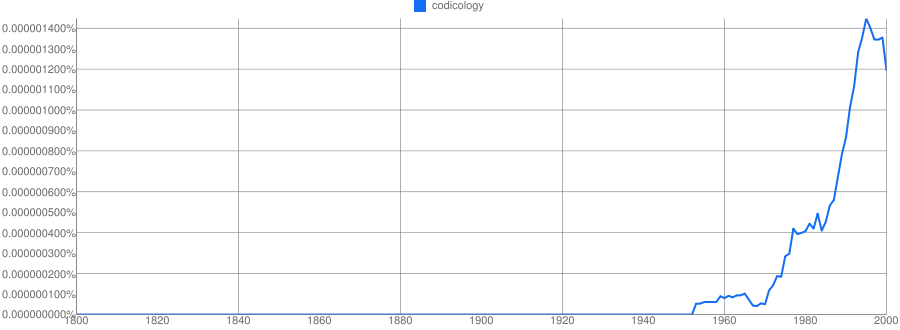
A Google ngram of the use of the word codicology throughout history. Notice how the graph parallels the work of Prof. Beit-Arié (Hattip- Shamma Friedman).

Recently, while casually surfing the web, I came across “a hilariously unsuccessful for-profit online education project” known as Fathom.com, which ran during the internet bubble. In a time when forecasts floated around saying that “distance education” would be “a $9 billion industry by 2003”, Columbia University and other formal and informal institutions of higher learning banded together to “provide high quality educational resources to a global audience through the Internet.” Although the site hasn’t been updated in a few years and a lot of the links are broken, its courses are still up (now for free), and include some in Jewish Studies. To my great delight I came across one entitled “An Introduction to Hebrew Manuscripts“, co-authored by an all-star cast made up of the art historians Joseph Gutmann and Evelyn M. Cohen; the former JTS librarian and professor of Medieval Hebrew Literature and Jewish Bibliography Menahem Schmelzer; and the preeminent codicologist Malachi Beit-Arié. Beit-Arié, who is professor emeritus at Hebrew University, a member of the Israeli Academy of Sciences and Humanities, and past director of the JNUL, is currently at work on a project to create an online database of codicological information collected by the Hebrew Palaeography Project. The “study of books as physical objects” is quite an important field to be familiar with when approaching the Talmud and I immediately read through the seminar’s four sessions.

course images

Prof. Christine Hayes teaching a Yale Open Course. Prof. Hayes now assigns her online lectures to her current Intro to the Old Testament students.

Yet while reading about the different ways in which Jews have transmitted knowledge on paper I could not help but think of how I was learning all of this from a format which had in itself become passé. Within a decade of its publication, the really excellent seminar had already fallen by the way side as its medium fell out of use. Online learning still exists, but in slightly different formats, through the extremely successful iTunes University and Academic Earth. Except for podcasts like Prof. Michael Satlow‘s series “From Israelite to Jew“, most online courses nowadays are video or audio recordings of actual university courses. Both iTunesU and Academic Earth really have a huge amount of valuable information (with some overlap), but only a limited amount of Jewish Studies courses, which is why I was surprised to see that Fathom even had a Jewish Studies section on its site. A couple of years ago my friends and I discovered Prof. Christine Hayes’ online course “Introduction to the Old Testament (Hebrew Bible)” and we were bothered that we could find practically no other full courses in Jewish Studies. Yeshiva University has a few academic lectures available on iTunes U and the Orthodox adult education organization “Torah in Motion” also has a number of academic lectures available for a dollar or two each. In Hebrew, the Youtube channel of Hebrew U has a few lectures worth watching, like Prof. Avigdor Shinan’s Introduction to Aggadic Literature and videos of the last World Congress of Jewish Studies. Still, this is scarce when compared to both the plethora of other courses available in the humanities and the amount of money which goes into Jewish Studies in the academy. When the number of potential listeners is also taken into account, it is pretty surprising that more Jewish Studies courses or guest lectures aren’t available online.

Perhaps students of Jewish Studies would do well to take the cue from Prof. Beit-Arié and try and curate a website based database that brings together links to the various free courses available online. Such a collection would not only make finding what is already available easier, but might convince more institutions to take part in online learning.

Standard
Around the Web, English

Around the Web – August 19, 2011

El Shaddai Game Cover Art.pngA few months ago, Shai and I had the pleasure of hearing Prof. Daniel Boyarin give a talk at Hebrew University’s Havruta beit midrash entitled “Metatron in the Bavli and in Enoch 3”, based on work he has published in such articles as “The Parables of Enoch and the Foundation of the Rabbinic Sect: A Hypothesis“. Little did we know that while we were sitting in Jerusalem readings texts on Enoch computer programmers out in England were busy putting the final touches on the game El Shaddai: Ascension of the Metatron, for PS3 and Xbox 360. Jim Davila of PaleoJudaica has been keeping the blogosphere up-to-date on the game’s much anticipated release. According to the game’s website, players of El Shaddai star as Enoch:

a young man chosen by God for his strong, pure heart. He is human, but has been called to the heavens by the will of God to serve as a scribe on the Council of Elder. He has descended to earth as an arbiter to pursue the Grigori, a group of fallen angels, and prevent the execution of God’s plan to flood the earth.

The game is openly based on the Deuterocanonical book of Enoch and has received praise for its “sophisticated and visually arresting aesthetics and remarkably deep and nuanced, yet easy to grasp, combat system”.

Over at the Jewish Press, Steven Plaut has an article which attempts to respond to Christian anti-Semiticism directed at the Talmud (Hat-tip to the Adderabbi).  In order to prepare for the weekly “around the web” here at the Talmud Blog, we have a feed going for every time “Talmud” (and other related words) show up on the internet.  I would guess that almost half are related to anti-Semitic websites. A frightening thought. There are great resources out there for people looking to counter these claims (especially “The Talmud in Anti-Semitic Polemics” at ADL).  Many of the anti-Semitic statements made about the Talmud and Christianity are, needless to say, spurious. But there are some passages that do indeed say some pretty nasty things about you know who. Plaut is certainly correct that scholars in previous generation had many false positives, but this does not mean that Jesus is never mentioned in the Talmud.  Plaut is unfortunately ignorant of Talmudic manuscripts – which is grievous regarding an issue with a long history of censorship.  In the information age, any anti-Semite can easily find what he is looking for. For a great, recent work that avoids these kind of apologetics, we have of course Peter Schaefer’s Jesus in the Talmud. The work itself is quite controversial for a number of reasons, but at least it does not shy away from confronting the issues head-on – and with expertise.

Finally, Menachem Mendel announces that Joseph Cedar’s award-winning film Footnote will be screened (for all you poor unfortunate souls who have not seen it yet) at the NY Film festival in early October. Stay tuned for a review by Shai Secunda and Elli Fischer at the Jewish Review of Books.

Standard
Around the Web, English, Recent Publications, Talmud in the News

Around the Web (more or less) – August 12, 2011

Mississippi Fred MacDowell of On the Mainline posted a fascinating comment on Christian Hebraism and the Mishnah on Amit’s post from two weeks ago. Although he only identifies here as “S.”, the digital-database savvy and characteristic out-of-the-box thinking of MacDowell is as apparent as ever.

Tālār-e āʾina, 1896. In the Golestān Palace Museum.Encyclopaedia Iranica announced the publication of a volume of collected entries on the Jews of Iran:

Comprising all the entries published in the Encyclopaedia Iranica through 2010, the Jewish Communities of Iran represents the most comprehensive collection of research published to date on the life, history, culture, language, music, literature, and customs of the Jews of Iran, one of the oldest communities of the Jews in the world.

The book is available for preorder on Amazon or Eisenbraun’s.

And finally, Shana Strauch-Schick’s recent dissertation is noted at JTA.  But you heard it first here. Stay tuned for a list of recent dissertations in the field.

August 11, 2011

NEW YORK (JTA) – Yeshiva University’s graduate school of Jewish
studies will award a doctorate in Talmud to a woman, Shana Strauch
Schick, for the first time.
[The dissertation is on ““Intention in the Babylonian Talmud: An
Intellectual History”]

While Yeshiva has multiple programs in Talmud, Schick, 30, is the
first woman to obtain a doctorate in the subject from the Bernard
Revel Graduate School. A New Jersey native now living in suburban
Detroit, Schick successfully defended her dissertation on Aug. 4 and
will formally graduate in September.

“Orthodoxy has long emphasized the value of the study of Talmud,”
Schick told JTA in an interview. “But Talmud study, which in yeshivot
is the central focus of the religious duty to learn Torah, is still
rarely emphasized as a vital part of women’s education.”

Schick holds a master’s degree in Bible from Revel and a bachelor’s
degree in Judaic studies from YU’s Stern College for Women. She plans
to spend the next academic year in Israel doing post-doctoral studies
at Bar-Ilan University.

Standard
English, Talmud in the News

The Book and the Legend

No longer just "the national poet", Bialik has become a fashion statement.

In the year 1903, C.N. Bialik and Y.H. Ravnitsky, neighbors in the same building in Odessa, set out to produce what would be one of the most influential books in the study of aggada since the Ein Yaakov. Sefer ha-AggadahThe Book of Legends– was completed 100 years ago, with the publication of its sixth section in 1911.  To mark this anniversary, Ha’aretz recently featured an article (hat-tipAncient Hebrew Poetry) by one of the foremost Bialik scholars, Shmuel Avneri (not to be confused with Shlomo Avineri). Avneri lists numerous instances where Bialik’s books were burned by some ultra-Orthodox Jews in Israel, and he emphasizes how these cases were at odds with the positive and productive relationships which Bialik had with other segments of the charedi community. The author also lists numerous critiques of Sefer ha-Aggadah by secular and academic intellectuals, from Agnon to Shinan, who for the most part took issue with the liberal editing policies of Bialik and Ravnitsky. To his list I would add the important footnote in Carnal Israel in which Boyarin criticizes Bialik for his “misogynistic” selection of texts.

As a translation and anthology, Sefer ha-Aggadah has many problems, some of which Prof. Shinan’s own updated version will seek to correct. Yet no one can deny the massive contribution that it has made to the popularization of aggadah over the past hundred years. As Alan Mintz has pointed out:

Throughout the early twentieth century, cultural and religious Zionists sensed the need to make rabbinic thought available in formats and languages that were accessible to native Hebrew speakers, religious and secular alike. Sefer ha-Aggadah (The Book of Legends) by C.N. Bialik and Y.H. Ravnitsky was an early example, one that has profoundly influenced Israeli culture.

As attested by the reflections of several modern Israeli writers, Bialik and Ravnitzky had an enormous influence on the early generations of Zionists in Palestine/Israel. Yoram Kaniuk writes in his memoir 1948:

We were the sons of the Bible, yet we were also sons of Bialik and Ravnitsky’s The Book of Legends, and we loved to read how Moses sees Joshua enter the Tent of Meeting and is jealous of him and says to God “one hundred deaths and not one jealousy”.

More examples may be found in Amos Oz’s Story of Love and Darkness. Without such a compilation it is doubtful that Rabbinic literature would have succeeded in taking such a significant role in the formation of the Zionist ethos. One may add that Bialik’s position as “the national poet” also contributed to the work’s success.

Thanks to the translation of William G. Braude, Sefer ha-Aggadah has become a staple of Jewish learning outside of Hebrew speaking communities, as evidenced by such English language online learning attempts as Sefer Ha-Bloggadah. Through such forums, Sefer ha-Aggadah continues to enlarge the community of readers that engages Rabbinic texts, and promises to do so in the future as well.

Standard
Around the Web, English, Technology

Digitally Humanizing Jewish Studies

RAMBI has added RSS feeds (=RAMBIRSS)

The past week has seen some updates in the digital humanities side of Jewish Studies.

For those of us who like wasting time constructively online, RAMBI has added some 17 RSS feeds of recently published articles. Each feed is dedicated to different categories of the catalog.

In its newest version, The Friedberg Genizah Project added another 70,000 images or so to its database. Most of the images are of fragments located in the Cambridge University and British Libraries. The FGP also made some significant “website improvements”, such as a redone “browse by collection function”, a unified advanced search, an expanded text search, joins display, and more (I hope in a future post to provide guidelines for getting the most out of FGP).

Standard
Around the Web, English, Talmud in the News

Reading the Talmud in…

The South Korean ambassador to Israel visiting a yeshiva in Bnei Brak, earlier this month (picture from ynet, courtesy of the municipality of Bnei Brak)

The South Korean interest in Talmud has been a real hot-topic over the past few months. This piece outlines the phenomena, but as a simple Google search will show, there are many, many more articles on the subject (see also Menachem Mendel’s coverage).

But what does Talmud Study in South Korea actually look like? Perhaps a recent op-ed by Mario Blejer in the Korean JoongAng Daily, one of South Korea’s three daily English-language newspapers, may help answer that question. Commenting on the current debt crisis in Greece, the former governor of the central bank of Argentina and former director of the Bank of England seeks to find a solution in “the Talmud, the ancient repository of Jewish legal commentary – and one of the oldest sources of human thought on morality and economic activity”.  He then goes on to summarize the sugya of “kofin oto ad she-yomar rotze ani” as it appears in Bavli Kiddushin (50a) in order to “show that there are mechanisms that can – and should – be used to place pressure on the parties in the interest of obtaining superior voluntary outcomes.”

The article’s title, “The Talmud and Greek Debt”, is quite reminiscent, interestingly enough, of studies penned by Saul Lieberman.

Standard
Announcements, Around the Web, English, Events

Talmud in the New World

The first- all-American- attempt at a critical edition of the Talmud

Since the early decades of the twentieth century, the bond between academic Talmud and America has been a strong one.  To name but a few highlights, Julius Kaplan published his  pioneering work on the redaction of the Babylonian Talmud, Solomon Shechter took up residence in the great city of New York, while Henry Malter published the first ever (semi-) critical edition of part of the Babylonian Talmud in Philadelphia in 1928.

The four current authors of this blog normally live in Israel, but are all visiting the United States for the summer.  We are all in transition.

Just the other day, Alan Brill responded to Tomer Persico and his classification of Brill’s blog as “American,” by wondering what it means to  be American, Israeli, or Maltese (added in honor of Henry) in a globalized, fiber-opticized world.   Brill also wondered how (and whether) the Talmud Blog is American, Israeli, or something else.  Some similar questions were raised back on the old Talmud blog, and they are crucial not just for sociological speculations, but related to this blog’s preoccupation with context.  Shai thought then, and continues to maintain, that regardless of the radical changes in our world, context continues to matter.

A lot of what the new wave of “contextual Talmudists” do, is make connections between textual (that is, non-material) things and probe their significance.  It’s a messy business and often difficult to argue or articulate which parallels are worth pursuing and what is a strangely coincidental set of characteristics. The problem plagues virtually every area of comparative historical research, but particularly of ancient times.  If everything in the room that I am now sitting in will vanish (as it one day will), save for a few, arbitrary objects, will anyone be able to reconstruct the feeling of sitting where I sit and breathing the air I breathe, watching the flashes of lightening across a charred Gotham sky, the pitter-patter of a soaking summer rain on the fast streets below? And yet scholars do it all the time, and occasionally get somewhere with the few things that remain. Of course the real interest is not in the texture of banal living, but in the world of thoughts, ideas, and religion. Against all odds, even this sometimes works.

Since we are traveling we would like to: a. ask for help from our Israeli readers; b. apologize for a relative slack in posting; and c. announce some upcoming Talmud Blog events.  Traveling and fasting (some of us preferred to do this simultaneously) has taken a toll and it will be a few days until we get back to a normal posting schedule. Regardless, we’ll have a tougher time keeping tabs on Talmudic goings-on in Israel, so we would appreciate if readers there could keep us posted via email of upcoming events in the Holy Land. For readers in the greater Teaneck area- Shai will be delivering a few shiurim at Congregation Rinat Yisrael on Shabbat Hazon. Yedidah and Amit can be heard on Tuesday nights on the Upper West Side of Manhattan at Mechon Hadar. Before I host Shai in Teaneck, I’ll be at Princeton for two weeks, where I hope to blog from Tikvah’s Undergraduate Summer Seminar.

For further discussion, see here. Also- don’t miss Manuscript Boy‘s exciting updates (days 1, 2, and 3) from the Books within Books colloquium on the European Genizah.

Standard
Around the Web, English

From R. Simeon Qayyara to Meir Ariel

Hebrew U trained Roni Shweka‘s dissertation bears the title Studies in Halakhot Gedolot: Text and Recension. For the past year or so he’s been hanging out at Oxford’s Yarnton Manor analyzing genizah fragments alongside some of the field’s most experienced readers of medieval manuscripts. His new book, Shir Chadash, is a collection of “derashot” on various songs of different musicians in the Israeli rock scene. In an interview, Haaretz’s music reviewer Ben Shalev summarizes Shweka’s contribution to Israeli music criticism:

Nobody else has thought or written about Israeli music like that… Nobody else has dove into the depths of the Talmud and Gemara in order to find possible keys for explaining recent rock songs.

Israeli Renaissance, anyone?

Standard