The section of the Babylonian Esther Midrash quoted by Shai in his post has a parallel in Vayikrah Rabbah and in the Pesikta de-Rav Kahana (Vayikrah Rabbah 28:6 [664-666]):
Shave and a Hair Cut
In a piece just published at Tablet Magazine, I briefly discuss the Purim Triumph panel at the famous synagogue in Dura Europos. The art at the Dura synagogue is significant for many reasons, one of which is the way it echoes extra-biblical Jewish traditions – aka midrash. There seems to be a bit of this in the Purim fresco: In the left side of the panel, Haman is dressed something like an Iranian stable-boy leading a royally garbed Mordecai on a white horse. It is possible that Haman’s attire points to the lowly position of stable-boys in Iranian life and particularly in epic literature. Continue reading
Difference and the Iranian Talmud
One of the foundational concepts to emerge from twentieth century linguistics is that meaning is produced through difference. Ferdinand de Saussure’s now banal idea that there is no inherent connection between a particular linguistic sign and the object it refers to was path-breaking at its time. It has echoed across countless intellectual and cultural endeavors which emphasize how the relationship between signifiers and their signified is essentially constructed and maintained only relationally. Continue reading
Whence Good Questions?- Guest Post by Jon Kelsen
“The scientist is not a person who gives the right answers; he’s one who asks the right questions.” -Claude Lévi-Strauss, Le Cru et le cuit (The Raw and the Cooked), 1964
I spend a lot of time asking questions, and a lot of time learning and teaching Talmud. These pastimes are deeply related; the process of uncovering and addressing qushyot u’ba’ayot constitutes the meat and potatoes (or tofu and quinoa, for some of our readers here) of the Talmudic enterprise. The Bavli is a text explicitly animated by query, and we know the joy of the Talmudist who discovers that she or he has “asked like a lamdan,” who has raised the question of Abbaye, the Stamma d’Talmuda, Tosafot, or R. Akiva Eiger. To be a good learner, and certainly a good learner of Talmud, therefore, includes being able to ask good questions. Continue reading
The Flow of Things: Ruminations on Talmudic Layout

Diane Samuels, ‘The Luminous Manuscript’. Permanent exhibition of The Center for Jewish History, NY. Posted with artist’s permission.
As our readers may have noticed, we’ve recently adapted the blog to WordPress’ new “Twenty Fourteen Theme.” Besides exemplifying WordPress’ sleek sense of style, the theme caught our eye in that it structures the homepage almost like a daf of Talmud, with the main text in the center and related texts surrounding it towards the margin.
In celebration of The Talmud Blog’s redesign, I have been invited to offer some observations on the layout of the Talmud inspired by my background as a practitioner and scholar of the visual arts. This is a double honor for me as this is also my inaugural post. Thank you for the invitation.
Shamma Friedman, Israel Prize Recipient
As most of our readers already know, last Sunday Prof. Shamma Friedman was told that he will receive the seventh Israel Prize in Talmud this May. This is a fitting tribute to a scholar who has had an enormous influence on the study of Talmud both within and beyond academia. Continue reading
A Review of Eyal Ben-Eliyahu’s “Between Borders”- Guest Post by Hanan Mazeh
Eyal Ben-Eliyahu‘s Between Borders is the kind of book which deals with such fundamental questions that it makes you wonder how it is that they had not been seriously addressed before. Based on his 2007 Hebrew University dissertation, the book aims to examine the territorial borders of the land of Israel as reflected in a wide array of Palestinian texts – from biblical books through the Amoraic era – and tries to formulate the different concepts of “Eretz Israel” that these borders represent.
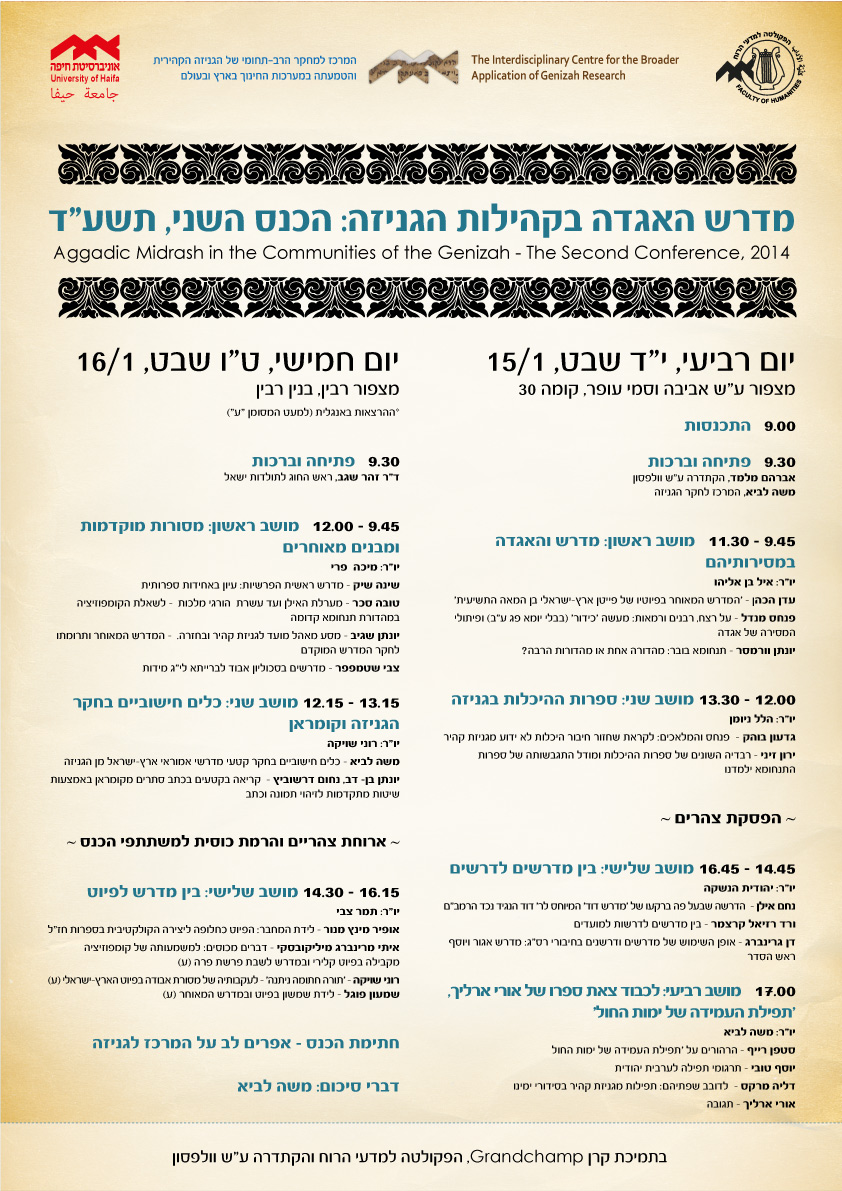
A Conference on “Aggadic Midrash in the Communities of the Genizah”
The newly founded center for Genizah Research at the University of Haifa will hold the second conference of the research group on “Aggadic Midrash in the Communities of the Genizah” on Wednesday and Thursday next week, 15-16/1/2014 . The conference will present the fruits of the group, as well as lectures by scholars who deal with the subject and adjacent topics such as the relationship between Piyyut and Midrash, the question of oral homilies and sermons, the representation of Midrash in Judeo Arabic materials, and more.The first day will also include an event marking the recent publication of Uri Ehrlich’s edition of the Amidah prayer according to Genizah fragments . On the second day there will be a special session on the use of new computational tools for classifying and analysing material from the Genizah from Qumran.
A Post for the 17th of Tevet
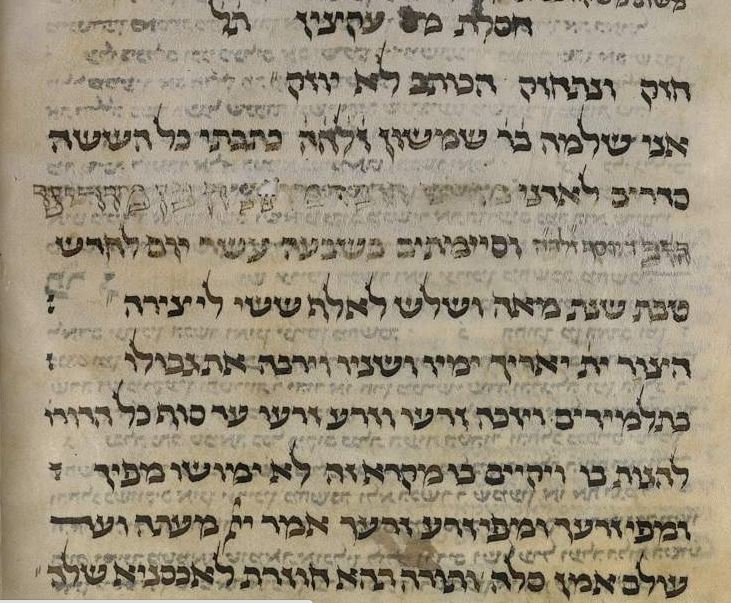
Today’s Hebrew date, the 17th of Tevet, marks the 671st anniversary of the completion of the talmudic section of Munich, Cod. hebr. 95, more commonly referred to as “The Munich Manuscript,” by the scribe R. Shlomo the son of R. Shimshon. Continue reading
Thinking Legally vs. Thinking Historically: A Penn Conference- Guest Post by Chaim Saiman
UPDATE: AUDIO POSTED ONLINE
Tomorrow, Penn Law School will be hosting a workshop whose genesis is an ongoing discussion between myself and Shai, reflected in a previous post on this blog. The workshop is designed to look at the divide between academic and yeshiva approaches to Talmud through the prism of legal theory. Continue reading