English, Recent Publications

Boyarin’s Intertextuality Now Available in Hebrew

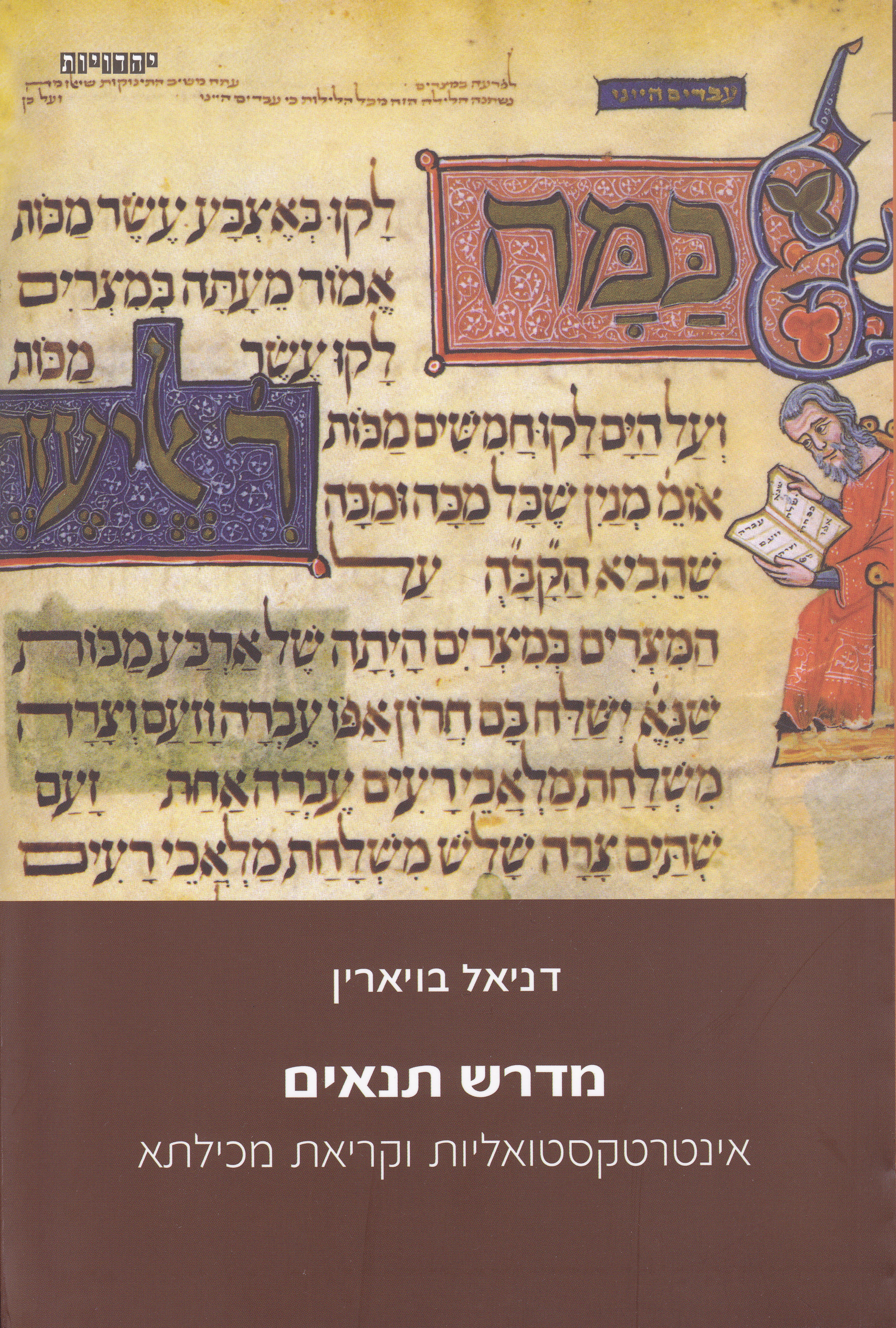
Last spring, future Talmud blog contributors and other Jerusalemite students of Rabbinic literature were lucky enough to spend a delightful evening with Prof. Daniel Boyarin, discussing Carnal Israel from the hindsight of twenty years. Prof. Boyarin had scheduled his trip to Israel for the release of a translation of his earlier work, Intertextuality and the Reading of Midrash in Hebrew. Little did we know that only a few months later some of us would be collaborating on a web log. Nor did we fully understand how long we would have to wait for the release of Midrash Tanaim: Intertextualiut viKriyat Mechilta (Hartman, Alma, and Keter 2011).

Truth be told, now that the volume is in my hands, the time spent on its preparation (and its strange recall by the publisher after its initial release…) seems to have been well spent. I only purchased it a few hours ago but I’ve already started plowing through the two new chapters Prof. Boyarin wrote for the Hebrew edition: “Midrash as Anti-Philosophy” and “Rhetoric, Theology and Allegory in Paul and Origen”. Both seem to offer authoritative summaries of some of Boyarin’s scholarship since Intertextuality‘s English release in 1990. Another chapter by Ishay Rosen-Zvi provides an overview of the affect that Boyarin has had on research into Rabbinic literature- “What is Left to Interpret? Thoughts on Boyarin and his Footsteps”. These chapters add significant value to the book, but its main contribution is no doubt the way it makes Boyarin’s scholarship accessible to the Israeli reader. Boyarin has still left plenty of writings to translate, and I hope that we’ll soon see translations of other works of his as well. You can hear Boyarin and other scholars (Menahem Kahana, Galit Hasan-Rokem, Joshua Levinson, and Dina Stein) discuss the book at the Shalom Hartman Institute on November 27 at 8:30pm.

Talmud Bloggers and Boyarin (far right with the wine glass), Spring 2011

Standard
Announcements, English

The Book Club

Over the next few weeks the Talmud Blog will be launching some exciting new ventures.  One of these is “The Book Club” – a space where a recent and significant book in the field will be discussed by readers of the Talmud Blog. Each Book Club discussion will be lead by a different discussion leader, and later on in the discussion the book’s author will have an opportunity to weigh in as well.  We will announce the name of the book six weeks in advance in order to give people time to read the book carefully.  When possible, we will try to arrange a discount to purchase the book (though often the most affordable way to read academic books is at your local academic library).  The only rules for participation are reading the book before commenting and observing the Talmud Blog’s normal commenting etiquette.

The first Book Club meeting at the Talmud Blog will discuss Ishay Rosen-Zvi, Demonic Desires: “Yetzer Hara” and the Problem of Evil in Late Antiquity (Philadelphia, 2011).  Readers receive a 20% discount by using the code P2B8 when shopping at the UPenn website.  We hope to open space for discussion on December 15, 2011, which will be accessible as a tab on the main menu.

Looking forward to this exciting endeavor!

Standard
English, Guest Posts, Ruminations

A Moving Target- Guest Post by Chaim Saiman

The View from There

As part of the Talmud Blog’s efforts to foster dialogue between and beyond the various academic fields in which rabbinic literature is studied, we present to you “The View from There” a series by scholars from beyond classic academic talmud study.  The following explanation of the legal-theoretical approach to halakha (and the legal nature of rabbinic literature) grew out of a recent conversation between Shai and Chaim Saiman.

The old saw is that in the academy they tell you what Abayye wore while in yeshiva they tell you what he said. There is no doubt that what he wore and what he said are related and influence each other—they must. Indeed, to a large extent you can’t really understand what he said without understanding the world in which he said it, especially if what Abayye “wore” includes the entire social and intellectual world that he lived in.

Here is the issue: Most people are not interested in what Abayye the man said. The more sophisticated you are about the composition of the Bavli, the harder it is to sustain that notion anyway. My academic Talmudist friends tell me that we know very little about the chain of events from Abayye the man and his words to the text that made its way into the Bavli. As a lawyer and legal scholar interested in halakha and the cultural/intellectual world it reflects and produces, I tend to study what he said (if there was a “he”) as filtered through a tradition of interpretation, mediated through the stam/savoraim/rishonim/aharonim, as well as academic Talmudists. Each of these abstractions in turn simply masks thousands of other personalities with specific localized histories, influences and agendas. Thus to make any sense of halakha and its protracted development we would have to understand not only what Abayye wore, but what Rashi, Tosafot etc., “wore” as well. Such a project is not only nearly impossible, I am not even sure it is desirable. Besides, at some point don’t all these influences and counter-influences, histories, and counter-histories, agendas and counter agendas regress towards some kind of mean?

In the end, most of us study something like “the moving average” of the interpretation of particular statements. Now it is true that some scholars (generally historians) are more interested in examining the inflection points of that trend, and others (traditional conceptual readers, i.e. lamdanim, and legal theorists) are more interested in analyzing the broad sweep, each with their own set of conceptual categories. Further, while legal theorists acknowledge that taking note of and recovering past inflection points can be influential in shaping present ones—this is true precisely because we assign normative weight to materials of the past. But it is a long step from here to the claim that one can recover the true social meaning of any of these texts in their “native” context—especially since this is invariably done with an eye to the present.

The process of law involves making normative arguments about the present by appeal to sources of authority from the past. While we allow rules of the past to make normative claims on the present, the price they pay for this honor is that they are filtered though the present interpretive assumptions. True, present assumptions can and often do contain contain a healthy dose of historicism, but since law incurs normative demands, the history will always be infused by the normative needs of the now. Hence a standard legal argument for position “X” would be that X is superior to Y because (i) its normatively superior; (ii) is produces better results; (iii) it represents a more coherent understanding of the governing legal materials; and (iv) X was classically understood to be the correct answer in the period A before the Z’s (influenced by B) shifted the understanding to Y. A lawyer has no qualms making the historicist argument of number (iv), but in conjunction with other forms of argument, and always with an eye to the present normative question. “History” is simply another form of normative legal argument, and its salience is in part determined by how well it fits into the tradition of interpretation.

Perhaps another way to think about this is to bracket the “history” part of this question entirely. Take the very clear and important shift in interpretive assumptions that has taken place in US law before our very eyes: from the liberal purposivist method of statutory interpretation of the 60’s and 70’s, to the conservative textualism that now reigns supreme.

Even living in this culture, and being well-positioned to understand its legal and political dynamics, we can tell at least 10 different stories about why this took place, from the reductively materialist, to the wildly idealist; from returning to the Founder’s view of separation of powers, to the takeover of the judiciary by conservative ideologues determined to entrench the interests of the propertied elite. And each of these narratives will be shaped in part by whether we think the shift from purposivism to textualism is a good or bad thing, and as part of an overall argument of whether we should continue or abandon the current interpretive modality. The question of what motivates legal and political decision-making is hotly contested even when all the “facts” are known: why then, do we think that we can find a few lines from the Bavli, a few from the Digest, and tell a story about what is “really” happening underneath?

I am writing this in stronger terms than I actually believe, but I think it’s worth putting front and center when we consider the interrelationship between legal theory, traditional conceptual and source critical approaches to the Talmud. Thoughts?

Chaim Saiman teaches contracts, statutory interpretation and Jewish law at Villanova  Law School.  He is currently at work on a book tentatively titled Halakhah: The Rabbinic Idea of Law.

Standard
English, Reviews

In a Name: Some Late Night Ruminations on T. Ilan’s Lexicon of Jewish Names 4

People with newborn babies often find themselves awake at absurd hours of the night, a kind of teasing reminder of youthful eves long gone, when staying up late meant going out and having fun. Your parents may very well have worried about you on those nocturnal adventures. Now as a parent, it is you up worrying, and you’re home in the rocking chair. Will she have everything we want for her? Will fate treat her kind? What will we name her? Will she ever burp?

Up with my newborn a few nights ago, I puzzled especially over the penultimate question. One tool at my disposal was Tal Ilan’s latest volume of her Lexicon of Jewish Names in Antiquity – The Eastern Diaspora.  Truthfully, there was no chance on this blessed Earth that my wife would approve of “Mahlafta” – a very popular female name that shows up repeatedly in the Aramaic Incantation bowls, or the Iranian name “Dadī” for that matter (which I suppose was in a way already taken by me). But hunting for baby names was still a good excuse to peruse this invaluable tool for scholars of Jewish late antiquity – Talmudists included.

There is something about being up late that brings out the critic in you. Perhaps this is a fading memory of late night theoretical debates in smoky literary cafes…or perhaps not. That said, my thoughts on the book, even if critical, in no way mitigate the overall value of a work (and series) that is virtually peerless in aim and scope. And my comments are haphazard and not very comprehensive; we might say they are the product of late night ruminations.

The volume, although numbered four in the series, is actually the third to appear thus far. As such, the organizing principles that guide the work were already laid out in the earlier volumes, and now the names just roll. There are however new methodological issues to iron-out, and to her credit, Ilan is honest with her readers about these difficulties and other such challenges. The main issues have to do with the two largest corpora: the Babylonian Talmud and the Aramaic incantation bowls. Both include numerous male names, and in the case of the bowls, many female names (a true boon in a field of inquiry that suffers from a dearth of female names – a legacy of the unequal gender politics of text composition and transmission in the ancient world). As Ilan points out, there is usually no way to know whether a client in the bowls was Jewish or Zoroastrian (or Mandaean, Christian, Manichaean, or what have you), and for this reason she needs to tabulate the statistics twice – with and without these doubtful identifications.  Again, she responsibly informs the readers of the problem, and addresses it in her calculations. Yet the sum total of the book will still give the casual reader the impression that, for example Zoroastrian theophoric names were extremely common for Jewish women in late antique Babylonia (which I should add certainly is possible – witness Yaakov Elman’s suggestion that Rav Nahman’s daughter, דונג, an otherwise unattested name should actually read דינג or Dēnag – a popular Zoroastrian name related to the important religious concept of the Daēna \ Dēn). Perhaps due diligence is enough, but I’m left wondering why not leave these doubtful names out and have the interested reader consult the growing incantation bowl prosopography herself if there is a need to know about names that Jewesses merely may have had in late antiquity. Perhaps Ilan simply could not resist leaving such a valuable treasure-chest of names out of her collection.

Still on the subject of the bowls, the book does attempt to identify some clients of the bowls as probably Jewish based on certain factors.  One is the content of incantations, for example the inclusion of the Shema might indicate a Jewish owner.  But that claim (as the book even somewhat acknowledges) is quite problematic, given what we know about the intercultural travels of magical traditions. The presence of R. Joshua b. Perahya and his Jewish divorce document in Mandaic incantations is a case in point. If scribes of different persuasions might incorporate “foreign” magical formula, why not the clients, who were almost always illiterate. In my opinion a more problematic decision in the book is the tentative identification of all currently etymologically unidentifiable nominal elements in the bowls as Iranian. And similarly, rabbinic names without a clear identification are considered Iranian.  This apparently stems from the need to categorize the names linguistically, following the series’ scheme, but even after the book admits to this rather problematic approach, for me the admission is not enough.  It seems misleading to categorize, even tentatively, names that appear in the corpus of magic bowls or the Bavli as Iranian based merely on context – even if all other avenues of determining their provenience have been exhausted.  If I were to try to correlate all this with Ilan’s broader scholarly approach, I think it has something to do with her  tendency towards comprehensiveness. Her many books and articles aim to include as much data as possible on a subject, instead of focusing on a small set of data and beating that data to death. The volume (and series) certainly is comprehensive, but I wonder if that comprehensiveness sometimes is taken too far.

Still up late in the rocking chair, I also wondered about the book’s immediate contribution to Talmudists. On the one hand we have a helpful attempt to historically locate each rabbinic name with a specific rabbinic personage – even (and especially) when more than one sage bore a certain name. Most of these identifications are based on accepting Sherira Gaon’s (and Seder Tannaim ve-Amoraim’s) chronology, and also based on some of the classic research by Hyman and Albeck. Yet again, the problems of these presumptions are acknowledged in the introduction, and once again, Ilan still proceeds largely unfazed following the obligatory caveat.  I fear that in a quest towards comprehensiveness and” getting it all done”, the exceedingly complicated nature of this particular task is not given its proper due. More than that, signal research in the field, like A. Cohen’s Ravina and his Contemporary Sages which reflects the messiness of the data, is simply omitted. How many ‘Ravinas’ were there, after all?

There also is the issue of literary names, and to what extent these “names” really were names in use at all. A case in point is “Haruta” – the name employed by R. Hiyya’s wife to seduce her husband(!) at b. Qiddushin 81b. As Ilan makes clear, the name might not really be Ms. Hiyya’s real name but perhaps simply a “nickname”.  She dutifully cites Shlomo Naeh’s wonderful article “Freedom and Celibacy: A Talmudic Variation on Tales of Temptation and Fall in Genesis and its Syrian Background” in J. Frishman and L. van Rompay (eds) The Book of Genesis in Jewish and Oriental Christian Interpretation (Louvain 1997), pp. 73-89. But the findings of that article actually indicate that Haruta is not merely a nickname, but an attempt by a storyteller to play with the hot topic of celibacy and consider where “liberation” (Haruta) fits into that discourse – is it liberation from legal and ethical strictures (as we normally understand it today) or liberation from bodily passions (as an ascetic might see it)? This problem repeats itself whenever we have a literary context that gives reason to suspect that the name is not an historical name at all, rather a literary device of some sort. Indeed, the Talmud itself is far more literary than it is historical.  Similarly, the problem exists in extra-rabbinic sources when we encounter a name like Shōshen-Dūxt. As Ilan notes, this was the name of the Exilarch’s daughter who became the Jewish wife of king Yazdgerd I. Or so we are informed by the ninth century Pahlavi work, The Catalogue of the Provincial Capitals of Ērānšahr.  As Geoffrey Herman has pointed out, however, that this source probably merely reproduces a floating tradition then current in the Jewish community, and not anything approaching historical fact. What that means is that the name Shōshen-Dūxt may very well have been a Jewish name, but it was not born by a Jewish Sasanian queen.

One of the great pitfalls of book reviews is that the reviewer nearly always wants something other than what the author is willing to provide. The curse of human differences and expectations, or is it a blessing? In my rocking chair at 2:00am (and the following day, blearily, at my desk) I wanted a book that listed all the names actually in use by Jews in the late antiquity Eastern Diaspora, and one that analyzed their etymology closely. Something along the lines of Philip Gignoux’s magisterial Noms propres sassanides en Moyen-Perse epigraphique (Vienna 1986-) – which in my opinion should have been consulted by Ilan far more than Justi’s Iranische Namenbuch (Marburg 1895).  Alas, I did not get my wish. But the book remains the only of its kind, reflects years of painstaking (and good) research, and will be an indispensable tool for Talmudists and other scholars of Jewish late antiquity.

Standard
English, Talk of the Town

Back to School Shenanigans

With the month of November only a couple of days away, the MLB off-season over with a bang, and the first signs of snow falling in the Northeast, the school year here in Israel is just about ready to start. Here in Jerusalem, Hebrew U students will have new opportunities to study with Talmud Blog contributors and friends as The Department expands its teaching base and Rabbinics continues to find more homes in the university.

Last week, a few die-hard Talmudists got together to kick off the school year with a pre-yarhei kallah style gathering at the Nachlaot abode of one blogger/student. Books were discussed, cookies were nibbled, and summer experiences were shared until another blogger/student (granted, much more advanced at both), Pinchas Roth, stepped up to deliver a brief talk. Pinchas discussed two cases of “מקבילות שלא ממש מקבילות,” or “parallels that are not necessarily parallels” in medieval rabbinic literature. An interesting discussion ensued, and it served as a good example (but hopefully not a warning) for the new students in attendance of what their future studies in the Talmud department might look like. Later, as wine bottles were opened and handouts were reunited in a pile on the coffee table, talk turned to the ever growing number of degrees students combine with Talmud, which now include Art, Biology, and Computers. As the night wore on, it became clear to everyone present that notwithstanding Pinchas’ talk, of course nothing could really parallel Talmudic studies. And also, that the time had come for everyone to make their way home to their desks, where late night philological work might continue, uninterrupted.

Standard
English, Guest Posts, Readings

Medicine and the Redaction of the Talmud- Guest Post by Michael Satlow

Ancient forms of pain "relief".

One of The Talmud Blog’s goals is to create a forum for scholarly discussion. This guest post by Michael Satlow is an attempt to start a conversation. Readers are invited to engage in it by writing in the comments section below.

Have gum disease? Boils? Abscesses? Anal  sores? An ear ache? A swollen eye? Insect stings? Check out the Bavli for a remedy.

The Babylonian Talmud is full of medical advice. Enough advice, in fact, for Julius Preuss to fill a fat tome entitled Biblisch-Talmudische Medizin that he published in 1911 (translated by Fred Rosner as Biblical and Talmudic Medicine. Rosner has several other books on the topic as well). The advice frequently strikes us as suspect. Is it really true that burning a century old reed tube (hardly easy to come by as it is) filled with salt in one’s ear is the best and most efficient cure? Where can I get the fat of a goat that has never given birth? Will my insurance cover it?

Joking aside, I recently stumbled on one of the longer extended discussions of medicine in the Bavli, at Avodah Zarah 28a29a (where all the examples cited above can be found). The passage is as fascinating as it is tedious, and despite Preuss’s magnum opus – itself also both fascinating and tedious – I am sure that there is much more scholarly work to be done on this passage and those like it. Where did they get this information? What was their understanding of medicine? What did they do when the cures failed to work?

On this reading of the passage, though, I was struck by a much more technical and abstruse question: How can it be reconciled with contemporary theories of the redaction of the Talmud? Nearly all scholars today agree that there was at least one – and perhaps more – stages of redaction of the Bavli. The redactors, the theory goes, worked from collections of tannatic and amoraic sayings, the latter usually conveyed in pithy sentences.  The redactor(s) pieced these sayings together and connected them with the distinctive argumentative style known as stam. These redactors, the stammaim, added additional material as well, such as aggadah.

My question, in short, was how such a theory – and especially the theory of transmission – can account for a passage such as Avodah Zarah 28a-29a. Many of the cures are attributed to amoraim, predominantly Babylonian. Were these cures transmitted along with the amora’s short statements, to be reconstituted by a redactor in the form of this sugya? If so, what would these (hypothetical) transmission booklets have looked like?

To further complicate matters, there are two traditions in the sugya that record an amora saying, “I did all [of these cures], and I wasn’t healed until a certain merchant told me….”  In the first case, Abaye seems to respond to cures reported in the names of Rav Aha the son of Rava and Mar bar Rav Ashi. In the second, Rav Pappa seems to respond to cures reported by Rav Aha the son of Rava (again) and Rav Ashi. Could Rav Pappa really be responding to Rav Ashi? The same literary form of the two comments suggests the work of a redactor, but how extensive was the intervention?

How might we explain the redaction history of the passage?

Michael Satlow is a professor of religious studies and Judaic studies at Brown University. In addition to writing for his own blog, Then and Now, Prof. Satlow is an adviser to The Talmud Blog. 

Standard
English, Piyut, Readings

A Sign of Confusion? The Hometown of Elazar Birabi Qilir

Archeological sites in Israel feature signs that explain the findings and elaborate on their historical context. Many of these signs quote texts that are relevant to the site in most cases from the Bible and rabbinic literature. To my joy, while hiking in the ancient synagogue at Arbel in the Galilee last week, I came across the following sign that quotes from a liturgical poem by Elazar Birabi Qilir, one of the prominent payytanim of the late ancient school of Hebrew liturgical poetry.

The first thing that drew my attention was the partial defacement of the sign; while I could not explain the erasure of the ר from the word הקליר, the damage to the acronym לסה”נ (literally, according to the Christian calendar) suggests that someone thought that it is improper to mention the Christian calendar in the context of an ancient synagogue. Such a purist practice is not unusual in some nationalistic circles, which reminded me the outrageous phenomenon of defacing Arabic names from street and highways signs around the country (but this is a matter for another post on another blog).

But then I noticed another thing; according to the sign the Qiliri was a resident of Tiberias in the seventh century. That the Qiliri lived during the seventh century can be deduced with reasonable certainty from his mention of the Muslim conquest of Palestine in that century. However the only clue we have concerning his hometown is the ambiguous mention of קרית ספר in the acrostic of several of his poems. קרית ספר, to be sure, is mentioned in the Bible (Joshua 15:15) as the ancient name of דביר in the southern part of the country (not to be confused with the modern ultra orthodox west-bank settlement מודיעין עילית, also known as קרית ספר). At any rate scholars agree that קרית ספר is a generic name for a central Jewish town in late antique Palestine. It is true that Tiberias falls under that category but other places qualify as well – most notably Sepphoris – and in fact it was suggested by several scholars (including the late Ezra Fleischer) that the latter was the hometown of the Qiliri.  It was a real pleasure to find a mention of the Qiliri at this ancient synagogue but it would have been nicer if the Israeli Nature and Parks Authority would be more modest in its attempts to revive the past.

Did you come across similar inaccuracies in other archeological sites? Tell us about it…

Standard
English, Recent Publications

Demons in the Outfield

Ishay Rosen-Zvi, the man who brought us the new and improved Sotah ritual, has published his second book, Demonic Desires (not to be confused with another book with the same title). Some of the chapters have previously been published as articles, but the book as a whole gives a full, updated and comprehensive picture of its subject: a detailed and meticulous study of the Yetzer Hara.

The book, in essence, tackles one of the most entrenched myths in the academic study of Jewish sources, since many years before Carnal Israel: that Judaism, historically, is a sex-positive religion.

Rosen-Zvi’s book does not actually say that is what it does – in fact all it claims to do is analyze all the occurrences of yetzer hara in Tannaitic and Amoraic literature (he does not include Tanhuma, for example, or Avot deRabbi Natan). Along the way he comes across three startling conclusions:

  1. The yetzer has a very humble beginning in Tannaitic literature. In the school of R. Akiva, following much of Second Temple Literature, yetzer hara is just another word for “thoughts” or “heart” or “mind”. However, in the school of R. Ishmael, the yetzer is a much more wily and cunning adversary.
  2. This Evil Inclination, the yetzer, is not a rabbinic euphemism for the Freudian Id. It is not part of the person – it is a foreign intruder into the person. It is this yetzer that became current in Amoraic literature.
  3. This yetzer has nothing to do with sex. Nothing at all. It wants people to sin, yes, but it is not a “blind appetite” or just an “inclination” towards the evil; it leads its hosts to every kind of sin it can think of. Most often towards slacking off in Torah study.

This is the claim, and a full review will of course tackle every part of this claim, including the amazing comparative work Rosen-Zvi does with Patristic – especially monastic-literature, expanding on the work of Michal Bar-Asher Siegal. The clincher, however, comes at the end. We know that we think that the yetzer is sexual. So where does that come from? It comes both from the anonymous stratum of the Bavli – both anonymous statements and the give-and-take of the sugya – and from stories in the Bavli. These two come together *in this case* (Rosen-Zvi is careful not to haphazardly say anything about a “Stammaitic Culture”, a very dubious term in his opinion) to form a new image of the yetzer.

The yetzer is turned into sex; but the imagery of the yetzer as a powerful adversary, that can and should be vanquished, that the righteous can kill, and that should be exorcised like a demon, remains in place.

And so, it is no longer really tov meod to have an evil yetzer; it is in fact very bad. When sex is equated with the yetzer, per se, not as a kind of sin, it too becomes very bad. The prayers and admonitions to the yetzer that it leave us alone becomes admonitions not against sin but against sex. Not very positive.

This is, in my opinion, the coolest part of Rosen-Zvi’s exhaustive and authoritative book. Unlike other books in the field, halakha and aggada are discussed together, and all the sources are brought to the table. It can safely be said that it tackles all the occurrences of the term and says something about each one. The various roles and guises of the yetzer are mapped out and neatly laid on a time-line, and also flagged when they fail to fit a neat pattern, which Rosen-Zvi will readily admit (but that happens very rarely; one such instance is the famous mishnah at the end of m. Berakhot on yetzer tov and  yetzer ra; Rosen-Zvi says the “dual yetzer” school of thought is quite marginal in the rest of rabbinic literature).

A real review is in the works for the near future; stay tuned!

Disclosure: Ishay is not only a dear friend, and a teacher and mentor, but also my employer for the past number of years; I have worked on this book, as well as several other projects, for him.

Standard
English, Recent Publications, Talmud in the News, Technology

From the Pages of Haaretz

One of the best parts of the holiday season here in Israel is that the local papers have to put out more supplemental material to keep everyone occupied. In addition to the regular weekend magazines, each holiday gets its own special section.  This seems to mean more articles that relate to rabbinic literature, as editors scramble to fill these now numerous weekend and holiday editions. Two of them, from Saturday’s Haaretz, are worthy of discussion here.

In the book section, folklorist Eli Yasif has a review of a recent collection of papers given at the fifteenth World Congress of Jewish Studies’s session on Louis Ginzberg’s Legends of The Jews. The papers, originally delivered in honor of the passing of one hundred years since the start of the book’s publication, cover a wide variety of topics, some only tangentially related to Legends (videos of the lectures have been available online for quite some time now on Hebrew University’s youtube channel). Together they also provide ample room for Yasif to discuss the “American” characteristics of Legends, and hence the name of the article, “An American Legend”. Yasif seeks to better understand why the work has become a standard on bookshelves across America, often in its shortened Legends of The Bible version, whereas Israelis have for the most part gotten their dosage of aggadah exclusively from Bialik and Ravnitsky’s Sefer ha-Agadah (a point brieflly addressed on the Talmud Blog this past summer). He offers a few explanations, such as Legend‘s size and the lack of a Hebrew translation of the one volume Legends of the Bible. To his reasons I would add that Bialik would have still been a household name in Israel even if he hadn’t co-penned Sefer ha-Agadah. Bialik’s stature clearly played a role in his collection’s success while Ginzberg’s pedigree and position in the Conservative movement in America did not help in Israel. As Yasif mentions, the academic virtues of Legends far exceed those of Sefer ha-Agadah. I would venture that its relative slow appreciation in academic circles in Israel, also noted by Yasif, might be due in part to the rather late appearance of an index to the Hebrew edition. Although a Hebrew edition had already appeared in the sixties, the index was only published in the recent Shechter edition.

The other Haaretz article deals with the technological aspects of the Friedberg Genizah Project. Some of the most exciting parts of the article are its discussions of the project’s breadth and of the technology behinds the “joins” – cases where previously unconnected fragments can be shown to have actually stemmed from one artifact. Amazingly, project director Prof. Yaakov Shweka promises to have 99% of all genizah fragments online by the end of 2012. The article’s discussion of the technology behind fragment recognition is truly fascinating and well worth reading. It turns out that some of the programmers joined the team because of their work developing face-recognition programs for Google and Facebook. Similar technology is being used to recognize and piece together various fragments dispersed in libraries all over the globe. The hope is to one day apply this technology to sift through Qumran fragments as well.

From Tahrir to Ben Ezra, it is exciting to see that even Genizah study is being affected by Facebook.

Standard
English, Ruminations

Talmud and the Absurd: The Elephant in the Sukkah

Since the 1990’s (and Daniel Boyarin’s Carnal Israel), there has been a fair amount of discussion about the Talmud, the carnivalesque, and the absurd.  Put simply, the Talmud contains a fair number of passages, even halakhic ones, that we might say operate on a plain other than the normal sphere of human existence.  Amazingly, these passages interact in strange and unexpected ways with the more regular talmudic fare.  Much of this research has been driven by criticism developed in the study of literature that probes the meaning of “bizarre” texts and their relationship to the normative work. This is, for example, one of Socrates and the Fat Rabbis primary concerns, and it also powers a fascinating discussion about courtroom etiquette in Barry Wimpfheimer‘s  Narrating the Law.

This morning, reader Yair Rosenberg sent me Pshita‘s most recent creation – a children’s story that reworks the following talmudic discussion.

If he used an animal as a wall of the Sukkah, R. Meir declares it invalid and R. Judah valid, for R. Meir was wont to say, Whatever contains the breath of life can be made neither a wall for a Sukkah, nor a side-post for an alley nor boards around wells,  nor a covering stone for a grave.  In the name of R. Jose the Galilean they said, Nor may a bill of divorcement be written upon it. What is the reason of R. Meir? — Abaye replied, Lest it die.   R. Zera replied, Lest it escape.  Concerning an elephant securely bound, all  agree [that the Sukkah is valid], since even though it die,  there is still ten [handbreadths height] in its carcase.

 Regarding what then do they dispute? Regarding an elephant which is not bound. According to him who says, Lest it die, we do not fear;  according to him who says, We fear lest it escape, we do fear.  But according to him who says, Lest it die, let us fear also lest it escape? — Rather say, Regarding an elephant which is not bound, all agree [that the Sukkah is invalid]; regarding what do they dispute? Regarding an[ordinary] animal which is bound: According to  him who says, Lest it die, we fear [for that[ according to him who says, Lest it escape, we have no fear.  But according to him who says, Lest itescape, let us fear lest it die? — Death is not a frequent occurrence.  But is there not an open space between [the animal’s legs? [It refers to] where he filled  it in with branches of palms and bay-trees. But might it not lie down? — [It refers to] where it was tied with cords from above. And according to him who says, Lest it die, is it not tied with cords from above?  — It may occur that it is made to stand within three [handbreadths] of the covering but when it dies, it shrinks, and this might not enter his mind… (Bavli Sukkah 23a-b; translation follows Soncino).

Here’s Pshitta’s video, with apologies to those who do not read / understand Modern Hebrew:

What interests me here is both the pedagogic angle and the cultural meaning of a video like this.  As in its “who threw R. Yirmiyah out of the beit midrash video, Pshita is using strange talmudic texts to try to make Talmud study (and the organization) playful, counter-cultural, anti-bourgeoisie, and most importantly, relevant to Israelis who do not identify with normative expressions of Judaism, Jewish text study, or even Israeli national culture.  In the R. Yirmiyah video, this “New Yeshiva Bochur” who studies in a secular yeshiva, engages in social justice in South Tel Aviv, and presumably believes in the right of Palestinian self-determination (you can argue that I am over-reading here. But better a strong over-reader than a weak under-reader), jostles for space in the beit midrash, alongside “real” yeshiva bochurim.  Just like R. Yirmiyah, he reserves the right to ask his klutz kashas. Now we have a video in which an absurdist talmudic debate about an elephant serving as a sukkah wall is told using the form of a children’s story.  It might also relate to the now entrenched cultural phenomenon of holiday videos on youtube. But what does this video want?

Criticism always takes place someWHERE. Bakhtin’s criticism had clear political motives, and so does this Pshita video. But what are they?

Standard