English, Piyut, Readings

Piyyut and Modern Hebrew Poetry – The Passover Connection

Amir Gilboa
(1917-1984)

It is well known that modern Hebrew poetry makes extensive use of the Bible and to a lesser extent of rabbinic literature. What is less known is the role of liturgical texts and poetry in the modern poetic corpus. In what follows I exemplify how a piyyut for Passover by the late antique poet Yannai influenced Amir Gilboa, a prominent Hebrew poet who began publishing poetry in the 1950’s. The piyyut by Yannai opens with the declaration: אז רוב ניסים הפלאת בלילה (‘Then You performed many miracles at night’) and then enumerates the many miracles that occurred according to the Bible and rabbinic tradition at midnight. Here are some lines from the Piyyut (the alphabetical acrostic is highlighted):

וישר ישראל לאל ויוכל לו לילה
…זרע בכורי פתרוס מחצת בחצי הלילה
נושע מבור אריות פותר בעיתותי לילה
שנאה נטר אגגי וכתב בספרים בלילה
…עוררת נצחך עליו בנדד שנת לילה
קרב יום אשר הוא לא יום ולא לילה
רם הודע כי לך היום אף לך הלילה
שומרים הפקד לעירך כל היום וכל הלילה
תאיר כאור יום חשכת לילה

Israel wrestled with the angel and prevailed in the night,
The first-born of Egypt you did smite in the middle of the night…
Daniel, rescued from the lion’s den, interpreted the dread vision of night,
Haman, in his enmity, wrote his instructions against the Jews at night,
But You did conquer him by the king’s sleep departing at night…
Hasten the day of redemption, of which it is said “It shall be then neither day nor night”,
O Most High! Make known that to You belong day and night,
Appoint watchmen for Your city day and night,
Shed the brightness of day on the darkness of the night.

Originally, this Piyyut was composed by Yannai for the Sabbath in which the Torah portion from Exodus 12:29 (‘At midnight the Lord smote all the first-born in the land of Egypt’) was read in late antique Palestinian synagogues, but it became famous and widespread when it was included at the concluding parts of the medieval Passover Haggadah, where it is found until this day. Amir Gilboa alludes to this piyyut in more than one place and I shall discuss here one of the more interesting occurrences from a poem entitled ידעתי בחלום (I knew in the dream); here are the relevant verses from the poem:

.ידעתי בחלום החלום לא כחלום יעוף
.ידעתי בחלום החלום חולמים בי ריבואות
.נפקחתי. חצות. מי מאיר כאור יום חשכת לילה
.ושמש עומד דום בחלון בחלום כביום ההוא בגבעון אזכור
הנה הנה קרב הלילה אשר הוא יום ולא לילה
.ויום התמיד בא בחצי הלילה. וכבר הוא לא יעריב
.ובוקר אור מזהיב. נפקחתי. הנה הנה לפני, ירושלים
(אמיר גלבוע – כל השירים, תל אביב 1987, כרך ב’, עמ’ 83)

I knew in the dream the dream like a dream will not fade.
I knew in the dream the dream tens of thousands dream in me.
I woke up. Midnight. Who sheds the brightness of the day in the darkness of the night.
And the sun stands still in the window in the dream as it did at Gibeon, I remember.
Behold, behold the night, which is neither day nor night, is approaching
And the eternal day comes at midnight. And it shall no more dusk.
And the morning becomes gold. I woke up. Behold, behold in front of me, Jerusalem.

The poem opens with the dream of a speaker who wakes up at midnight. Interestingly, the midnight in the poem corresponds directly to the list of midnight miracles in the Piyyut. Gilboa fuses the language of his poem with that of the Piyyut; for examples the line ‘מי מאיר כאור יום חשכת לילה’ in the poem is a reworking of the payytanic verse ‘תאיר כאור יום חשכת לילה’, and similarly the line ‘הנה הנה קרב הלילה אשר הוא יום ולא לילה’ corrospondes to ‘קרב יום אשר הוא לא יום ולא לילה’. It is worth mentioning that in both cases we witness a process of secularization of the payytanic text; in the first example Gilboa wonders who is the one who performs the miracle and in the second he omits the appeal to God for salvation. Interestingly enough, Gilboa adds to the list of midnight salvations in the Piyyut another biblical scene that is not mentioned in the latter – the story about the battle of Joshua as narrated in Judges chapter 10. But like Yannai who concludes the Piyyut with Jerusalem ‘שומרים הפקד לעירך כל היום וכל הלילה’, itself a biblical allusion to Isa. 62:6), Gilboa too ends the dream sequence with the sacred city.

This poem is but one example of Gilboa’s impressive use of Piyyut in his poetry and there are many more. Before Yom Kippur – in exactly half a year – I plan to discuss another poem by Gilboa that correspondes to a famous Piyyut from the liturgy of the day that opens אכן מה נהדר היה מראה כהן (Indeed how splendid was the vision of the High Priest).

Until then have an inspiring holidays or at the very least a wonderful spring.

Standard
English, Readings

You Rejoice – though not Me: Some Notes on bMeg 10b and its Parallels

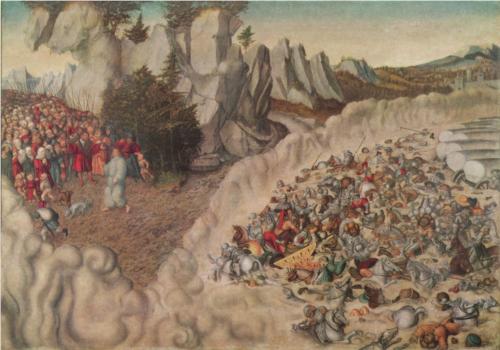
Lucas Cranach the Elder 'Untergang des Pharao im Roten Meer' (Germany, 1530)

Does God rejoice at the downfall of the wicked? Surely He wants the good to prosper and the wicked to perish. Yet, the destruction of God’s own creatures, regardless of some poor choices they may have made in the past, is also not a cause for Divine celebration. If one wishes to ascribe to a logical, binary scheme, the answer to this question can either be “yes” or “no”.  But this is the Talmud Blog, where a rabbinic “yes, but…” / “no, but…” will do just fine.  Indeed, rabbinic literature contains both views.  On the one hand, R. Ishmael confidently  responds to his students (preserved at Sifre Numbers 117) that indeed, God is happy when those who anger Him perish, while we also have a moving, anthropomorphic portrait of God’s pain at the wicked’s demise (mSan 6:5).

One of the better known talmudic passages that deals with this subject appears at bMeg 10b – towards the beginning of the so called Babylonian Esther Midrash (bMeg 10b-17a) which I am now teaching in the Hebrew University Talmud Department. The Babylonian Esther Midrash is a unique corpus. It is apparently the only complete midrash on a biblical book that was compiled in Babylonia, and as such it affords a rare window into Babylonian midrashic imagination. Scholars like Eliezer Segal have produced significant and lasting scholarship on the Bavli’s Esther Midrash. The primary tool in these scholarly endeavors is a kind of comparative criticism, that unfortunately ends up seeing the Bavli’s Esther Midrash as an essentially tone-deaf, pale reflection of Palestinian midrashic poetics.  Blame it on postmodernism, but I see in the Bavli’s ‘belatedness’ the beauty of the mosaic, pastiche – in short, a textual realization of Late Antiquity.

The passage that interests me appears towards the beginning of a long list of ‘petihtot’ to Esther, which Segal has demonstrated derive mainly from Palestinian exemplars. Indeed, the vast majority of tradents are Palestinian sages.  Further, in his assessment the full poetic punch of these petihtot is often effaced in the Bavli. This is true, but only if you consider Palestinian synagogal poetics as the sole form of legitimate poetry. Arguably, there is another kind of poetry that takes place in the processes of deconstruction and subsequent reconstruction which the Bavli performs on its Palestinian rabbinic heritage.

The point I have to make is a relatively, small, philological one.  But I do think that it partially explains a formerly incomprehensible Yerushalmi and also contributes to a deeper understanding of the development of two passages in the Bavli.  In any event, it has been far too long since the Talmud Blog had a post about a close, original reading of a sugya.

ר’ יהושע בן חנניה פתח לה פתחא להאיי פרשתא מהכא: והיה כאשר שש ייי עליכם להיטיב אתכם ולהרבות אתכם כן ישיש ייי עלי[כ]ם להאביד אתכם וג’

ומיחדי הקב’ה במפלתן שלרשעים 

והכת’ בצאת לפני החלוץ ואומרים הודו לייי כי לעולם חסדו ואמ’ ר’ יוחנן מפני מה לא נאמ’ כי טוב בהודאה זו לפי שאין הקב’ה שמח במפלתן שלרשעים

ואמ’ ר’ שמואל בר נחמני אמ’ ר’ יונתן מאי דכת’ ולא קרב זה אל זה כל הלילה באותה שעה ביקשו מלאכי שרת לומר שירה לפני הקב’ה אמ’ להן הקב’ה מעשה ידי טובעין בים ואתם אומרים שירה לפני

אמ’ ר’ יוסי ביר’ חנינה הוא אינו שש אבל אחרים משיש דוקא נמי דכת’ ישיש ולא כת’ ישוש שמע מנה

R. Yehoshua b. Hanania introduced the section from here: ‘And it shall come to pass that as the Lord rejoiced over you to do you good, so the Lord will rejoice over you to cause you to perish’ (Deut 28:63). 

Now does the Holy One, blessed be He, rejoice in the downfall of the wicked?

Is it not written, ‘as they went out before the army, and say, Give thanks unto the Lord, for his mercy endureth for ever (2 Chron. 10:21)’, And R. Yohanan said: Why are the words ‘for he is good’ omitted from this thanksgiving? Because the Holy One, blessed be He, does not rejoice in the downfall of the wicked? 

And R. Shmuel b. Nahamani said that R. Yonatan said, What is the meaning of the verse, ‘And one came not near the other all the night (Ex. 14:20)’?   At that time the ministering angels wanted to chant their hymns before the Holy One, blessed be He, but He said, The work of my hands is being drowning in the sea, and shall you chant hymns before me?

R. Yossi b. R. Hinana replied: He himself does not rejoice, but he makes others rejoice.  This is indicated also by the text, which writes yasis and not yasus, which proves [what we said]. 

(bMeg 11a, following MS Columbia; translation based on Soncino)

The opening verse is taken from the so-called “rebuke” section of Deut 28.  The link between this verse and Esther seems to center on the threatening verb “cause to perish (להאביד)” in Deut 28:63 and its ubiquity in Esther, for example at 4:7.  Apparently, R. Yehoshua understood the near destruction of the Jews in Esther as a realization of the Deuteronomic rebuke.  Judging from the first three petihtot of Esther Rabbah which cite Deut 28:66-68 and other later Palestinian midrashic parallels, this was apparently not an unusual way of introducing the Scroll of Esther.

The rest of the passage, however, is somewhat peculiar, and as such has gained the attention of generations of scholars.  I will focus on two issues:  The Talmud objects to the depiction of God as rejoicing over causing the destruction of the wicked, since two midrashic interpretations demonstrate that God does not rejoice when the wicked are punished (following Yehoshafat’s defeat of the Moabites; and after the drowning of the Egyptians in the Red Sea – the latter an example of a startling Babylonian reversal which was used in medieval times to justify the absence of Hallel recitation after the first day of Passover, but that is for another time).  The contradiction is resolved via a closer reading of the original verse from Deuteronomy, where God is now said merely to cause others to rejoice yet not rejoice Himself.  In other words, the entire sequence was generated by an apparent misinterpretation of the original verse that did not conform to midrashic traditions about God not rejoicing at the downfall of the wicked, and the conclusion is essentially to read the verse more carefully.  Further, as others have already pointed out (for example, E. Segal), the formulation of the original question “Now does the Holy One, blessed be He, rejoice in the downfall of the wicked,” is somewhat jarring, since nowhere in rabbinic literature do we find an entire generation of Jews referred to as “wicked”.

The passage bears a strong connection to a parallel at bSan 39b:

ויעבר הרנה במחנה

אמ’ ר’ אחא בר ר’ חננא באבוד רשעים רנה ובאבוד אחאב רני רינה

ומי חאדי הקב’ה במפלתן שלרשעים

והא כתי’ בצאת לפני החלוץ אומרים הודו ליי’י כי לעולם חסדו

ואמ’ ר’ יוחנן מפני מה לא נאמר כי טוב בפרשה זו לפי שאין הקב’ה שמיח במפלתן שלרשעים

ואמ’ ר’ שמואל בר נחמני אמ’ ר’ יונתן מאי דכת’ ולא קרב זה אל זה כל הלילה באותה שעה שטבעו מצרים בים ביקשו מלאכי השרת לומ’ שירה אמ’ להן הקב’ה מעשה ידי טובעין בים ואתם אומרים שירה לפני

א’ר יוסי בר’ חנינה הוא אינו שש אבל אחרים משיש דוקא  נמי דכת’ ישיש ולא כתי’ ישוש שמע מינה

‘And there went out the shout throughout the camp’ (1 Kings 22:36).

R. Aha b. R. Hanina said: ‘When the wicked perish, there is song (Prov. 11:10)’, and when Ahab perished there was ‘song of songs’ (following MS Yemenite, hagadot hatalmud, and others).  

Now does the Holy One, blessed be He, rejoice in the downfall of the wicked?

Is it not written, ‘as they went out before the army, and say, Give thanks unto the Lord, for his mercy endureth for ever (2 Chron. 10:21)’, and R. Yohanan said: Why are the words ‘for he is good’ omitted from this thanksgiving? Because the Holy One, blessed be He, does not rejoice in the downfall of the wicked? 

And R. Shmuel b. Nahamani said that R. Yonatan said, What is the meaning of the verse, And one came not near the other all the night (Ex. 14:20)?   At that time the ministering angels wanted to chant their hymns before the Holy One, blessed be He, but He said, The work of my hands is being drowning in the sea, and shall you chant hymns before me?

R. Yossi b. R. Hinana replied: He himself does not rejoice, but he makes others rejoice.  This is indicated also by the text, which writes yasis and not yasus, which proves [what we said]. 

(b. San 39a according to another Yemenite MS, MS Herzog).

This passage appears at the end of the fourth chapter in tractate Sanhedrin, where the Mishna describes how, after conveying a sense of seriousness to witnesses, the court reassures them that their task is essential and worthy.  One of the verses recited for the witnesses is Prov. 11:10: “when the wicked perish there are shouts of joy”.  At bSan 39b, the Talmud cites a verse from I Kings (22:36) that describes the news spreading of (the wicked) King Ahav’s demise.  R. Aha b. R. Hinina cites the verse from Prov and adds that when Ahav died there was even greater rejoicing.  Note that the Yemenite MS Herzog is vocalized רִנֵי רִינָה.  This leads into the same sequence that appears at bMeg 10b.

It is now easier to understand why the passage refers to “the wicked” – for Ahav’s wickedness was infamous. Yet, in certain respects the bSan passage is even more problematic than its bMeg parallel. The verse from Deuteronomy is not even quoted, but is nevertheless presumed in R. Yossi’s closing exposition.  And the opening question (‘Now does the Holy One…rejoice in the downfall of the wicked’) is almost incomprehensible, for where do we see God himself rejoicing at Ahav’s death?  On the other hand, there is reason to assume that the bSan passage is “primary” to the one in bMeg in the sense that the initialbuilding blocks of the passage were composed within the discursive context of bSan (yes, I am aware of Zvi Septimus’ article). This can be demonstrated since specifically bSan seems to have developed out of a parallel Palestinian passage preserved in the Yerushalmi that also appears as a comment on the same Mishna:

כת’ “ויעבר הרינה במחנה”.

מהו “הרינה”. הריני.

וכן הוא או’ “בצאת לפני החלוץ” וגו’. ללמדך שאף מפלת הרשעים אינה שמחה לפני המקו’ם.

It is written ‘And there went out the shout throughout the camp (1 Kings 22:36)’. 

What is “the shout” – hareni.

And it also says, ‘as they went out before the army (2 Chron. 10:21)’ etc. To teach you that even the downfall of the wicked is not a joy before Omnipresent. 

It seems clear that there is some relationship between the ySan and bSan passages. The Yerushalmi comments on the same Mishna, quotes the same verse from 1 Kings and then cites the same midrash on 2 Chron 10:21 (which first appears in the Mekhilta Beshalah, Shira parsha 1, p. 118).  Yet, on the whole, the meaning of this short Yerushalmi passage has eluded interpretation, particularly the first line.  What does the word הריני mean here, and what does it add to the verse from 1 Kings?

Not surprisingly, the traditional commentators try to apply the Bavli parallel to the Yerushalmi, and they suggest that the definite article (הרינה – the shout of joy) is interpreted here to refer to the great joy felt at the demise of the wicked.  Neusner’s translation emends the text accordingly “What is this cry (HRYNH)? Lo, it is a song (HRY RYNH).” On the other hand, the Mohr Siebeck translation suggests a reading of חרון – anger.  This seems to be based on the second line of the Yerushalmi, which cites the Mekhilta about God not fully rejoicing at the defeat of Moab.  Since the latter is apparently linked to the first line with the words “and it also says (וכן הוא אומר),” one might assume that the first line about “the shout” should also convey the same message of Divine displeasure at the downfall of the wicked.

In fact, the words “וכן הוא אומר” should actually be read “וכאן הוא אומר” (“and here it says”), and they merely represent a direct though shortened quotation of the Mekhilta passage according to the best witnesses. As for the first sentence “מהו הרינה – הריני”  the final word might perhaps be read as הרינו and represent a regressive assimilated form of הפעיל צווי הרנינו – ‘(you, pl.) Rejoice!’  As such, the Yerushalmi interprets 1 Kings 22:36 to mean that God is telling the Jews to rejoice (הרנינו) at Ahav’s death.  This then is juxtaposed to the midrash from the Mekhilta where God does not fully rejoice at the defeat of Moab.  The tension between these two positions, however, is unresolved.

This brings us back to the bSan parallel. If the original, Palestinian set of amoraic comments on mSan 4:5 contains two apparently unreconciled views of the Divine reaction to the demise of the wicked, the Bavli turns this material into a dialectical sequence.  Thus, originally, the comment on the verse from 1 Kings attributed to R. Aha b. Hinina (אחא בר חננא  – a name which looks suspiciously close to “” אחאב רני רינה as indeed is made clear in a variant preserved in geniza fragment CUL: T-S Misc. 28.201) apparently refers to God commanding rejoicing at the demise of the wicked Ahav. Notwithstanding the vocalization of MS Herzog, perhaps originally the term was to be read רנו רינה and similarly represent a regressive assimilation, now of the פיעל צווי form רננו.  Either way, the Bavli explicitly interrogates this midrashic understanding of 1 Kings, since in two places God is seen as not rejoicing at the downfall of the wicked.  The Bavli’s answer, based on Deut 28:63, now works perfectly.  God himself does not rejoice, but he causes others to rejoice – precisely as we see in the midrashic reading of 1 Kings 22:36 explicitly preserved in the Yerushalmi though only residually in the Bavli.

In short, we have a passage at bSan 39b that seems to, artfully, make use of a cryptic Palestinian text that juxtaposes God’s command to rejoice at Ahav the wicked’s death with his lack of joy at Moav’s defeat. This is turned into a series of questions that clarify where Divine joy at the downfall of the wicked is to be located – not within the godhead itself, rather in divine encouragement to rejoice. A philosophically fascinating proposition.

At last, this sequence intersects with bMeg 10b, where the citation of Deuteronomy 28:63 as a frightening petihta to Esther seems to elicit the need to ‘soften’ the troubling notion that God Himself rejoiced at the near destruction of the Jews in the Purim story.  No, God Himself did not rejoice. But he did encourage others to do so in carrying out their awful, destructive task.

Standard
English, Recent Publications

The Babylonian Talmud, Now in Arabic

As reported in such news outlets as the Jerusalem Post, Yeshiva World News, and PaleoJudaica, a new translation of the Babylonian Talmud into Arabic has just been published in Jordan and is on sale for $750. Veteran readers of the Talmud Blog may recall Jonathan Marc Gribetz’s article on past attempts at translating the Bavli into Arabic. Various friends of ours have been keeping us up-to-date on this seemingly succesful publication, one of whom tracked down this advertisement promoting the Sha”s:

Translation (based on that of blog-reader Yedidya Schwartz):

 The Babylonian Talmud (In Arabic)

The translation of the Babylonian Talmud is historically unprecedented, entailing a six-year effort of more than 95 translators, researchers, and language editors under the supervision and leadership of the Middle East Studies Center – Jordan.

Hurry to buy the first copy translated into Arabic (20 Volumes).

The Babylonian Talmud is considered the most important product of historical Judaism and theoretical religious teaching for Jewish communities.

The translation of the Babylonian Talmud into Arabic represents a fundamental shift in the perception of the religious and intellectual foundations of Orthodox Jewish thinking.

This translation opens up a wide horizon for academic studies in understanding Jewish religious thought and in recognizing its various manifestations throughout history.

Stay tuned for a full review of the edition in the coming months.

Standard
English, Ruminations

Reading the Talmud in France

File:Armoiries république française.svgMany people ask me why I chose France when I decided to write my PhD dissertation on rabbinic literature. It is a very good question since there are only a handful of Talmud specialists in this country, and they are hardly read by people outside of France (or inside it for that matter…). France, in that respect, cannot be compared to Israel, the US, the UK or even to other European countries such as Germany or Italy where the situation is somewhat better.

I always found this state of affairs very sad. After all, it is a country with a long history of great talmudic scholarship – Rashi and many of the Tosafists, not to mention the scholars from Provence… I’m not saying that no one reads the Talmud in France. On the contrary, there are many yeshivot and community centers where the Talmud is studied in the traditional way. It goes without saying that only or mainly Jews attend these Talmud classes (in some synagogues women can join too). When an academic approach is at stake, however, one seems to go up a blind alley.

There are many explanations to this sad state of affairs. Of course, we can go back to the 13th century “Dispute de Paris” with its horrific outcome – the burning of hundreds of Talmud manuscripts found all over the French Kingdom, or the decision to expel all the Jews from France in the following century. But for the purpose of this post let’s stay within the limits of the last century, which, in the very beginning saw the promulgation of the “law of 1905” that decreed the separation of the church and the state, and promoted the value of the “laïcité” (secularism), so precious to the French. The “laïcité” in France is much more than a concept. It is a social and cultural value, whose roots are to be found already in the period of the French “Lumières” that defined themselves against religion in a very provocative and combative manner (contrary to the German Aufklärung). As a proof for its importance one can cite the fact that this value is promoted and used by ALL of the main candidates in the upcoming presidential election, even by Marine Le Pen. Of course, the latter, and to a certain extent all the candidates from the political center, use this value in order to defend the Catholic values that are so imbedded in French culture that no one sees them as “religious” any more. No one, that is, who is from a Catholic background. In other words, as some French sociologists have already pointed out, French secularism is a modern form of Catholic Christianity, in which Catholic values (and customs to some extent) are being stripped of their theological load in order to be presented as neutral, humanistic and universal.

In the context of French Academia, the 1905 law had some very significant consequences. Since most French universities are public, the law implied that they could not host departments of theology which in many cases (as in Germany, for example, or in some private universities in the United States) constitute a serious academic platform for religious studies and research. A few such enclaves still exist, as for example in some universities in the Alsace and Loraine Regions that were not part of France in 1905, or in the rare private universities such as the Institut Catholique de Paris. Some fields in religious studies, such as New and Old Testament studies and Patristics, were already imbedded in French universities so that the impact of the law of 1905 was not fatal in their regard. Those specialists found their way to departments of history, philology and so forth. To some extent this is also true regarding medieval Jewish Studies (the first scientific translation of ‘The Guide to the Perplexed’ was produced in French by Solomon Munk in the middle of the 19th century). But as for the nascent field of Talmudic studies, it did not gain enough prestige and importance in order to be integrated in one of these “laic” departments. There were (and still are) departments of Hebraic or Jewish studies in some French public universities, yet most of the specialists that crowded them worked on ancient (biblical, second temple), Hellenistic or medieval Judaism, while the Talmud was  for the most part left aside.

And then there was Levinas. Yet here too, his Lectures Talmudiques were delivered mainly within Jewish circles, and were not viewed as an integral part of his academic work or his philosophy (a trend that may now be changing). Sure, it leads to the fact that we can find some references to the Talmud in the writings of Levinas’ interlocutors, like Derrida or Lacan, but these are by no means the work of specialists, and neither did they influence the heavy apparatus that is the French university to give more importance and space to talmudic studies.

The Talmud is still viewed today in French culture as a religious corpus, intended mainly for religious purposes. I am not saying that this state of affaires is unique to France, but I am still always disappointed to find out that in the country of Derrida or Foucault, who wrote the most interesting and rich critiques on western philosophy in the second half of the 20th century, the Talmud, which offers something that can be viewed an anti-philosophical thought, is mostly ignored by the intellectual circles.

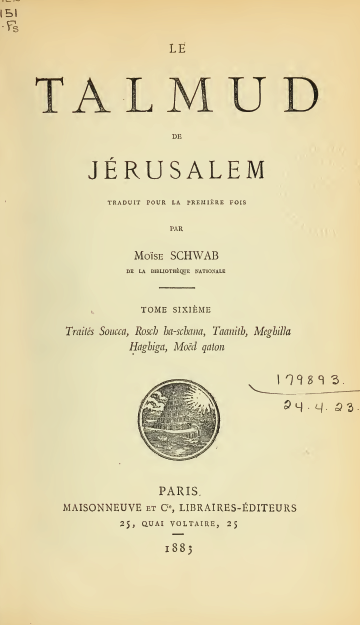
There is also a very practical aspect to this problem – for the French reader there is no complete edition of the Babylonian Talmud, the Mishnah, or the Midrashim. As for the Palestinian Talmud – this was indeed translated in the 19th century by Moïse Schwab, though in an admittedly beautiful (I think) yet highly problematic rendition.

The few specialists that are working in France are of course aware to this situation and are working on changing it. The best example is a project I am proud to participate in, which consists of a scientific edition of the Mishnah, and its first complete translation into French – a project led by Daniel Stökl Ben Ezra from the Ecole Pratique des Hautes Etudes.

I have to admit, if I chose Paris as the place to work on my PhD on the “ethics of the self” in the Talmud, it was not because I wanted “to bring light to the Gentiles” but mainly because back then I was still under the “spell” of French Theory (which is after all a much more American notion, not to say invention, than a French one). Ever since, I realized how neglected the Talmud is by the rich intellectual discourse that is going on in this country, and I started to refer to my work as a mission, or at least a very important job. Talmudic thought, when studied in its historical context (that is to say not in a Levinasien way), can shed light on many subjects that occupy western societies in general and the French one in particular. Its “realistic” approach (“no law can be imposed on the public unless it can endure it”), its anti-mystical attitude, and its general ethical demand – to live an individual life of virtue without retreating from the social, day-to-day world – all these and other values discussed in the rabbinic corpus can contribute much to the problems French society has to deal with these days. Of course, it will not be possible to integrate talmudic texts into the public discourse here unless we show that they are not more or less “religious” (in the modern sense of the word) from the founding texts of western civilization. This job is still in its infancy, and with some naivety (some may say pretention), I promise to keep you posted on the developments.

Standard
English, Recent Publications, Reviews

Otzar Ha-Geonim He-Hadash- Review by Yosaif Mordechai Dubovick

Otzar Ha-Geonim He-Hadash, Ed. R. Brody with C. Cohen and Y.Z. Stampfer (Jerusalem: Ofeq Institute, 5772).

Review by Yosaif Mordechai Dubovick

Towards the end of the sixth century, the torch of rabbinic leadership passed from the Amoraim to leaders referred to in Geonic literature as the Savoraim. Their successors, the Geonim of the Babylonian Yeshivot of Pumbedita and Sura, saw themselves as the logical heirs of Talmudic interpretation and Halakhic ruling. For a period of close to 600 years, the Geonim, through their teachings, responsa and halakhic writings (and those of their students) helped to cement the Bavli’s form. Talmud study that considers the perspective of Geonic (and Geonic-era) literature is invaluable for tracing the redaction of the text and the history and formulation of Halakha; and for understanding many subsequent medieval commentaries as well.

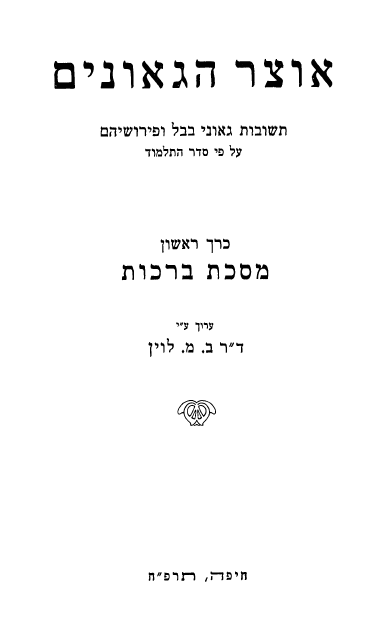
In practice however, using these texts for Talmud study is a daunting task. Geonic responsa have survived in numerous collections but many of them have not been properly indexed; Many Halachic codes and legal monographs shared the same fate. Despite the state of disarray of Geonic literature, from 1928 to 1942, Dr. Benjamin M. Lewin self-published – on his own printing press – 12 volumes of Otzar Ha-Geonim, which he sub-titled “Thesaurus of the Geonic Responsa and Commentaries following the order of the Talmudic Tractates”. Beginning with Berachot and ending – due to his untimely passing – with Bava Kamma, Lewin managed to achieve the impossible. His work did not end with his death: A partial volume to Bava Metsia was published posthumously and his personal hand-lists to tractates Bava Batra and Hullin were included in A. Kimmelman’s index to Geonic literature.

Lewin, working alone and under financial stress, gleaned Geonic material from responsa collections, Geonic halachic works as well as newly published Genizah fragments. He divided (in most volumes) his compilations into two sections; ‘Responsa’ and ‘Commentary’, published parallel sources alongside one another in synoptic fashion, included footnotes of his own and from other scholars of his generation (e.g. Professors J.N. Epstein, S. Assaf, S. Lieberman and S. Abramson) and added detailed indices.

Later attempts to replicate Lewin’s methods are few and far in between. Aside from Kimmelman’s aforementioned list in Shnaton Mishpat haIvri 11-12, we have H. T. Taubes’ compilation to Sanhedrin (1967) and Y. Cohen’s Ginzei Geonim on the first three chapters of Bava Batra (1995).

This is the current literary backdrop against which we eagerly greet Prof. R. Brody’s latest work, Otzar Ha-Geonim He-Hadash. To say that this volume takes up where Lewin left off would be a discredit to the effort and scholarship invested in it. The reader should not expect to find a continuation of Lewin’s oeuvre nor even a revised edition of the older material. Rather, we have before us a fresh volume, meticulously planned from its inception.

Each section has been handpicked by the discerning eye of a master of Geonic literature. This task, daunting in itself, required the editor to decide which sources to include, which are merely repetitions and may be relegated to the notes, and which sources, although related to the sugya, are not truly native to Bava Metsia and should be merely cited but not quoted. Gone is Lewin’s partition between responsa and commentary and the reader is no longer required to alternate between different sections of the work.

All previously published material has been re-edited against the original manuscripts, alongside of which we encounter much ‘new’ responsa and commentary. Specifically, we are made privy to parts of a soon-to-be-published edition of Rav Hai Gaon’s Mishpatei Shavuot. This edition was originally under preparation by the late Prof. S. Abramson. According to the introduction and bibliography in Brody’s new book, it is slated for publication this year. Along with commentaries to Bava Metsia used as source material, Brody’s notes also reference a section in the introduction, written by Abramson, dealing with Rav Hai’s retractions in halachic decisions (p. 24 no 1). And beyond this exciting news, we are provided with newly discovered sources from texts penned by Rav Shmuel b. Hofni. These include Sefer Hamashkon, Sefer Hat’naim, Sefer Hakinyanim and chapter 74 from his “Introduction to the Mishnah and the Talmud”. The great Geonic innovator also makes an appearance – parts of Rav Se’adyah Gaon’s Sefer Hapikadon and his Sefer Hashtarot are represented in Brody’s volume. These works too are being readied for publication, and we look forward to welcoming their arrival in print.

Other novellea await the reader. In Brody’s minimalistic notes, we learn of Rav Sherira Gaon’s knowledge of Greek (p. 152 no. 2 – possible) as opposed to his son Rav Hai’s certain lack of knowledge in this field (p. 120 no. 7). Philological information abounds: Persian loan-words are discussed (see p. 32 no. 8) and the editors, experts in Judeo-Arabic, trace the Arabic etymologies of many words and phrases in Geonic literature (p. 31 n. 7; p. 34 no. 4; p. 215 no. 8; p. 216 no. 1; p. 217 no. 1).

Preserved in the notes as well are vignettes from Abramson’s unpublished discourses, a sort of academic “torah she-be’al peh”. Hinted at is his understanding of the phrase “tartei mativta” to mean the Yeshiva of Sura and the parallel yeshiva of the Resh Galuta (Exilarch), contrary to popular convention that this refers to the yeshivot of Sura and Pumbedita (see p. 80 no. 13). Further such gems include one of Abramson’s notes to the text of Mishpatei Shavuot (p. 316 no. 5) and a discussion of an attribution issue related to a particular work (p. 51 no. 8).

The following Geonic comments provide a sampling of some of the fair: Rav Hai seemed to have understood the sobriquet “Paponai” to mean “followers of Rav Papa”, contrary to the now conventional definition “those of the city of Paponia” (p. 176 no. 5). From a citation in a responsa attributed to Rav Zemah b. Paltoi Gaon (Pumbedita 872) it is apparent that this Gaon viewed the three “Bavot” as one tractate (p. 212 no. 9). This datum adds to our knowledge of the literary structure of Talmudic corpus as understood in the middle Geonic Era.

Those who have studied Bava Metsia are aware that many of the tractate’s passages are attributed by the Rishonim to Geonim or Savoraim. The current volume makes note of this (pp. 25, 72, and 102) and the editor is of the opinion that these attributions are not to be viewed as authentic – providing another viewpoint to the debate as to how the Savoraim and Geonim added to the Talmudic text (if at all). In contrast, see p. 26 no. 2 for a Geonic reading of the sugya, which relegates a part of the text to the “stam”.

The editor informs us in his English preface that three more volumes are planned, thereby completing “Otzar Ha-Geonim” on all of Bavli, after which he hopes to “prepare a corrected and updated version of his [Lewin’s] work”. The volume on Bava Batra is cited extensively (18 times), as well as a volume containing Shavuot (pp. 10, 63, 284). Citations to Otzar Ha-Geonim on Sanhedrin are to Taubes’ edition; and no hint is given of whether the remaining three volumes will include Sanhedrin as well. Interestingly, the editor also cites material from the forthcoming volumes to the following mesechtot: Hullin (p. 70), Bechorot (p. 138) and Erachin (p. 131).

Otzar Ha-Geonim He-Hadash on Bava Metsia innagurates a new page in Geonic studies. Bava Metsia is a widely studied tractate, from both a textual as well as an halachic perspective. This volume displays a superb blend of academic and traditional Talmud study. Those with an interest in Geonic Talmud commentary would do well to avail themselves of this literary treasure. We wish to offer our thanks to Prof. Brody for undertaking this vast endeavor, and we eagerly await its succeeding volumes on all of the Talmud Bavli.

Yosaif Mordechai Dubovick is currently writing a PhD dissertation on Rabenu Hananel at Bar-Ilan University. His publications include “Rabenu Hananel on Tractate Bava Kamma” (Jerusalem, 2011).

Standard
Around the Web, Conferences, English

The APJ’s Symposium on Halakha (Jewish Law) and Philosophy of Law: Authority, Halakha, and the ‘Official Vigilante’

We just got this announcement from the Association for the Philosophy of Judaism‘s (APJ) Aaron Segal:

The Association for the Philosophy of Judaism is pleased to invite all interested parties to its forthcoming online symposium on halakha (Jewish law) and the philosophy of law (21-28 March), which will take place on its new site http://www.theapj.com/blog. The symposium is entitled “Authority, Halakha, and the Official Vigilante,” and will center around a discussion of the problems of authority and law in relation to Mishna Sanhedrin 9:6, in particular the rule that zealots may attack the Jewish man who is having sexual relations with a Gentile woman. On March 20th materials will be posted on the new website which will contain some discussion of the issues by the symposium participants Sari Kisilevsky (CUNY), Ken Ehrenberg (SUNY), and Laliv Clenman (Leo Baeck). Of particular relevance will be the following texts: Mishna Sanhedrin 9:6, Babylonian Talmud Sanhedrin 81b-82b, and Palestinian Talmud Sanhedrin 27b.  

Please contact info@theapj.com with any questions.

Their old site, Philosophy of Judaism, hosted quite a few interesting symposia and discussions. Hopefully in their new home they’ll be able to reach even more readers.

Standard
English, Recent Publications

Recent Publications from Brody and Co.

As tweeted earlier last week, Prof. Brody of Hebrew University’s department of Talmud and Halakha has just published, along with Zvi Stampfer and Carmiel Cohen, a new edition of Otzar Ha-Geonim. Stay tuned for an in-depth review in the coming weeks, and, until then, check out the table of contents and introduction here. This new volume is part of a larger project, funded by the Israel Science Foundation, which will eventually fill in all the original volumes B.M. Lewin did not complete, as well as supplement the earlier volumes with more material.

And if you’re already calling the Ofek Institute or your preferred seforim store for a copy, you might want to think about asking them to save you a copy of Prof. Brody’s  Teshuvot Rav Natronai Gaon, first published in 1994, and recently reissued in a brand new edition.

Standard
English, Readings

The Missing Daf

Purim Day, Thursday, March 8, 2012

Modiin, Israel

Anyone on the inside knows that academia in general is full of intrigue, that Jewish studies is really one big ‘Spy vs. Spy’ episode, and that the Talmud Department is, well, the stuff of an oscar-nominated film.

This one is really too good to make up. The Talmud Blog’s most connected, most secretive informant, BM, who has made a name for himself in Jewish studies in every so many ways, just emailed me that a missing Daf from tractate Megilla of the Babylonian Talmud has just been discovered. This of course is from smack dab in the middle of the Babylonian Esther Midrash, and it certainly fills in a lot of missing blanks. It was discovered by an accomplished, traditional Jerusalem scholar, AB. I know what you’re thinking, another Friedlander Yerushalmi on Kodashim. But THIS, in fact, is the most exciting news in the field, even more than Menachem Kahana waving around the title page of some secret, Jerusalemite manuscript catalog.  So go ahead, scroll down.

SS

Click here

Standard
English, Talk of the Town

And the Epstein Goes to…

(Scroll down for the most exciting Talmud news in 30 years!)

As is the custom, the friends and members of the Talmud department convened this Sunday to award prizes and remember the founder of the department – J.N. Epstein – and one of its master teachers, E.S. Rosenthal. The Epstein prize was awarded to Ms. Shikma Kaspi, who gave a paper on the increasingly scholastic nature of the debate on the penalty for unintentional murderer in rabbinic law. Kaspi claimed that if biblical law was interested in either apprehending an intentional murderer or hiding the unintentional one in a sacred precinct, rabbinic law – having no such sacred precincts – was increasingly interested in the details and particulars of the mistaken act. Kaspi pointed out that B. Mak 7b brings matters to an absurd conclusion, when – like a 9th grade physics teacher – it maps out the various positions and vectors of a meat-cleaver swung over a mishappen butcher’s shoulder. Kaspi took it to mean that the heat of the moment was no longer a concern for the sages. (Following Isaac Baer, she could have also pointed out that rabbinic though understood the cities of refuge to be not only a kind of protective custody, but a penalty in and of itself, following Greek law).

Dr. Ronni Goldstein of the Bible department was awarded the Rosenthal prize. Goldstein discussed several Rabbinic Hebrew words that are better explained by Akkadian. This continues an effort begun already by B.A. Levine, in his awe-inspiringly short doctoral dissertation, and Goldstein added several more words to this list. Most striking, in my opinion, is the Tannaitic reading of Lev. 24:16: “the man (=the blasphemer) shall be put to death; the entire assembly shall stone him with stones”. In Sifra this verse is read thus: “all the assembly shall be his enemies”. Now, on the face of it, this simply means that since the verse already says that the man shall be put to death, the second clause, that of stoning, is superfluous. Additionally, the requirement to stone the blasphemer has already been stated in 24:16. And so, to avoid  superfluity, the tannaim derive a moral lesson from the verse. Goldstein showed that in Akkadian both ragamu and bel debabu (I misplaced the handout, ANE specialists, please correct me in the comments) have legal connotations: the first is a law-suit or a complaint, and the second is a legal adversary. Tannaitic Hebrew contained both terms, and the Tannaim read רגום as meaning not “stoning” but “suing”. The homily means therefore: “the entire community shall be his legal adversaries”, pointing out that the blasphemer also, apparently, sinned against the entire community.

In the news department, Prof. Menahem Kahana used the occasion to announce that the catalog of all Mishnah, Tosefta, Yerushalmi and Bavli fragments is now in print, and even held up a copy of the title page to prove it. Similar announcements have been made in the past (see, e.g., Yaakov Sussman’s article in Teuda 1 (1980) and its continuation in Mehkerei Talmud 3 (2006)), but this time – as sources confirm – it is for real. The real question, however, is whether the database used to create the printed catalog will be released in the near future as well.

Standard
English, Guest Posts

The Bible in the Bavli: Some First Numbers- Guest Post by Michael Satlow

Over the past few months, as noted earlier, with the help of research assistants I have been compiling a spreadsheet that records each occurrence of a biblical verse cited in the Bavli. The purpose of this data is not so much to ask qualitative questions (e.g., where and how does the Bavli cite a particular verse?) but to allow for quantitative analysis that might lead to new questions and avenues of investigation.

As I slowly gain more familiarity with the many extraordinary but poorly documented powers of Excel, I’ve just begun to analyze this data.  Here are a couple of preliminary observations:

1.  The Bavli cites somewhere in the neighborhood of 5900 discrete verses of the Hebrew Bible.  The Hebrew Bible contains approximately 23,700 discrete verses.  That equates to about 25% of the Bible; meaning, of course, that 75% of the Bible is never cited.  It is worth noting that 3,295 verses are cited only a single time in the Bavli.  I am not yet sure what to make of this – one next step is to analyze the density of citations by biblical book.  Does the Bavli prefer citing from certain books, especially when the size of the book is also taken into account.

2.  The seven most-cited verses (with NRSV translations, and some surrounding material added for context) are:

  • Deuteronomy 24:1 (37 times): Suppose a man enters into marriage with a woman, but she does not please him because he finds something objectionable about her, and so he writes her a certificate of divorce, puts it in her hand, and sends her out of his house; she then leaves his house and goes off to become another man’s wife.
  • Numbers 5:13 (29 times): If any man’s wife goes astray and is unfaithful to him, if a man has had intercourse with her but it is hidden from her husband, so that she is undetected though she has defiled herself, and there is no witness against her since she was not caught in the act; if a spirit of jealousy comes on him, and he is jealous of his wife who has defiled herself; or if a spirit of jealousy comes on him, and he is jealous of his wife, though she has not defiled herself
  • Leviticus 25:5 (24 times): You shall not reap the aftergrowth of your harvest or gather the grapes of your unpruned vine: it shall be a year of complete rest for the land.
  • Numbers 30:3 (24 times): When a woman makes a vow to the Lord, or binds herself by a pledge, while within her father’s house, in her youth, and her father hears of her vow or her pledge by which she has bound herself, and says nothing to her; then all her vows shall stand, and any pledge by which she has bound herself shall stand. But if her father expresses disapproval to her at the time that he hears of it, no vow of hers, and no pledge by which she has bound herself, shall stand; and the Lord will forgive her, because her father had expressed to her his disapproval.
  • Leviticus 2:2 (21 times): After taking from it a handful of the choice flour and oil, with all its frankincense, the priest shall turn this token portion into smoke on the altar, an offering by fire of pleasing odour to the Lord
  • Numbers 6:5 (21 times): All the days of their nazirite vow no razor shall come upon the head; until the time is completed for which they separate themselves to the Lord, they shall be holy; they shall let the locks of the head grow long.
  • Leviticus 6:3 (20 times): When any of you sin and commit a trespass against the Lord by deceiving a neighbour in a matter of a deposit or a pledge, or by robbery, or if you have defrauded a neighbour, or have found something lost and lied about it—if you swear falsely regarding any of the various things that one may do and sin thereby— when you have sinned and realize your guilt, and would restore what you took by robbery or by fraud or the deposit that was committed to you, or the lost thing that you found

Five of these verses deal with matters of civil law; three deal with women.  Why these verses in particular, though?  Verses dealing with some expected topics, such as Shabbat or circumcision, are absent.

I have some ideas for at least some of the verses.  Deuteronomy 24:1-4 are the basis for almost the entire legal institution of divorce – the rabbis need to keep appealing to them for authority, perhaps at a time when most Jews would have respected the Bible far more than rabbinic say-so.  Similarly, the sotah (“suspected wife,” in Numbers 5), issues dealing with female vows (Numbers 30:3), and the nazirite vow (Numbers 6:5) are dealt with only in these places and all generate a large body of laws. I am not yet entirely satisfied with these explanations, and would welcome yours as well!

Michael Satlow is a professor of religious studies and Judaic studies at Brown Universityand has been a mentor and sounding-board for the New Talmud Blog from the beginning.  This post was crossposted from his own blog, Then and Now.

Standard