English, Guest Posts, Postscripts

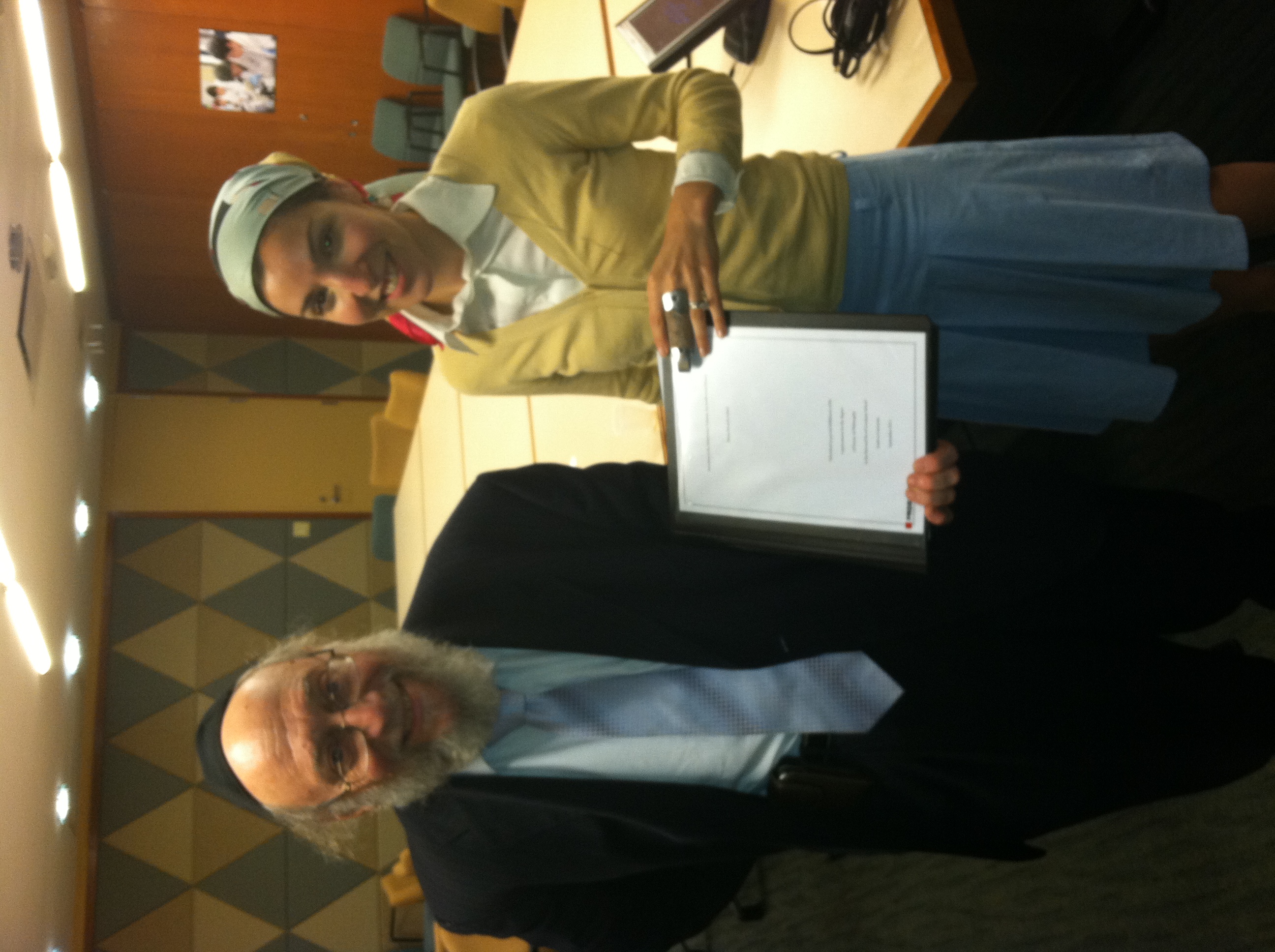
Haim Zalman Dimitrovsky ז”ל- Guest Post by Prof. Shamma Friedman

Haim Zalman Dimitrovsky ז”ל

Shamma Friedman

Haim Zalman Dimitrovsky (1920-2011) belonged to the first generation of academic Talmud scholars born and educated in Israel, and certainly one of the outstanding among them. His personality encompassed a unique blend of knowledge, talent, and devotion, a combination that was all his own.

A graduate of the prestigious Yeshivat Merkaz Ha-Rav, and before that Talmud Torah Etz Haim in Jerusalem, Dimitrovsky was loyally committed to the State of Israel in the making, and as a young man took up arms and served in the Hagana during the War of Independence. He was trained in the scholarly methods and high standards of the Talmud Department of the Hebrew University at the feet of J.N Epstein and Simha Asaf, whose methods he combined with the traditional learning and orientation he received through the tutelage of his father, Rabbi Yaakov Yosef Dimitrovsky.

His spoken Hebrew was that of a native speaker, and at the same time rich and flowing naturally out of the Talmudic sources. His written Hebrew style, was likewise enriched in both these directions: from his absolute mastery of the wealth of all strata of Hebrew, stemming from his command of Talmudic and other sources, and the natural control of a native speaker, it emerged as a creation of stylistic beauty few could match.

Similarly, his research and studies, in all the various fields he addressed, all reflect this one of a kind combination of Torah scholarship, scientific methods, and religious-Zionist conviction.

Professor Dimitrovsky’s profound understanding of the complexities of the vast Talmudic corpus, down to the most minute detail, cannot be acquired except by arduous devotion to Torah study from an early age. With these strengths, Dimitrovsky created a unique scholarly profile, based on a meticulous scientific method founded on the peshat of the text, accurate historical understanding, and overall – sound common sense. He integrated a deep-seated, natural grasp of the material with fierce devotion to the beauty of Jewish tradition, even when working in the broader, secular reality of the academic setting.

These were the same qualities that led to the dialogue of love between him and his students, all during his teaching career, and above all, his inherent modesty – genuine, personal, and special to Haim Zalman Dimitrovsky. Through his years as Professor of Talmud at the Jewish Theological Seminary of America, and later at the Hebrew University, Dimitrovsky trained generations of scholars of Talmud and Midrash.

These strengths mark his scholarship also: scholarly precision with loving mastery of his material persisted in his ongoing project of putting order into the texts and uncovering the depth level of correct meaning: “nahara nahara ufashtei“.

It is therefore not surprising that he gave preference to the literature of the rishonim – its profound depths require scholarly expertise as a sub-discipline in itself: “tzvat bi-tzvat asuya“. For example, Rashba, the chief disciple of the Nahmanidean school, as well as a decisor who wrote thousands of responsa – only a true scholar – astute, with the entire rabbinic corpus at his fingertips – is equal to the task of transmitting the Rashba to future generations. Dimitrovsky did so, from editing the Rashba’s novellae to compiling his responsa, with all their fragments. Every conversation with Prof. Dimitrovsky demonstrated that this was a labor of love.

Consider also the neglected, abstruse discipline of elucidating the writings of the early aharonim, namely, the masters of pilpul, who formed the link to the following generations while their own teachings were nearly forgotten, overshadowed by both rishonim and aharonim. Dimitrovsky stepped in, shed light, analyzed, and breathed new life into their words. His illumination of the semikha controversy likewise typifies his work which was devoted to the intermediate generation.

Another lost corpus restored by Dimitrovsky was the editions of the Talmud printed in Spain and Portugal before the expulsion. These disconnected dry bones were restored to their grandeur and provided with his fully innovative history of these little known prints.

Thus he was able to direct a concentrated in-depth focus to the commentarial and halakhic works of the Rashba; the printers of the forgotten edition of the Talmud dating from before the expulsion from Spain; of Y. Berav and Joseph Karo in the context the semikha controversy; and the entire genre of pilpul. Armed with profound powers of analysis on the one hand, and a restrained style, on the other, he has thereby enabled us to restore our own link to this almost-forgotten generation, and to hear – through his words – their muted majesty.

We were deeply gratified in 1994, when the unique achievements of our teacher, so well know to us, his students, were publicly recognized with the award of an Israel Prize in an official ceremony.

Shamma Friedman is the Benjamin and Minna Reeves Professor of Talmud and Rabbinics at The Jewish Theological Seminary teaching at The Schechter Institute of Jewish Studies, and Adjunct Professor in the Talmud Department at Bar Ilan University.

Standard
English, Recent Publications, Reviews

Another Review of Socrates and the Fat Rabbis

At the old Talmud Blog, I kept a log of reviews of Daniel Boyarin’s Socrates and the Fat Rabbis.  And then I couldn’t keep up. Two months ago, I had the distinct pleasure of responding to a paper of Prof. Boyarin’s which was itself a response to two reviews – that of Adam Becker: “Positing a ‘Cultural Relationship’ between Plato and the Babylonian Talmud’ which appeared with Barry Wimpfheimer, “The Dialogical Talmud: Daniel Boyarin and Rabbinics” in JQR 101:2 (Spring 2011), and Reuven Kiperwasser’s in Jewish History, which interestingly enough had at that point not yet been published. Kiperwasser’s important review has finally appeared in the most recent issue (in print) of Jewish History.  Hopefully, we’ll get to see a response by Prof. Boyarin at this blog in the future.

Standard
English, Reviews

Review of Why Study Talmud in the Twenty-first Century

In 2009, Paul Socken edited a collection of articles entitled Why Study Talmud in the Twenty-first Century.  It is for the most part a finely curated group of essays that provide real insight into the inner-world of modern Talmudists – even if there are some minor organizational problems (some with gender implications).  In the most recent Shofar Magazine, Ricky Hidary offers a great summary and assessment of the collection, which I can attest is well worth the read, and if you buy books, the money.

Standard
English, Talmud in the News

The Book and the Legend

No longer just "the national poet", Bialik has become a fashion statement.

In the year 1903, C.N. Bialik and Y.H. Ravnitsky, neighbors in the same building in Odessa, set out to produce what would be one of the most influential books in the study of aggada since the Ein Yaakov. Sefer ha-AggadahThe Book of Legends– was completed 100 years ago, with the publication of its sixth section in 1911.  To mark this anniversary, Ha’aretz recently featured an article (hat-tipAncient Hebrew Poetry) by one of the foremost Bialik scholars, Shmuel Avneri (not to be confused with Shlomo Avineri). Avneri lists numerous instances where Bialik’s books were burned by some ultra-Orthodox Jews in Israel, and he emphasizes how these cases were at odds with the positive and productive relationships which Bialik had with other segments of the charedi community. The author also lists numerous critiques of Sefer ha-Aggadah by secular and academic intellectuals, from Agnon to Shinan, who for the most part took issue with the liberal editing policies of Bialik and Ravnitsky. To his list I would add the important footnote in Carnal Israel in which Boyarin criticizes Bialik for his “misogynistic” selection of texts.

As a translation and anthology, Sefer ha-Aggadah has many problems, some of which Prof. Shinan’s own updated version will seek to correct. Yet no one can deny the massive contribution that it has made to the popularization of aggadah over the past hundred years. As Alan Mintz has pointed out:

Throughout the early twentieth century, cultural and religious Zionists sensed the need to make rabbinic thought available in formats and languages that were accessible to native Hebrew speakers, religious and secular alike. Sefer ha-Aggadah (The Book of Legends) by C.N. Bialik and Y.H. Ravnitsky was an early example, one that has profoundly influenced Israeli culture.

As attested by the reflections of several modern Israeli writers, Bialik and Ravnitzky had an enormous influence on the early generations of Zionists in Palestine/Israel. Yoram Kaniuk writes in his memoir 1948:

We were the sons of the Bible, yet we were also sons of Bialik and Ravnitsky’s The Book of Legends, and we loved to read how Moses sees Joshua enter the Tent of Meeting and is jealous of him and says to God “one hundred deaths and not one jealousy”.

More examples may be found in Amos Oz’s Story of Love and Darkness. Without such a compilation it is doubtful that Rabbinic literature would have succeeded in taking such a significant role in the formation of the Zionist ethos. One may add that Bialik’s position as “the national poet” also contributed to the work’s success.

Thanks to the translation of William G. Braude, Sefer ha-Aggadah has become a staple of Jewish learning outside of Hebrew speaking communities, as evidenced by such English language online learning attempts as Sefer Ha-Bloggadah. Through such forums, Sefer ha-Aggadah continues to enlarge the community of readers that engages Rabbinic texts, and promises to do so in the future as well.

Standard
English, Recent Publications

An Unusual Ashkenazi Qina for the Ninth of Av

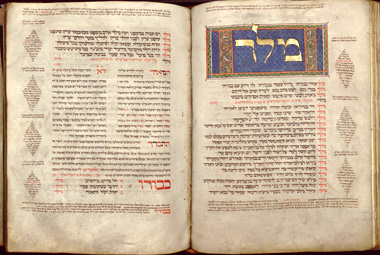
Nuremberg Mahzor, 1331

The Ninth of Av is around the corner; here is a short post on an unusual qina (lament) from medieval Ashkenaz…

The Nuremberg Mahzor is a fourteenth century prayer-book according to the eastern Ashkenazi rite. The illuminated manuscript contains not only breathtaking artwork but also important payytanic texts, some of them unattested anywhere else in medieval manuscripts. Among these piyyutim is an unusual qina for the Ninth of Av that relates an imaginative dialogue between the Crusaders and the Jewish people.

The qina opens in medias res with the following verses:

“Come with us, you of smitten cheeks,”                                                                                           Say the uncircumcised and the unclean, my smooth-tongued enemies.                                     “We  are on our way to the land of the lovely diadem, the radiant land.                                   We  shall attack and plunder the spoil of the fortified cities,                                                       There we shall take our share, to each man two lengths of dyed cloth.”                                                                   (Translation by T. Carmi, in his The Penguin Book of Hebrew Verse)

The awkwardness of this call had led Haim Hillel Ben-Sasson many years ago to explain that “the impact of the crusader climate opinion was so widespread that during one of the crusades the writer of a lament wrote as though crusader excitatoria (propaganda letters) were addressing the Jews” (A History of the Jewish People, p. 416). More recently, Elisabeth Hollender discussed the qina and wrote: “it is startling to see that here even the liturgical space, the communication with God, is not free from the fear of Christian attractivity… Israel cannot accept this offer, and it is exactly this refusal that shows the Jewish devotion to their religion, their God, as can be seen in the next passage of the qina”. Indeed the qina continues with harsh criticism of Christianity but also with a bitter sense of desperation from the absence of God and the past leaders of Israel.               This intriguing qina (and other qinot from the Nuremberg Mahzor) is discussed in Hollender’s article that was published recently in Giving a Diamond – Essays in Honor of Jospeh Yahalom on the Occasion of His Seventieth Birthday. The volume (edited by Wout Van Bekkum  and Naoya Katsumata ) was published by Brill and features fifteen essays that deal with various aspects of Hebrew verse and prose compositions from Late Antiquity and the Middle Ages.

Standard
Around the Web, English, Recent Publications

Around the Web – August 4, 2011

Over at The Immanent Frame, Lena Salaymeh (who has organized an AJS session that I’ll be participating in) posted about orality, religion, and secularism by way of the Talmud and law-school forms.

This may be old news for some, but I just saw Steven Notley and Ze’ev Safrai’s new collection of rabbinic parables reviewed at Biblioblog Library.

Standard
English, Recent Publications

Kosher Sects

Since the dawn of academic Jewish studies, critical scholars had a few pet topics.  Chief among these was Jesus of Nazareth and his relationship to Judaism, and Sectarianism.  Indeed, everybody loves sects.

A recent volume, proceedings of a UCL conference, represents the most recent contribution to the study of sectarianism and Judaism – now from a historical perspective.  The table of contents shows that the book has been divided into three sections: Ancient, Medieval-Modern, Theory and Practice. The section on Ancient is most germane to the readers of this blog:

Prologue: How Do We Know When We Are On To  Something? (Albert I. Baumgarten)

Religious Variety and the Temple in the Late Second Temple  Period and Its Aftermath  (Martin Goodman)

The ‘Sectarian’ Calendar of Qumran   (Sacha Stern)

Determining Sectarian by ‘Non-Sectarian’ Narratives in  Qumran (Ida Fröhlich)

The Nazoraeans as a ‘Sect’ in ‘Sectarian’ Judaism?   A Reconsideration of the Current View via the Narrative  of Acts and the Meaning of Hairesis  ( Joan E. Taylor)

Legal Realism and the Fashioning of Sectarians in Jewish  Antiquity ( Christine Hayes)

Of these , the article of greatest interest is Hayes’.  Here is the summary which appears at the end of the article:

The case I have argued is this: despite a surface appearance of great diversity, rabbinic representations of heretics (especially Sadducees and minim) for all their individual differences share a common element—a realist resistance to rabbinic legal nominalism and creative Scriptural exegesis. Ranging from skepticism to incredulity, from ridicule to outright hostility, the resistance of these non-rabbinic others leads ultimately to rejection of both the law and legal authority—either Pharisaic-rabbinic, as in the case of the Sadducees, or in the more extreme case of the min, both rabbinic and Scriptural. I have argued that the literary representation of heretics in classical rabbinic literature is rooted in a historic phenomenon: a divergence in legal epistemologies that can be traced to the late Second Temple period, involving (a) groups, often with a priestly orientation, who favored an approach to the law that placed a high value on epistemological certainty, and (b) a group or groups who were willing on occasion to set aside considerations of “the way things really are” in the determination of the law. The former viewed as absurd the nominalist tendency of the latter to overrule determinations of law that commanded a high degree of epistemological certainty, a tendency found in Pharisaic and later rabbinic law

It’s published by Brill, and we all know what that means, but you can still read the volume at your local, academic library.

Standard
English, Postscripts

Post Script: Hayim Zalman Dimitrovsky

This past Sunday, Professor Hayim Zalman Dimitrovsky was laid to rest in his hometown of Jerusalem.  Professor Dimitrovsky was one of the greatest talmudic philologists of the previous century, and his research included pioneering talmudic higher criticism, scientific editions of medieval talmudic commentators, a collection of fragments of early Spanish talmudic prints accompanied by an indispensable guide to this phenomenon, and intellectual biographies of  schools of talmudic study.  Professor Dimitrovsky merited to learn with some of the greatest Talmudists of the early twentieth century, including J.N. Epstein and Simcha Assaf.  More importantly, from his post at the Jewish Theological Seminary and later, at the Hebrew University Talmud department, he succeeded in raising generations of scholars who not only continued his work, but advanced the field in completely new (and different) directions.  His death is a loss not only for his family, friends, students and colleagues, but for the field at large.  He was the last of a generation.

In the coming days, the Talmud blog will be sharing brief remarks in memory of Prof. Dimitrovsky from those who knew him best. May his memory be a source of comfort to all who studied with him, and all who have studied his works.

Standard
English, Reviews

Protestant Mishnah

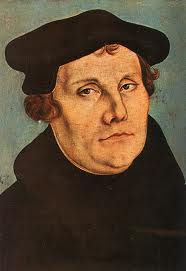
Lucas Cranach’s portrait of Martin Luther, 1529.

A serendipitous combination of circumstances brought Jonathan Z. Smith’s Drudgery Divine and Hanan Gafni’s Peshutah shel Mishnah to my shelf side by side. Gafni’s brand-new book, based on a dissertation written under the supervision of Jay Harris at Harvard, is written in beautiful and clear Hebrew and attempts to introduce the uninitated reader into the complex and fraught world of Mishnah scholarship in its infancy.

The Mishnah has two strands of textual tradition: the Babylonian and the Palestinian. Yaakov Zussman, through his command of the Mif’al Hamishna, claims  that there are no Mishnah  manuscripts that follow the tradition of the Bavli. This is no coincidence, per Zussman: the Babylonian tradition – of which all extant Jewish communities are heirs – did not prize the study of Mishnah on its own. The Mishnah was to be studied in conjunction with the Bavli. When Maimonides wanted to write a commentary on the Mishanh, he had to use a Palestinian Mishnah manuscript and sometimes update it to keep it in line with the Mishnah or the halakha of the Bavli.

The first edition of the Mishnah was printed in Naples, in 1502, with Maimonides’ commentary. Ovadia of Bertinoro published a commentary in Venice, in 1549. Study of the Mishnah on its own regained some ground in Kabbalistic circles in 16th century Safed – R. Joseph Karo’s supernatural Maggid was in fact the Mishnah personified.

But Gafni’s study begins in earnest somewhat later, scouring Kabbalistic works from the Lurianic school for oblique references to “Peshat and Derash” in the Mishnah. These references – that give his book its name – were the seedling that allowed Mishnah scholarship to begin in the school of the Vilna Gaon.

Gafni surveys scholars by geography, beginning with Safed, then Lithuania, Italy, Galicia, Germany and then, finally, Vienna. Scholars are selected, described and their work is discussed. Each chapter ends with an example, that is useful for understanding the real meaning of the figure’s work – often readers of such books end up knowing so little about the actual substance of the work. Many of the debates important to the interface between Jewish studies and Jewish people in our time are echoed in these sketches: should scholars be engaged in the issues of their communities? Should they bring their religious agendas to their work with them?

But for me – reading Smith at the same time – the striking point was the Protestantism of it all. The idea that these early Mishnah scholars had, that at some time in Jewish history there was a moment of purity, of clarity, when everything was pristine and not mangled up by the Talmud and its casuistry strikes a note that Smith hears elsewhere. Just as early study of religion was focused on highlighting the “uniqueness” of the one Religion – i.e. Apostolic Christianity, through a Protestant lens- so perhaps early study of Judaism by Jews was marked by their aversion to the Talmud (read: Bavli), its embarrassing complication, superstition, and stringency. The Bavli was the repository of choice for the shame Jews had of their own religion; as the protestants blamed the “rabbins” for the Jews and their strangeness, the Maskilim blamed the Bavli. Then, when they began to study the Mishnah as a work unto itself, this added another layer of embarrassment: really, the Bavli couldn’t understand the Mishnah at all!

The field in fact took over a century to recover. Only David Halivni and Eliezer Rosenthal, neither a “natural” heir to this tradition, both steeped in traditional talmudic study that they did not hate, were able to bring the Bavli back into the limelight. Numerous lessons were learned from this retreat from the Bavli, as well: first, that there are other texts besides the Bavli, and second, that the Talmud is neither stupid or superstitious. It is an interesting and complex product of its time and place – and that it is, on a most basic level – still not really understood.

Standard