English, Readings

Sins Without Borders

The confession of sins is a key feature in the classical Jewish process of atonement in general and in the Yom Kippur liturgy in particular. The obligation to confess during Yom Kippur appears already in the Tosefta (Kippurim 4:14) where we also find, in the words of Rabbi Yehuda son of Patera, that one has to specify each individual sin. Rabbi Aqiva disagrees with that opinion but R. Yehudah’s opinion was codified and made part of the liturgy. See for example the following passage from Maimonides’ Mishne Torah, Hilkhot Teshuva:

How does one confess? He says: ‘Please God! I have intentionally sinned, I have sinned out of lust and emotion, and I have sinned unintentionally. I have done such-and-such and I regret it, and I am ashamed of my deeds, and I shall never return to such a deed.’ That is the essence of confession, and all who are frequent in confessing and take great value in this matter, indeed is praiseworthy (chapter 1).

The list of sins that appears in almost every medieval prayer books consists of forty four sins, two for each letter of the Hebrew alphabet. Every line opens with the formula על חטא שחטאנו לפניך (for a sin that we have sinned before you) followed by the individual sin. The list had become so standard that it can be hardly regarded as authentic or personal in any way. Interestingly in a few medieval manuscripts we find unique lists of sins. Many of the sins in such lists are quite obvious, such as בביטול תורה (in not studying Torah) or בחילול שבת (profaning the Sabbath). However frequently we find very innovative sins such as בגילוח זקן and בגידול בלורית (shaving the beard and growing forelock) or בחימוד בגדים and בחימוד נשים (desire for cloths and desire for women).  Below is a list of the most unusual sins I found in these sources: ביין נסך (in non kosher wine), בהילוך על גבי עשבים בשבת (in walking on grass on the Sabbath), בהריגת בריה בשבת (in killing a creature [e.g., insect] on a Sabbath), בלימוד שלא לשמה (in studying the Torah not for its own sake), בקטטה בבית (in a quarrel at home), בתפלה שלא בכוונה (in prayer without the proper intention),  בתרדמה בבית התפלה (in falling asleep in synagogue), בצער בעלי חיים (in causing animals to suffer), בתשמיש (in having sex), לגרום רעה בזרעינו (in wrongdoing with our sperm), בפנות לאלילים (in worshiping idols) and בעובדינו בקרוב להם (in worshiping near them). Such lists of sins are not only very interesting but also very useful for socio-historical studies that seek to explore the everyday practices and beliefs of medieval Jewish societies, a task that I hope to embark on in the near future.

Perhaps the most unusual sin, or at the very least the most awkward formulation, I came across is found in a prayer book according to the Fez (a city in Morocco) rite, in which the confession open with the following sin על חטא שחטאנו לפניך באהבת אדם (for a sin that we have sinned before you in the love of a person). Suggestions for what that sin might be would be greatly appreciated.

And an easy fast (צום קל) for those observing.

Standard
English, Recent Publications

The Safrai Revolution

We all have our coping mechanisms. I really do enjoy the soaring liturgy of Rosh Hashana, the tunes, the gravitas. But everyone has their limits. To get through the marathon sessions in shul, an interesting book is quite simply, indispensable. This holiday, it was the latest volume of Mishnat Eretz Yisrael tractate Rosh Hashana (2011). Like previous volumes, the book represents the intellectual fruits of study sessions held in the Safrai  family.  The text of the Mishna includes both the ed. princ. alongside the celebrated Kauffman manuscript, which unfortunately is not reproduced in the clearest manner.  The commentary, referred to as the  “Safrai commentary” is historically and sociologically oriented (whatever the latter is supposed to mean). I picked up Mishnat Eretz Yisrael previously, but this Rosh Hashana I had enough time to get through almost the entire volume, start to finish.

There are plenty of readings that I disagreed with, instances that I thought the scholarly judgment was “off,” and many times that I found the commentary stray well beyond the matter at hand. And yet as a cultural phenomenon – a new edition of Mishna that incorporates academic insights and presents them to a non-academic public (that is, beyond the sphere of S. Jerusalem, where as the saying goes, even the milkmen are learned) – I think it is a great accomplishment.  In certain respects, it recalls the Da’at Miqra series. Yes, there are serious and even fatal flaws in the approach taken by the project as a whole and even in some of the better volumes. But the fact remains that the series was successful in introducing certain (selective) aspects of the academic study of the Bible into the Orthodox Jewish sphere.  I have to say that the Safrai Mishna does it much better, and from an Orthodox theology perspective, will encounter far less resistance from the Orthodox public.  It also. I believe, has the potential to travel far beyond the confines of Israeli Orthodoxy, if it is only marketed properly, and if future volumes are just a little prettier.

Standard
English, Events, Guest Posts

The Burning of the Talmud in Rome on Rosh Hashanah, 1553- Guest Post by Menachem Butler

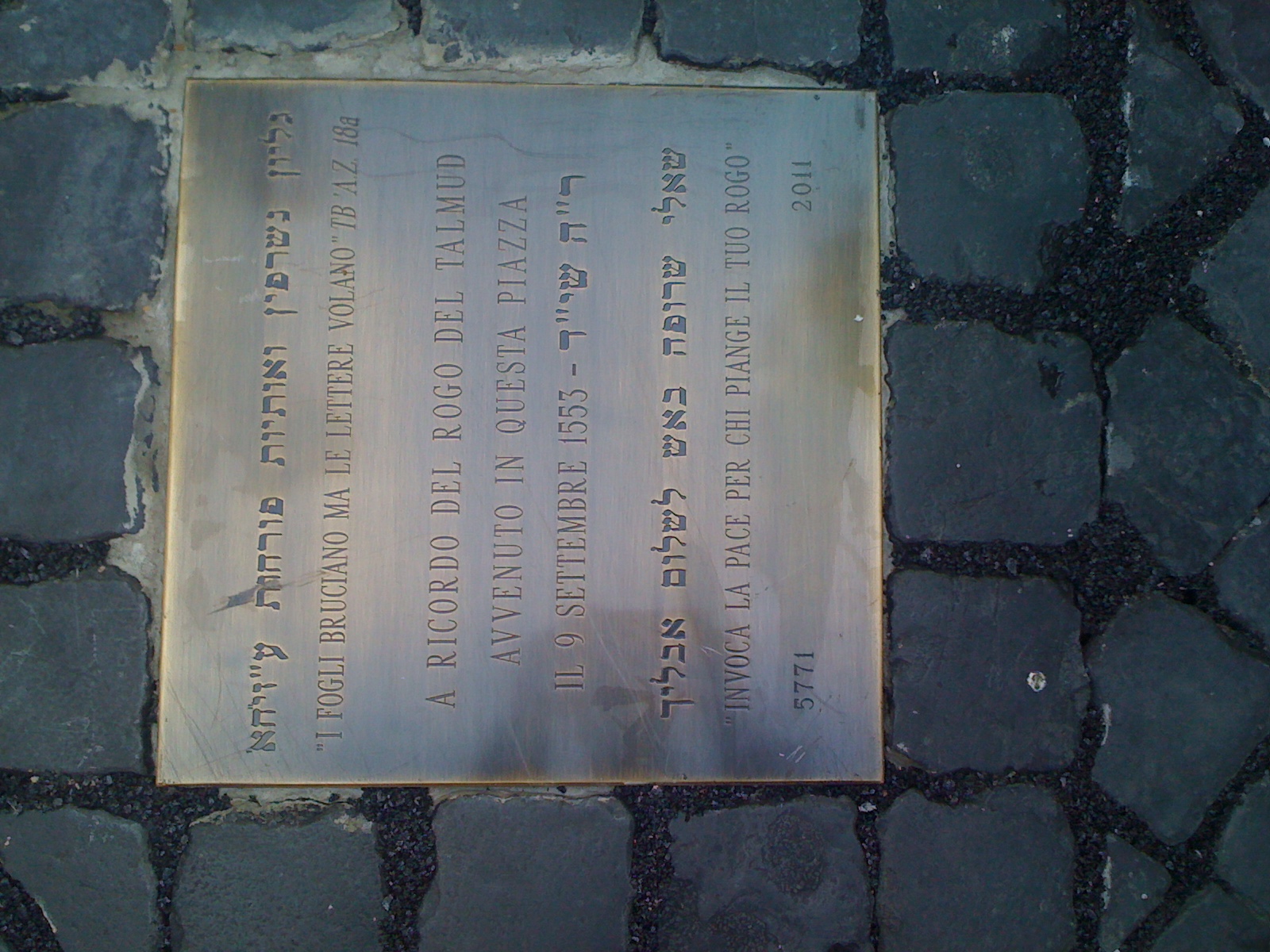
Last Monday I received a most fascinating email from Chief Rabbi Riccardo di Segni, MD, of Rome, with a picture of a plaque unveiled just the previous afternoon in the market place of Rome to commemorate when, in 1553, the Inquisitors confiscated every copy of the Talmud in Italy; the search took about nine days. On Rosh Hashanah 5314 (9 September 1553), the Talmud and many other Jewish books were burnt in the Campo dei Fiori. Throughout the remainder of the sixteenth-century, a complete edition of the Talmud could not be found anywhere in Italy. Chief Rabbi Riccardo di Segni described this event as “the beginning of the persecution of the Jewish printed book, after that of manuscripts.”

The idea for this plaque placement came after the Boyarin family of Berkeley, California, toured Italy a half-dozen years ago. As Prof. Daniel Boyarin described in remarks delivered at an event celebrating the completion of Rabbi Adin Steinsaltz’ Talmud translation into Italian at the Campo dei Fiori in November 2010, the idea was conceived “[f]ive years ago when we walked in this beautiful place, [and Chava Boyarin] observed the statue in memory of Giordano Bruno’s martyrdom here, and remarked that there was no memorial for the wagon-loads of Talmud manuscripts and books burnt here in 1553.”

Professor Daniel Boyarin’s entire remarks are transcribed below and a recording is available here. At the event last year, it was announced that a permanent plaque would be affixed at that location in time for this year’s Rosh Hashanah, 458 years after the Talmud was burnt at that very location. Chief Rabbi Riccardo di Segni sent me the picture below of the plaque that now rests on the street of the marketplace in the Campo dei Fiori.

Chief Rabbi Riccardo di Segni told me that in the week since the plaque has been affixed, many tourists and local residents have passed through the marketplace and have stopped to learn about the event that took place at that very location in 1553. “Many tourists who casually crossed the square yesterday were Jewish,” he wrote to me. “One of them told me that he was a young boy who escaped from Berlin in 1938, so he knew what burning of books means, and he was deeply moved by this commemoration. After 458 years, we remember.”

As you can see in the picture, the text of the plaque is in Italian, with two quotations in Hebrew. The first is a quote from the Talmud (Avodah Zarah 18a), which offers the Talmudic account of the martyrdom of R. Hannaniah b. Teradyon. The second passage is from the elegy, Sha’ali Serufah ba-Esh, composed by Rabbi Meir ben Baruch, Maharam of Rothenburg, upon seeing the wagons of Talmudic manuscripts and commentaries burnt in a Paris marketplace in 1242. Sha’ali Serufah ba-Esh is among the most powerful elegies read on Tisha be-Av within Ashkenazic communities worldwide.

The Talmudic account of the martyrdom of R. Hannaniah b. Teradyon, who was burnt alive while wrapped in a Torah scroll, has been described by Moshe David Herr, “Persecutions and Martyrdom in Hadrian’s Days,” Scripta Hierosolymitana 23 (1972): 85-125, esp. 110-119 (Hebrew); Gerald J. Blidstein, “Rabbis, Romans, and Martyrdom: Three Views,” Tradition 21:3 (Fall 1984): 54-62; Daniel Boyarin, Dying for God: Martyrdom and the Making of Christianity and Judaism (Stanford: Stanford University Press, 1999); and Daniel Boyarin, “A Contribution to the History of Martyrdom in Israel,” in Daniel Boyarin, Menachem Hershman, Shamma Friedman, Menahem Schmelzer, and Israel M. Ta-Shma, eds., Atarah Le-Hayim: Haim Zalman Dimitrovsky Jubilee Volume (Jerusalem: Hebrew University Magnes Press, 1999), 3-27 (Hebrew); Joseph Dan, “Narrative of the Ten Martyrs: Mysticism and Martyology,” in Hana Amit, Aviad Hacohen, and Haim Beer, eds., Mincha le-Menachem: A Collection of Essays in Honor of Rabbi Menachem Hacohen (Tel-Aviv: haKibbutz haMeuchad, 2007), 367-390 (Hebrew), and broader on The Ten Martyrs, see Jan Wilhelm van Henten, “Jewish and Christian Martyrs,” in Marcel Poorthuis and Joshua Schwartz, eds., Saints and Role Models in Judaism and Christianity (Leiden and Boston: Brill, 2004), 163-181; and Ra’anan S. Boustan, “The Hagiographic Vita of a Priestly Rabbinic Martyr: The Figure of Rabbi Ishmael in The Story of the Ten Martyrs,” in Martyr to Mystic: Rabbinic Martyrology and the Making of Merkavah Mysticism (Tübingen: Mohr Siebeck, 2005), 99-148.

For scholarly discussions on the 1553 burning of the Talmud in Campo dei Fiori, see Avraham Yaari, The Burning of the Talmud in Italy (Tel-Aviv: Abraham Zioni, 1954; Hebrew), reprinted in Studies in Hebrew Booklore (Jerusalem: Mosad ha-Rav Kook, 1958), 198–234 (Hebrew); Kenneth R. Stow, “The Burning of the Talmud in 1553, in Light of Sixteenth-Century Catholic Attitudes Toward the Talmud,” Bibliothèque d’Humanisme et Renaissance 34:3 (September 1972): 435-449; Kenneth R. Stow, Catholic Thought and Papal Jewry Policy 1555-1593, Moreshet Series, vol. 5 (New York: Jewish Theological Seminary of America, 1977), 49-50, 54-59; as well as the more-recent scholarship by Amnon Raz-Krakotzkin, “Censorship, Editing and the Reshaping of Jewish Identity: The Catholic Church and Hebrew Literature in the Sixteenth Century,” in Allison Coudert and Jeffrey S. Shoulson, eds., Hebraica Veritas?: Christian Hebraists and the Study of Judaism in Early Modern Europe (Philadelphia: University of Pennsylvania Press, 2004), 125-155; Amnon Raz-Krakotzkin, “The Burning of the Talmud,” in The Censor, the Editor, and the Text: The Catholic Church and the Shaping of the Jewish Canon in the Sixteenth Century, trans. Jackie Feldman (Philadelphia: University of Pennsylvania Press, 2007), 32-56, 211-222; Fausto Parente, “The Index, the Holy Office, the Condemnation of the Talmud and Publication of Clement VIII’s Index,” in Gigliola Fragnito, ed., Church, Censorship and Culture in Early Modern Italy (Cambridge: Cambridge University Press, 2001), 163-193, which was drawn to my attention by Prof. Ariel Toaff; and most-recently (in a volume just published last week), in Piet van Boxel, “Robert Bellarmine Reads Rashi: Rabbinic Bible Commentaries and the Burning of the Talmud,” in Joseph Hacker and Adam Shear, eds., The Hebrew Book in Early Modern Italy (Philadelphia: University of Pennsylvania Press, 2011), 121-132 (chapter six), available here.

About the burning of the Talmud during June 1242, see Susan L. Einbinder, Beautiful Death: Jewish Poetry and Martyrdom in Medieval France (Princeton: Princeton University Press, 2002), 70-99 (Chapter three: “Burning Jewish Books”), and for the text of Maharam mi-Rothenberg’s Sha’ali Serufah ba-Esh, see Daniel Goldschmidt, ed., Seder ha‐Kinot le‐Tisha be‐Av (Jerusalem: Mosad ha-Rav Kook, 1972), 135-137 (no. 42) (Hebrew), which appears in English translation in Robert Chazan, ed., Church, State, and Jew in the Middle Ages (New York: Behrman House, Inc., 1980), 229-231, and in slightly modified form in Susan L. Einbinder, Beautiful Death, 76-78. The complete entire audio recording of Professor Daniel Boyarin’s remarks at the Campo dei Fiori is available here, and Rabbi Steinsaltz’ remarks are available here.

Five years ago when we walked in this beautiful place, [Chava Boyarin] observed the statue in memory of Giordano Bruno’s martyrdom here, and remarked that there was no memorial for the wagonloads of Talmud manuscripts and books burnt here in 1553.

‘Once these books are removed,’ an advisor to the Roman Inquisition had written, ‘it will soon result that the more that they are without the wisdom of their rabbis, so much more will they be prepared and disposed to receive the Christian faith and,’ what he calls, ‘the wisdom of the word of God.’ This Inquisitor well understood one thing. He understood that the Talmud and the study of Talmud are what have sustained the Jewish People and kept us against all odds alive and thriving. The wisdom of our rabbis is the word of God, and it this that has kept us faithful to the word of God ’till this day.

In Rome, the Inquisition raged while in the Benedictine monastery at Camaldoli near Arezzo, sat the Florentine humanists who studied the Talmud and Kabbalah together with rabbis. Giordano Bruno, whose own martyrdom, some 20 years after that of the Talmud here, was in large part owing to his having been influenced by those humanists and their interest in Jewish holy books. The placing of this plaque today thus closes the circle and indicates to us that it is not the Inquisition that has won the day, but the spirit of Camaldoli. Today in Rome, Jews and Christians study the Talmud and others of our shared holy books, not only with each other but with Muslims as well. Bruno might have dreamed that this would happen.

Daya le-Chakimah be-Ramiza, “a hint to a Sage is sufficient.” I only had to make the suggestion to the Rabbi of Rome, Rav Riccardo di Segni, and the process was set in motion that has brought us here today. Chazak u-Varukh!

Not only is this a day of mourning; however, it is also a day of celebration. Safadnu Et ha-Talmud Kan, ve-ha-Yom hi-Kimu Yeshiva al-Kivro. We have mourned and memorialized the Talmud in this place, and Rabbi Steinsaltz, shlita, has built a yeshiva on what was intended to be its grave.

The spirit of Bruno has been vindicated, but also the Talmud itself. For while the Inquisition sought to end all Talmud and Talmudic study, more people study the Talmud today than ever before in history, in large part due because of the great, and now completed, Baruch Hashem, project of Rabbi Steinsaltz, shlita.

We mourn the burnt holy books and rejoice together on the completion of this commentary on the Talmud.

Menachem Butler is the co-editor of the Seforim blog. This is his first contribution to the Talmud blog. 

Standard
Around the Web, English

GoogleDSS!

In its continued mission “to organize the world’s information and make it accessible and useful”, Google, in partnership with the Israel Museum, has developed an absolutely beautiful and powerful site for the viewing of the following Dead Sea scrolls:

  • The Great Isaiah Scroll
  • The Temple Scroll
  • The War Scroll
  • The Community Rule Scroll
  • The Commentary on Habakkuk Scroll
Google plans on digitizing more scrolls and fragments in order to eventually create “the first comprehensive and searchable database of the broader collection of scrolls“.

I haven’t spent this much time on Google since they re-digitized PacMan!

Standard
English, Recent Publications, Reviews

Footnote’s Footnotes

The latest Jewish Review of Books just arrived in my mailbox today. I have a review, co-written with Elli Fischer, of Joseph Cedar’s talmudic superdrama, Footnote.  We deal with a number of things in the review, including the movie’s “texture” and its use of cinematic footnotes. We also consider some of the gender implications of the movie, especially vis a vis Israeli masculinity (though there was not enough space to deal with the near total absence of women from the film, and the implications of that). Speaking of “gender” as much as possible we tried to get beyond the academic gossip that engendered the film and which the film itself engenders.  It is pretty much all anyone in Jerusalem discusses these days, aside from heavy philology. But fear not, the gossip is still there, if you look for it.

There are other interesting articles in the issue, including a timely one by Moshe Halbertal about law and forgiveness (and narrative) in the Talmud. The two names that lurk at every turn in his reading are “Robert” and “Cover”.  But for some reason, they go unmentioned.

Standard
English, Technology

Digitization at JTS

In a comment a few posts ago, JTS’ new digitization project was brought to the attention of the Talmud Blog by the indefatigable maven of online resources, S. Luckily, I’ve been working out of the JTS library for the past couple of weeks and was able to catch Joseph J. and Dora Abbell Librarian Prof. David Kraemer for a brief chat on the library’s various digitization projects.

Manuscript digitization at JTS can be divided into three categories. First, the genizah material from the ENA collection is nearly available in its entirety via Friedberg. Some of the fragments had been available already on earlier versions of the Lieberman database, but even those have been re-photographed for FGP.

Hebrewmanuscripts.org includes pictures of microfilmed manuscripts. While the images aren’t the best, the process was quick (the site now includes material from HUC as well).

Since they last microfilmed their manuscripts in 1990, JTS has acquired another 800-900 items. The funds originally intended for the microfilm of these manuscripts have been reassigned for a digitization of them. So far around 100 have been taken care of. These manuscripts don’t have surrogates and therefore take priority over other items in the library’s collection. After they are done being digitized, the focus will be turned to the most artistically distinguished manuscripts, some of which are already available through their Special Treasure site.

Under the leadership of Prof. Kraemer, the JTS library seems well qualified to take on the exciting challenges of the digital age. For more information on their projects I would suggest checking out their Facebook page.

Apology: This post was originally published before being finished while travelling from my iPad to my computer. Funny how a post on digitization would suffer from its author’s own digital ineptitude…

Standard
English, Recent Publications

Social Justice

Some of the scholars working in the field of Rabbinics are philologists, some teachers, and some are activists of some sort or another.  Recently, Aryeh Cohen launched a new blog that accompanies his forthcoming book, Justice in the City, due out this month. It looks like it will be a fascinating amalgamation.  From the publisher’s description:

Justice in the City argues, based on the Rabbinic textual tradition, especially the Babylonian Talmud, and utilizing French Jewish philosopher Emmanuel Levinas’ framework of interpersonal ethics, that a just city should be a community of obligation. That is, in a community thus conceived, the privilege of citizenship is the assumption of the obligations of the city towards Others who are not always in view—workers, the poor, the homeless. These Others form a constitutive part of the city. The second part of the book is a close analysis of homelessness, labor and restorative justice from within the theory that was developed. This title will be useful for scholars and students in Jewish Studies, especially Rabbinic Literature and Jewish Thought, but also for those interested in contemporary urban issues.

Standard
English, Recent Publications

Zion 76:3 published

The latest issue of the journal Zion has just been published. Yehudah Cohn’s book, Tangled up in Text, is reviewed (once again!), now by Yonatan Adler.  This time around, the reviewer is far more skeptical (and ironically, therefore, traditional).  It seems like a good and constructive review that does more than outline the book and praise it. It asks some serious questions, which Cohn is obviously well aware of.

Also in the issue, Michal Bar-Asher Siegal publishes an article, “The Making of a Monk-Rabbi: The Background for the Creation of the Stories of R. Shimon bar Yohai in the Cave,” which is based on her 2010 Yale University dissertation.


Standard
Announcements, Around the Web, English

Around the Web- September 20, 2011

First, in local news, we’d like to formally announce the opening of our Twitter account. You can now follow us @TalmudBlog. Thanks to our handy-dandy twitter-widget, our updates appear on the blog itself as well.

The new issue of the “Safranim’s Blog” just came out. The Hebrew language blog brings together the wise words of various Jewish Studies librarians from around Israel. This issue seems to be geared toward Rosh haShanah.

An Israeli organization called “Matmonei Aretz” (“מטמוני ארץ”) announced “the establishment of a Talmudic Museum in Jerusalem”.  The museum is dedicated to emulating the every day life of the Rabbis and is based on the scholarship of Prof. Ze’ev Safrai.

In related news, The Forward’s Philologos explains the meaning of the phrase “yarchei kallah” (h/t). The author seems to be unaware of the theory put forth by I. Gafni in his article “Nestorian Works as a Source for the History of the Yeshivot of Babylonia” (Tarbiz 51), on pages 572-73. Here’s a preview of Gafni’s theory:

אין צורך לומר, שגם מטבעות־לשון וביטויים הקשורים לעולם הלימוד יכלו לנוע במסגרת הממלכה הססאנית מדיאלקט ארמי אחד למשנהו. כאן ראוי להעיר — אמנם בדרך של השערה בלבד — על מושג מעניין, המופיע בתקנות בית־הספר בנציבין. בידוע, רבו ההשערות בדבר האטימולוגיה והמשמעויות הראשוניות של תיבת ׳כלה׳ בתלמוד ובספרות הגאונים, הן כתיבה בודדת והן בצירופיה השונים: ׳ריש כלה׳, ׳בני כלה׳, ׳יומי דכלה׳ ועוד. והנה, בתקנות נציבין נזכר כמה פעמים, כי התלמידים מתגוררים ב׳קליתא׳…

PaleoJudaica referred his readers to the The New York Times’ mention of a new exhibit on the Dead Sea Scrolls opening up in New York this October. From The Times:

The producers describe the show as one of the most comprehensive of its kind ever mounted; it will also include an in-scale re-creation of the Western Wall in Jerusalem, with a three-ton block of stone from the wall itself.

The following item isn’t news per se, but I did come across it recently and it is located somewhere “around the web”. Islamicmanuscripts.info includes dozens of interesting PDFs on, well, Islamic manuscripts, found in its “reference” section. The site also has some Jewish Studies classics like M. Beit-Arie’s Hebrew Codicology. Due to copyright issues, “all publications… have a read-only restriction and cannot be printed.”

Standard
English, Guest Posts

Thoughts on Near Eastern Legal Culture- Guest Post by Lena Salaymeh

This post is the first in what will be an ongoing series introducing our readers to the work of young scholars engaged in new and interesting research. 

I usually describe my research interests as being comparative Jewish and Islamic law (or legal history), but that depiction is often misleading.  The term “comparative” assumes two distinct legal traditions that interact in discernible ways.  But in the context of Jewish and Islamic legal history, my conception and implementation of “comparative” is more akin to thinking and to speaking in “proto-Semitic.”  As a metaphor, “proto-Semitic” offers a useful heuristic for thinking through how we approach the study of Jewish and Islamic law.  If you imagine scholars of Jewish law articulating their ideas in Hebrew and Aramaic, while scholars of Islamic law articulate their ideas in Arabic, then my objective is to converse with both groups of scholars in a meta-language (proto-Semitic) that engages both legal traditions.  Just as “proto-Semitic” is the common ancestor of the Semitic language family, Near Eastern legal culture is the shared antecedent of Jewish and Islamic legal systems. Undeniably, the challenge is that proto-Semitic no longer exists as a spoken language and is instead a scholarly reconstruction of a language that may have existed.  Similarly, I am interested in recreating the discourse of Near Eastern legal culture in the late antique and medieval periods using terminology and ideas from law, history, and critical theory.  While diglossia (in this case, speaking both in a Semitic dialect and in proto-Semitic) is inevitable, my objective is to transcend disciplinary boundaries.

My “proto-Semitic” perspective on the subject of my research differs considerably from the viewpoint of colleagues who assume that my research interest is “religious law.”  However, there are several interrelated problems in “religious law” as a category.  In contemporary discourse, the modern bifurcation between “secular” and “religious” law is taken for granted, but it lacks historical resonance.  There is a common presumption that the “essence” of religions is their laws, but this oversimplifies the multi-dimensional nature of religious groups and movements.  Instead of “religion,” I prefer more precise terminology in scholarship and in public discourse: theology, spirituality, ritual, belief, ideology, orthodoxy, orthopraxy, customary practice, local culture, and identity.  In focusing on the syncretic and dialectical relationships within Jewish and Islamic legal history, I am also mindful of Roman provincial, Sasanian, and Near Eastern tribal legal traditions.  In so doing, I seek to contextualize (and to broaden) the study of Islamic and Jewish legal history within a shared “proto-Semitic” legal culture.  I often invoke historical evidence from other (i.e, other than Islamic or Jewish) Near Eastern legal traditions precisely in order to substantiate the existence of Near Eastern legal culture.  Legal culture, based in a specific social space and time, is a more effective category of analysis for my work than “religious law.”

Relatedly, the word “religion” does not have a Semitic (and possibly proto-Semitic) equivalent.  “Religion” is a perplexingly problematic term for my research because it is both anachronistic and untranslatable.  In Arabic, the term “din” is translated as “religion,” but the root means “to profess.”  Likewise, in Hebrew, the term “dat” is translated as “religion,” but it means “law.”  The historical usage of both terms does not correspond to modern understandings of religion. This is not mere philological pickiness: if we insist on translating what we observe in Jewish and Islamic historical texts into a discourse about religion (with its modern, Western genealogy), we will stifle more imaginative and unexpected possibilities and interpretations of these texts and their socio-historical contexts.  Historical expressions of Judaism and Islam do not easily correspond to contemporary conventions about religion and it is precisely this complexity that is the basis of my research pursuits.

My commitment to “proto-Semitic” research includes exploring the Islamic legal-intellectual milieu of rabbinic jurists who wrote in Arabic (such as Alfasi and the Rambam) and studying Gaonic legal manuals.  I am working on an article that explores medieval Islamic juristic texts that discuss the possibility of using Jewish law as a source of legal authority.  I plan to contrast these Islamic legal discussions of the ‘other’ with references to Islamic law in Gaonic texts.  In another article, I expect to situate Karaite attacks on rabbinic oral law within debates about the authoritative significance of the legal opinions of late antique Muslim jurists.  As part of my broader endeavor to collaborate with colleagues, Zvi Septimus (Stroock Fellow, Harvard Center for Jewish Studies) and I are formulating a project to explore the intersections between some medieval commentaries of the Bavli and contemporaneous Islamic legal literature.

Recreating “proto-Semitic” is a wide-ranging endeavor that needs institutional groundwork; this is why I complement my research with administrative projects as a coordinator for the Initiative on Muslim-Jewish relations at UC Berkeley’s Center for Middle Eastern Studies.  I am interested in creating a network of scholars and of supporting unrecognized scholarly endeavors.  For example, we are currently trying to find funding to publish an Arabic translation of the Rambam’s Mishneh Torah in order to make this seminal Jewish legal text accessible to scholars of Islamic law who do not read Hebrew.  We are also raising funds to acquire an important collection of Judeo-Arabic midrashic literature from 19th/20th century Morocco, which would supplement UC Berkeley’s previous acquisitions of similar materials from Iraq and Tunisia.  There is much work to be done in the field of Judeo-Islamic legal studies and I have many more ideas and plans for how we can more deeply explore the interconnectedness of Jewish and Islamic legal systems.  I hope we will have opportunities to implement them and to continue rediscovering “proto-Semitic,” as a means of deepening our understandings of Jewish and Islamic legal history.  I invite readers to join me in reconstructing “proto-Semitic.”

Lena Salaymeh is a PhD candidate at UC Berkeley. Her dissertation is titled Late Antique and Medieval Islamic Legal Histories: Contextual Changes and Comparative (re)Considerations.

[Cross-posted at the Immanent Frame]

Standard