English, Readings

Total Disaster

The word אסון is quite rare in the Hebrew Bible. It appears in Genesis 42:38 and 44:19, where it refers to Jacob’s fear of Benjamin’s death. It also appears in the oft-quoted and frequently debated law of the two fighting men who hurt a pregnant woman in Exodus 21:22-23. Neither locus is very good for explaining what the word means exactly, apart from something bad. To make matters worse, in Exodus – the only legal context in which the word appears– the Septuagint goes uncharacteristically off-script and does not translate the term but rather the sentiment of the law. (In Genesis it translates malakisthênai, which probably means “to succumb [to death]; cf. Xenophon Cyropaideia 2.3.3).

In their distress, dictionaries also include several references to Hebrew Ben Sirah: these are supposed to help, since they are in Hebrew, and they are also translated into Greek and Syriac. The Septuagint of Sirach sometimes translates אסון as thanatos, death, but in one place (34:22-23/LXX 31:22-23) the meaning in Ben Sirah is more general:

[…] בכל מעשיך היה צנוע. וכל אסון לא יגע בך.

Be modest in all your doings/and no אסון will touch you

The Septuagint here translates אסון as arrôstêma, a sicknes or illness, and not simply “death”. This is related to the meaning that survived in modern Hebrew, “disaster.” The Biblical meaning of the word – in Genesis and Exodus – is still unclear.

The verse from Ben Sirah, however, had an interesting afterlife in the Palestinian version of the grace after meals. In a geniza fragment (T-S NS 122.39, no picture on Friedberg), we find a rhyme:

ורצון תעטרינו. ומזון תשבעינו. ואסון העביר מקרבינו.

כי אתה הוא יוצרינו וזונינו וזן את הכל.

Crown us with your benevolence, and satiate us with food, and remove אסון from us

For you are our creator and our feeder, and feeder of all [things].

The choice of the word אסון is interesting. The word rarely appears in the Talmuds, and when it does it is quoted from scripture, mostly Exodus. Additionally, here אסון does not seem to mean “death”, rather something more general, an antonym of רצון. And why choose אסון for the grace after meals? Why not something that rhymes just the same and makes more sense in context, like רזון or חרון?

The wording of the blessing is best explained by the immediate context of the word in Ben Sirah; the verse immediately following is

טוב על לחם תברך שפה. עדות טובו נאמנה.

Good (LXX: clearly, lampron) bless bread with lips/the testimony of his good faith.

The verse on “modesty” is in fact a heading for a list of instructions on how to eat and how to bless, and is situated after a segment called מוסר יין ולחם, The Teaching of Wine and Bread. The composer of this blessing knew Ben Sirah, and read וכל אסון לא יגע בך in the context of the blessing for food.

This snippet of Ben Sirah joins other prayers which are based on or influenced by Ben Sirah, such as מראה כהן, said at the end of the Ashkenazi Avoda Service on the day of Atonement, based on Ben Sirah 51, שבח אבות עולם.  Perhaps the entire Avoda Service itself is also based on the same chapter in many ways, but that is for another time and another post.
Standard
English, Recent Publications

Laughing Last

The Oz Vehadar edition of the Yerushalmi has hit the shelves. Apparently it happened last year, but nobody told me. It is nothing short of revolutionary.

The edition itself has been circulating for a number of years now, as the other side of the Artscroll Yerushalmi, but the full edition contains some treats.

First, a preface. The editors review the history of the printing of the Yerushalmi, and list all the commentaries and their sources – which they say they checked against the MSS. They neglect of course to give credit where it is due (MS Escorial of the Yerushalmi was “discovered” in 1977; Hilkhot Hayerushalmi, attributed to Maimonides – perhaps written in his hand – are quoted, but no word about how they were discovered. The first should have been attributed to E.S. Rosenthal, the latter to Saul Lieberman). They also put the text of ed. Venice at the center of the page, noting that MS Leiden was full of mistakes (echoing none other than Zacharias Frankel). The preface also contains an explanation of why it is important to learn Yerushalmi, and what the differences between the Bavli and the Yerushalmi are. The list of Yerushalmi terminology culled from Frankel’s Mevo Hayerushalmi, found in ed. Vilna, is conspicuously missing.

Second, the edition also comes with an incredible upgrade to Baer Ratner’s Ahavat Ziyyon Virushalaim: all the medieval authorities (their names cover a six page list, in three columns) who quoted the sugya or wrote on it are cited and quoted in full. There are no critical notes, and the editions – or MSS – should of course be checked, but this is an amazing step forward. (J. N. Epstein tried to do this almost eighty years ago, and the index cards that were salvaged from Mt. Scopus – the Israeli soldiers used to roll tobacco in them – are the basis of a continuing project by Yaakov Sussman to finish the work. A sample of this work can be found at the end of Haym Soloveitchik’s Hayayin Biyemei Habeinayyim). (Another similar tool, which also provides references to scholarly literature – mostly in Hebrew – can be found here).

Third, the editors are aware of the various MSS of the Yerushalmi, and even some genizah fragments. The latter were known already in ed. Vilna (1924) and are quoted as variants at the bottom of the page. I haven’t checked systematically, and the publishers do not mention if they have other geniza fragments. I suspect that they don’t. Variants from MS Leiden, Vatican, and Escorial are quoted in the margins of the Yerushalmi page.

The page layout itself was changed, and the publishers assure us that this was done in consultation with the Gedolim.
With or without the Gedolim, the set is not yet finished, and the size of the volumes is hulking – the Yerushalmi is printed three times in each volume, each time with a different set of commentaries. The full edition of Zeraim is nine volumes. This would mean about 20 volumes in all. The price tag (NIS 110/volume) is also quite hefty. Despite these shortcomings, this is a serious step forward towards making serious Yerusalmi scholarship easier and more comfortable to do. All we need now is the geniza fragments.

Standard
Around the Web, English

Essential Languages for the Study of Rabbinic Literature

The Early Christianity blogosphere has been abuzz discussing which languages one needs in order to study The New Testament. I thought we should take a stab at raising the discussion with regards to Rabbinic literatures. Here’s my attempt, broken down into different sub-fields (DISCLAIMER: I am a student at the Hebrew University):

  • Palestinian:
    • Primary: JPA, Greek, Latin, Syriac
    • Secondary: German
  • Babylonian: 
    • Primary: JBA (RBA), Greek, Middle Persian, Syriac, Latin
    • Secondary: German, French
  • Medieval:
    • Primary: Arabic, Latin
    • Secondary: German

Knowledge of Biblical, Rabbinic, and Modern Hebrew are taken for granted, although a deeper familiarity through coursework or grammars is also important.

Standard
English, Recent Publications, Reviews

Quotations of ARNB from an Oxford MS

The most recent Jewish Studies Quarterly contains an article by Christoph Berner, “Quotations from Avot de Rabbi Nathan B in MS Oxford (Bodleiana) Heb. c. 24,” JSQ 18 (2011): 217-265.  This takes us back to the good old days of publishing whole portions of rabbinic manuscripts in academic journals. This of course is still quite common in Israel, but less so in the US and Europe.
By the way, the word “quotations” in the article’s title should not be taken as an indication of size.  As Berner writes:

This manuscript is the autograph of the Magen Avot, a commentary on Avot de Rabbi Nathan A composed by Yom Tov ben Moshe Sahalon. As already noted by Schechter in his edition of Avot de Rabbi Nathan, MS Heb. c. 24 does not only contain the entire text of version A, but also vast passages of version B, which are quoted in the commentary. Although the significance of these passages for the study of version B can hardly be overestimated, it was beyond the scope of the editorial project situated in Gottingen to systematically search the voluminous manuscript (341 folios) for B traditions. In consequence, the synoptic edition of Avot de-Rabbi Nathan published in 2006 includes MS Heb. c. 24 as a textual witness of version A only,10 a fact that calls for a separate publication of the B material…

In other publication news, Seth Schwartz’ relatively new book was just reviewed by Eric Stewart at the Journal of the American Academy of Religion. For the most part, Stewart seems to like it.

Standard
Around the Web, English, Recent Publications

Another Synopsis Hits the Web

The Midrash Project of the Shechter Institute of Jewish Studies just added a synopsis of Midrash Qohelet Rabbah. The synopsis was put together by Shaul Barukhi under the guidance of Marc Hirshman and Reuven Kiperwasser, both of whom authored dissertations on Qohelet Rabbah (and in Kiperwasser’s case, also Qohelet Zuta). Hirshman is now at work on an edition of chapters 1-6.

Standard
Announcements, English, Recent Publications

Recently Announced Books

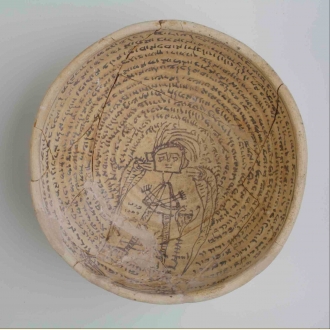
Not just your everyday cereal bowl. From the Bible Lands Museum's exhibit on Jewish Magic.

Eisenbruans has announced a new volume of editions of magic bowls. Aramaic Bowl Spells: Jewish Babylonian Aramaic Bowls Volume One will include bowls from the very important Schøyen Collection, and is being edited by Shaul Shaked, J.N. Ford, and Siam Bhayro. Shaked is one of the foremost authorities on the bowls, and his work has culminated in a slew of articlestwo volumes, and numerous lectures. I had the pleasure of hearing Ford give a talk at a conference that Shai organized last May in which he highlighted many Mesopotamian motifs that he found in the bowls. To top it off, Bhayro brings his expertise on the heterogeneity of pre-Islamic Mesopotamia and on magic texts from the genizah to the volume, which indeed promises to fill a very big gap in printed scholarship.

It goes without saying that the bowls are of utmost importance to the study of Talmud, and especially of the Bavli. Besides the linguistic importance, noted decades ago by Epstein and others, the bowls represent an important window on “the everyday beliefs and practices of the Jewish, Christian, Mandaean, Manichaean, Zoroastrian and Pagan communities on the eve of the Islamic conquests.” For some free content on the topic see here (profile from the Stanford Archaeological Center), here (an article by bowl expert Dan Levine), here (a summary by Shai of a lecture given by Shaked on rabbinic bowls), and here (another summary at the old Talmud blog, of a lecture by Bhayro on divorce motifs in the bowls).

Eisenbraun’s also announced the third edition of Emanuel Tov’s “Textual Criticism of the Hebrew Bible“. In its newest edition, the book, published originally in Hebrew as part of the “אנציקלופדיה מקראית”,

has incorporated the insights of the last ten years of scholarship, including new perspectives on the biblical texts among the Dead Sea Scrolls, all of which have now been published. Here are expanded discussions of the contribution of textual criticism to biblical exegesis and of the role of scribes in the transmission of the text. The introduction and references throughout the book have been thoroughly revised with the beginning student of textual criticism in mind.

Many of Prof. Tov’s articles, and even some of his books, are available on his personal website.

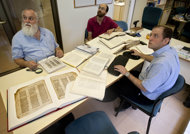
Members of the Hebrew University Bible Project at work. Note the Talmud scholar in the red shirt.

Although this may sound a little too biblical for readers interested mainly in the Talmud, textual criticism of the Hebrew Bible is an invaluable tool for understanding exegetical moves made by the rabbis. There are many instances in which midrashim were based on a text different than that which is before us today in most editions of the Tanakh. Additionally, scholars of rabbinic literature have a lot to bring to textual criticism of the Hebrew Bible, and the volumes of the Hebrew University Bible Project even have a dedicated apparatus of quotes from rabbinic literature.

Standard
English, General Culture, Recent Publications

The Sony Pictures Introduction to Talmudic Studies

A very interesting contribution to Talmudic Studies has just come out, and from a source that only a few months ago would have seemed rather unlikely- Sony Pictures Classics. SPC is distributing Yossi Cedar’s Footnote in North America and has just released the film’s press kit.

After providing a description of Talmudic Literature, the document discusses at length the field of research known as “Talmudic Studies”, dedicating a few paragraphs to “The Talmud Department at the Hebrew University- The Jerusalem School”:

The Talmud Department was one of the first of eight departments that were set up when the Hebrew University was established in 1928, and still exists to this day… The founder of the department, Prof. Yaacov Nachum Epstein, a legendary Talmud researcher with degrees from German universities and once a student of East European yeshivas, solidified the nature of the department that characterizes it to this day.

In light of Epstein’s studies, the Jerusalem school focuses on the bland textual reconstruction of the Talmudic texts and their wording during the preliminary research stages. The winding and unwinding of these long scrolls of ancient texts over the years resulted in many mistakes and errors, which raise doubt as to the authenticity of the text that were obtained. Therefore, before any researcher can ask himself questions that pertain to the content of the text, the concepts conveyed therein, the literary design or the history reflected therein, he must do his best to reconstruct the original text after it was obtained through dubious channels after hundreds of years.

This nondescript textual study, known as ‘philology’, requires extreme diligence. The researcher must collect photographs of the existing manuscripts of the text, some hidden away in libraries and basements around the world, and conduct a meticulous comparison of each and every word. This is painstaking work, rummaging around lost archives to find one more manuscript that will shed light on a baffling sentence in a forgotten text. Endless searching and documentation of small errors made by the Jewish book copier in the Middle Ages, in frozen Europe or remote Yemen, who lost focus for a split second…

This style is not very popular and the Talmud department attracts very few students as opposed to other departments. And among these students, some are forced to leave due to the high scholastic demands and the taxing nature of the work and studies. Nonetheless, many renowned researchers in diverse fields of Judaic studies included this department on their academic route and its academic standards are highly acclaimed in the field of Judaic studies the world over.

The critics of the Jerusalem school claim the exaggerated adherence to details prevents a view of the overall picture, and its members are an exclusive and arrogant clique that has lost its relevance.

The press kit is fascinating in the way that it seeks to provide a background to such a specialized field for the purposes of general culture (a movie).  It is definitely worth checking out.  Maybe someday it will even be considered required reading for Rabbinics courses.

Standard
English, Piyut, Recent Publications

Palestinian Vs. Babylonian Sources from an Unusual Angle

Scholars of Hekhalot literature, much like Talmudists, distinguish between Palestinian and Babylonian layers in the texts they study. The following post is about a rare occasion in which a newly discovered text from the Cairo Genizah potentially changes dramatically what we know about the provenance of ideas, motifs and texts.

Earlier this month another Festschrift was published (yet again by Brill), this time in honor of Menahem Schmelzer from the Jewish Theological Seminary in New York. Everyone interested in late antique and medieval liturgy, piyyut and theology can find many interesting articles in the volume.  Most interesting for the readers of this blog is Michael Swartz‘s piece on Ancient Jewish Liturgy and Mysticism. In a nutshell, Swartz shows that the author of a fifth or sixth century Palestinian piyyut (published a few years ago in Jewish Studies Quarterly by Michael Rand) was acquainted with the ascent narrative pattern in Hekhalot literature . Swartz then singles out the importance of this newly discovered piyyut:

This finding is significant because of how components of the Heikhalot corpus have been dated by several students of this literature, including this writer. The hymnic element, consisting of compositions praising God on his throne and abounding in elaborate descriptions of the angels, has been traced to Palestine in late antiquity. However, it has been argued that the ascent narratives developed in Babylonia and were used to frame these hymns. This source now serves as strong evidence for placing the element of ascent in amoraic and early post-amoraic Palestine, at least for the narratives of Heikhalot rabati and parts of Heikhalot zutrati. (p. 278).

Swartz’s findings not only affect the study of Hekhalot literature but also that of piyyut. We now know that at least some early payytanim were familiar with Hekhalot notions and perhaps more interestingely, that they felt free to include such materials in compositions that were performed in public. Hopefully Swartz’s contribution will provoke interesting reactions from scholars of Jewish mysticism, rabbinic Judaism and Hebrew liturgical poetry from Late Antiquity.

Standard
Around the Web, English, Technology

Some Notes and Questions on Digitization (Around the Web- September 5, 2011)

The Sunday Book Review of the New York Times ran an article yesterday by Lev Grossman on the place of the e-book in relation to the scroll and codex. Grossman outlines what he sees as the weaknesses in reading from digital books by pointing out its parallels with reading from a scroll:

Trying to jump from place to place in a long document like a novel is painfully awkward on an e-reader, like trying to play the piano with numb fingers. You either creep through the book incrementally, page by page, or leap wildly from point to point and search term to search term. It’s no wonder that the rise of e-reading has revived two words for classical-era reading technologies: scroll and tablet. That’s the kind of reading you do in an e-book.

Having himself authored a book entitled Codex, Grossman prefers reading from a bound product like the codex:

The codex is built for nonlinear reading — not the way a Web surfer does it, aimlessly questing from document to document, but the way a deep reader does it, navigating the network of internal connections that exists within a single rich document like a novel. Indeed, the codex isn’t just another format, it’s the one for which the novel is optimized.

People studying Talmud, back in the day.

Which, naturally, leads one to think- “what about the Talmud?”. On the one hand, the book is almost uniformly studied from its Vilna Edition; on the other, its digitization has enabled unprecedented search capabilities which have furthered its study. To make it only more complicated, it seems as though the Talmud’s “authors”, whoever they may be, intended on an oral transmission. Some of the earliest genizah fragments of the Talmud are parts of scrolls, and although they probably saw codexes in the hands of Eastern Christians, the early disseminators of the Talmud could never foresee innovations such as the Vilna Sha”s, Bar-Ilan, or Ma’agarim. This preamble is just so that I can ask how you learn the Talmud- from printed book or computer screen, and why?

In related news, Mississippi Fred Macdowell has some helpful tips on “searching online in Hebrew with imperfect OCR“.

Finally, Yitz (not Landes) reviews the iMishnah app for iPhone and iPad over at Tzvee’s Talmud Blog. This Yitz doesn’t use iMishnah but is an avid iTalmud user. It’s well worth the money but I’m a little hesitant about iMishnah- it doesn’t promise much more than the free “ובלכתך בדרך” app, profiled here by Richard Hidary.

Standard