English, Readings

Potty Mouth

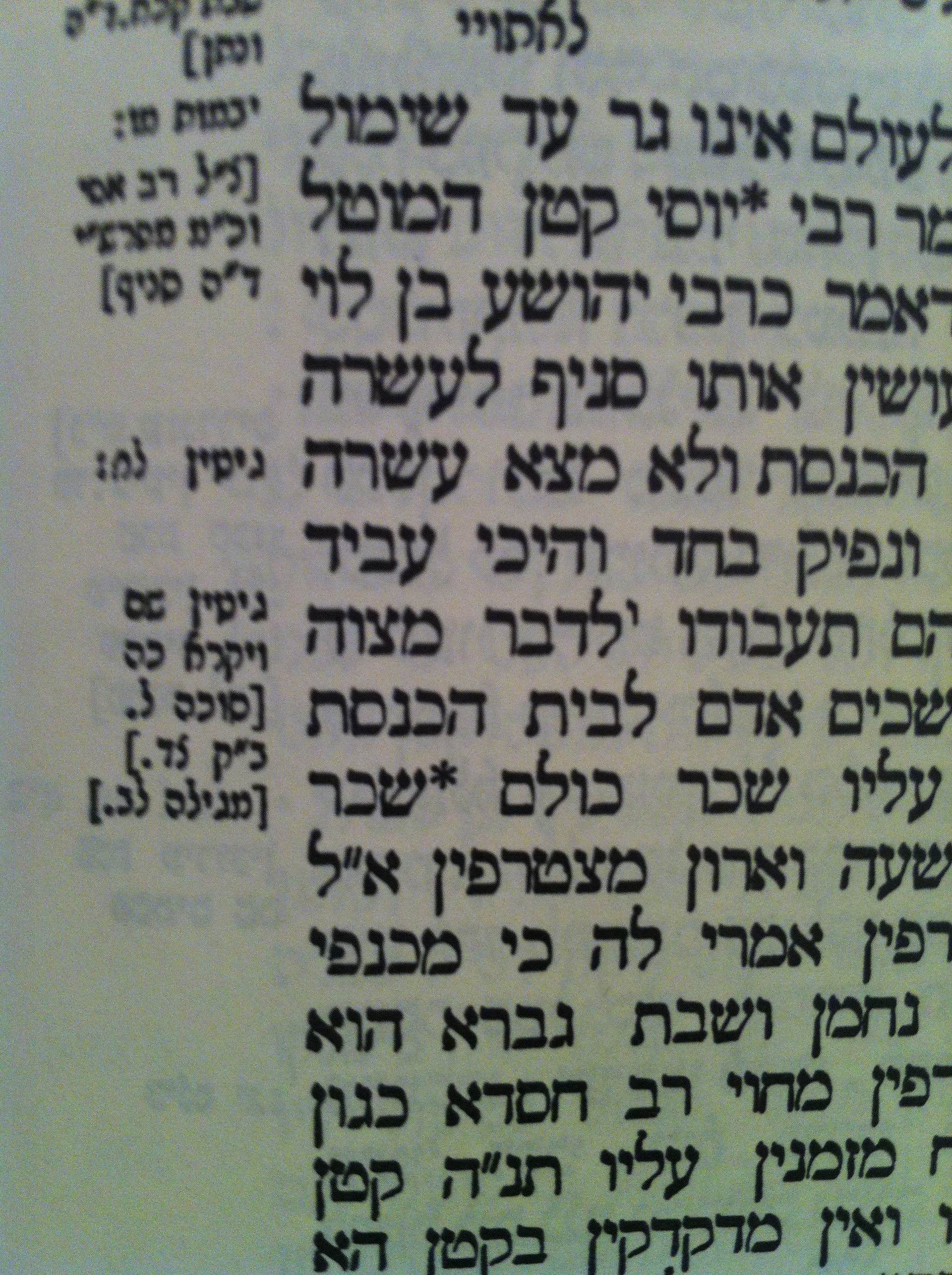
Looking for material for my MA thesis, “Injuries and Battery in Tannaitic Law” – and thus avoiding working on the actual thesis – I came across this entertaining snippet from the recently published S. Emanuel, Teshuvot Maharam meRothenburg vaHaveirav, §308 (pp. 641-642, author unknown):

One who calls his peer a mamzer, should leave the synagogue, and fast Monday and Thursday and Monday, and receive lashes after every fast, and ask for forgiveness at the last one, and give 12 dinar to the Kahal, and walk on (perhaps: to) his (the plaintiff’s) mother’s grave in the presence of 10 (men) and say (at the grave): “everything I spoke against your honor (kevodekh) was a lie.” And (the insulted party) can waive his share and the Kahal can waive their share as well. And the same law applies to a woman, but she is not whipped but she should pay the plaintiff 5 dinar for each lash, and the same applies for every law. And this is the case if for instance she is a widow, but if she is married, and owns no property, then she should write (a promissory note) that if she is widowed or divorced – she will pay. But “A Whore’s son (הורן זון)” is not like “Mamzer.”

Emanuel quotes the Nimmukin of R. Menahem of Mirzburg, the laws of shaming (106b), in n. 4:

There is no law concerning calling a man a whore’s son, since all he said was: you are a son of a whore, and perhaps his mother was simply promiscuous, or perhaps she was not married, but he should not(?) degrate himself and prostrate himself on his mother’s grave.

Two interesting items here are (1) there is a grave and severe penalty for calling someone a Mamzer, although Talmudic jurisprudence rules quite unequivocally that shaming with words does not count as shaming, and (2) that the offence was apparently directed not at the person being shamed but at his mother.

This of course leads one to suspect that in fact this was a penalty for calling someone a “son of a whore” and not simply a Mamzer. A mamzer could have come from any number of forbidden unions, all odious but not all casting shame upon the mother – the child of a rape victim, for instance. But calling someone a “son of a whore” insults their very own mother directly, in which case redress of the injured party is called for.

My guess is “son of a whore” was just too common an insult to force anyone who uttered it to drag him/herself over to the graveyard and apologize to the dead mother. But it might also mean that in this cultural milieu, Hebrew insults were stronger and more real than German ones.

Standard
English, Guest Posts

A Monumental Loss for Jewish Learning- Guest Post by Moriah Be’er Chriki, Yedidah Koren and Davida Klein Velleman

This post, crossposted from The Times of Israel, is the first in a series on the state of advanced Talmud study for women. 

In a world just opening its eyes to the possibility of women’s advanced and committed Torah study, the closing of the Advanced Talmudic Institute at MATAN, an institution which pioneered women’s study of Talmud, is a tragedy.

In the past few decades, the gates of Torah study have been opened to women, tapping into a previously underutilized sector of our community. Our generation has been privileged to witness and experience tremendous progress in the religious education of women, as, one by one, institutes, seminaries, and houses of study for women were established and thrived as centers for learning and teaching Torah.

In accordance with these developments, today’s women have soared to new heights, becoming active participants in realms previously closed to them – as halakhic advisers, as advocates in rabbinical courts, and even as heads of batei midrash (houses of study).

As women who have devoted their time to Torah study, how fortunate have we felt to actively take a part in this world, one which was largely inaccessible to our mothers and grandmothers.

Unfortunately, these advancements are undermined with the closing of our beit midrash, the Advanced Talmudic Institute at MATAN, at the end of this year.

MATAN, the Sadie Rennert Women’s Institute for Torah Studies, was established in 1988. The Advanced Talmudic Institute began its first cohort in 1999, and is a leading program in advanced study for women. The Talmudic Institute offers its students the unique opportunity to delve deep into the world of the Talmud, using both traditional and modern methods to understand this literary and spiritual gem of Jewish tradition. Over the course of the three-year program, students hone their skills and broaden their knowledge, as they strive to impact the world of learning in particular, and society and culture in general. To help build these future scholars, educators, and religious leaders, MATAN offers students a living stipend.

The Talmudic Institute has proven itself over the years, as its graduates have filled a variety of roles in secondary school and higher education, both in Israel and in the United States, and brought sensitivity and knowledge to the religious leadership. This year, 12 fellows comprise the sixth cohort of the Institute.

But, at the end of this year, the Advanced Talmudic Institute at MATAN will be shut down prematurely. Despite the personal obstacles this has created for us, our greater concern is the implication this has for the wider Jewish community.

The Advanced Talmudic Institute at MATAN is one of the only programs for women in Israel that focuses on high-level Talmud study. Closure of the Talmudic Institute will be a huge step back in the world of Torah study for women. Not only will those seeking to learn suffer, but there will be a community-wide impact as well. This powerhouse for training women to be educators in institutions of Torah study will no longer be able to provide the Jewish community with talented and able female leaders. The institutions that have begun to open their doors to women will no longer be able to turn to MATAN to instruct and support aspiring students of Talmud.

Most of the current students at MATAN have studied Talmud in university and will continue to do so. Although we appreciate the important tools that world offers us, do we want to send the message to Jewish women that the only place they can study this most central text is in academia? A university setting cannot replace the beit midrash, which facilitates careful, intensive Talmud study in an environment that allows one to immerse oneself in its reality.

We are in the middle of a unique historical process that is changing the face of religious Zionist society. The women’s Torah-study revolution is not over; it has barely begun. We must not let it fade into the paleness of a face behind a curtain.

Moriah Be’er Chriki, Yedidah Koren and Davida Klein Velleman are fellows in the sixth cohort of the Advanced Talmudic Institute at MATAN.

UPDATE: Matan issues an update and a clarification.

Standard
Conferences, English

Conference Review: Legal Heterodoxy in Islamic and Jewish History: Late Antique and Medieval Transformations, University of California, Berkeley, April 23-24- Guest Post by Marc Herman

I confess that I arrived at the conference last week with a healthy dose of skepticism.  Though billed as a treatment of “Legal Heterodoxy in Islamic and Jewish History,” I worried that the conference’s subtitle and chronological frame, “Late Antique and Medieval Transformations,” lightly masked a correlation of Islamic:Medieval and Jewish:Late Antique.  As I reviewed the schedule in advance, I noticed that the symposium poster announced scholars of classical rabbinics in conversation with scholars of medieval Islam.  How, I wondered, would this create a valid historical conversation?  And if history is not the goal, why study late antique Judaism alongside medieval Islam?  Would the goals be ecumenical?  Philosophical?  The theoretical study of law?

When Lena Salaymeh, one of the organizers, opened the symposium with a nod to the above disparity, it began an honest discussion of the challenge of placing Islamic and Jewish law in synchronic conversation.  The pride of place of rabbinics in both Jewish Studies and the popular Jewish imagination leads to a concomitant lack of emphasis on the medieval transmitters and interpreters of rabbinic culture.  Even among those who have studied medieval Rabbanite law, far greater work has been done on Jewish law in Latin Europe than on its counterpart in Arabic lands.  Recent decades have seen a resurgence of interest in Geonica, but surprising lacunae include Jewish law in Muslim Andalusia, North African halakhists, and even, relatively speaking, the legal writings of Maimonides.  Many books could be written about these and other topics, both from an “internal” perspective and by understanding them in light of their Muslim contexts.

This is not to say that the conference papers did not contribute to the study of Muslim and Jewish law in concert.  While previous scholarship has acknowledged connections between Sasanian-era rabbinic and nascent Islamic legal systems, these connections await thorough scrutiny.  G. Libson and others have long championed S. D. Goitein’s “Mediterranean society” view of medieval Judaism and Islam, but scholarship has not always appreciated regional or contextual factors in medieval Jewish legal history.  Developments in the study of Sasanian culture will improve the study of both Geonic-era Islamic and Jewish legal cultures.  Yaakov Elman’s paper, to nobody’s surprise, served as a good touchstone for that project. Only in teasing out what I like to call the “late antique soup” of the pre-Geonic world will we properly understand the rise of Islamic law.

Phenomenologically, I was most excited by the papers of Steven Fraade and Mohammad Fadel.  Fraade analyzed rabbinic traditions that valorize legal pluralism, while Fadel focused on the unusual positions of Ibn Hazm (d. 1064), who lived at the end of Muslim hegemony in al-Andalus and rejected the “normative pluralism” of medieval Sunni orthodoxy.  Though it went unmentioned, it is highly suggestive that as a religious minority, Geonic culture famously downplayed the multivocal vision of the rabbis, conceivably for similar reasons to Ibn Hazm.

A good conference is marked by the questions it poses and the avenues it opens, and this conference was no exception.  In her closing review of the proceedings, Talya Fishman outlined three areas of Jewish studies that could be enhanced by greater understanding of Islamic law: (1) the consolidation of legal traditions in the Geonic period; (2) a change in the “technology” of the law (from oral to written Torah); and (3) Geonic epistemology and treatment of both aggadah and halakhah.  To this list one may add the lacunae mentioned above, as well as scholarly understanding of Karaism (something this blog has recently highlighted).  Ultimately, Judeo-Islamic studies remains a young and exciting field.

Marc Herman is a graduate student in The University of Pennsylvania’s Department of Religious Studies.

Standard
English, Events, Talk of the Town, Talmud in the News

The Afghani ‘Geniza’

A few months ago, news broke in the Israeli media of an important manuscript trove that was discovered in Afghanistan. A spate of articles appeared in the press, each one covering just a bit more than the one prior it. Even Israeli television did not lost interest. With all the breathless reporting, the purple prose, and the melodramatic music playing in the background, it has been difficult to get a clear picture of what the value of the collection really is.

Last evening, Shaul Shaked delivered the annual Sara Soroudi lecture on Mount Scopus in a small, stuffy, and packed seminar room. In his unassuming and dignified manner, Shaked gave an initial report on the find, and presented some documents which he read and commented upon.  First things first: The collection apparently stems from around Dareh-Usuf in the vicinity of Balkhs in Northern Afghanistan. Of course neither Shaked nor the other Israeli researches interested in the documents have themselves seen the cave in which the collection was supposedly found. However, Shaked said that his sources in the region, which he claims are trustworthy, did testify to having seen the specific cave that stored the documents.

We know that Jews lived in Afghanistan in the Middle Ages from inscribed gravestones in Kur, but until now we have had virtually no further evidence about the community. Documents have been trickling out for some time now, and particularly in the last two years. There seem to be some two-hundred fragments, though more turn up all the time. And the majority of the collection is held with dealers in London, though in some other locations as well – including Jerusalem. As of yet, all of the research has been done via photographs. The dealers have yet to make a deal.

The find is known as a geniza by name alone. Like the Cairo Geniza, its contents are haphazard and do not represent a planned archival storage. Other than that, there is no evidence that the cave in which the contents were allegedly stored was associated with a specific Jewish communal institution. Further, its contents do not seem to have accrued gradually, rather apparently as a result of one (emergency?) deposit. The texts are mainly in Judeo-Persian, but also in Hebrew, Aramaic, Judeo-Arabic, and Arabic proper (that is in Arabic script, and sometimes even written by Muslims).

Shaked provided a nice sample of documents, many of which were actually quite colorful and of interest beyond specialists. He discussed two piyutim that have yet to be identified. One poetically referred to a mosaic of nations of the world. Tafsirs were a favored genre in the Judeo-Persian world, and Shaked discussed two of them – one on Genesis and the other on Jeremiah. Both hewed very closely to the original Hebrew, and the tafsir on Jeremiah contained “Babylonian” vocalization on both the biblical text and the Persian translation. “Babylonian” vocalization is actually quite common in the documents, and seems to point to a ninth century CE dating.

In general, medieval Persian-speaking Jews were not particularly interested in rabbinic texts. Shaked did show, however, a few texts of interest to Talmudists. One was a fragment from the second chapter of Mishna Avodah Zara. It seems that the text is close to the known geniza fragments, which would then again imply that written Mishna fragments outside of the Babylonian Talmud stem from a Palestinian and not Babylonian tradition – even when they may well have been written down in Iraq. Mention was also made of fragments associated with Saadya’s commentary on Jeremiah and his responses to Hiwi, while a fragment was shown that refers to the ba’alei miqrayim – perhaps a reference to Karaites. In addition, a charming philosophical text spoke of the endless production of books and book learning. The apparent connection to the Muslim world could be seen in a hadith-like Arabic fragment from the collection; while a business ledger dated to the eleventh century provided a window into everyday life. Finally, a long and detailed letter recounted the story of a poor chap who fled Bamiyan due to accusations of improper business practices and Sabbath desecration. He had to leave his wife back in Bamiyan in order to go live in Razny, and he defends himself in the letter. And so, a nearly millennium old human interest story.

From the evidence, the people associated with the documents seem to have known not only Judeo-Persian and Hebrew, but also Arabic, which may point to recent origins in Babylonia. Regardless, from the small sample that was shown, there is no doubt that the collection is extremely important for reconstructing the history and texture of life of c. eleventh century Afghani Jewry.

The problem of course is that nothing can really be published until the collection is purchased. And here one begins to wonder about matters that Shaked did not discuss: Have some of the dealers been feeding off of the media hype and inflating the prices beyond reason? There is no doubt that there are serious potential buyers out there interested in purchasing these truly important documents and making them available to scholars. But generally, buyers with the serious funds needed for a collection of this sort are not dumb, and they are not interested in paying far beyond the reasonable value. No doubt, antiquity dealers have a right to charge a handsome sum for a valuable collection, but it must be within reason.  They should know that sales of this type are based essentially on trust. And let us not forget, they too have a responsibility to preserve the heritage reflected in the documents by making them available for research.  If the documents are to finally reach scholars, it will take a dealer, or a group of dealers prepared to negotiate in good faith. There is simply no other way.

UPDATE: See Avraham Yoskovich’s comment in the comments section for a review of Haggai Ben-Shammai’s “companion” lecture at the National Library on Tuesday, May 1, 2012.

Standard
Dissertations, English, Reviews

Karaite Mishnah (and other friends too)

Ofra Tirosh-Becker, Rabbinic Excerpts in Medieval Karaite Literature, 2 Vols. Jerusalem: Mossad Bialik, 2012, 1219 pp., NIS 111.

Everyone knows about the Karaites. They need little introduction: Ninth century Jews tired of geonic hegemony, going back to scripture to find law and independence. But there is very little beyond that which has trickled outside of the academic circles that busy themselves with the Karaite movement, despite its great importance to the study of rabbinic Judaism.

There is much Karaite material waiting to be read. Simply read.  The great age of Karaite scholarship – in Jerusalem and its environs in the tenth-eleventh centuries – produced a great mass of work, fascinating and useful not only for students of Karaism. However, most Karaite commentaries lack editions of any kind; the Karaite communities have little interest in their own literature, and not much of it was published, while even less is in print today.

“It is one of the ironies of fate […] that the Karaites, the great fighters against the oral Torah, allowed me, with the grace of God, to reconstruct a new segment of the literature of the oral law.” Thus Menahem Kahana in his introduction to Sifre Zutta Deuteronomy (Jerusalem: Magnes, 2003). Kahana discovered this midrash by mistake in a survey of Hebrew manuscripts in Russian libraries, during the first days of Soivet perestroika. Kahana identified fragments catalogued as “Midrash on Deuteronomy,” as belonging to the commentary on Deuteronomy by the Karaite Yeshuah b. Yehudah. But he also discovered a long-lost tannaitic midrash quoted in them as well: Sifre Zutta Deuteronomy, which he proceeded to publish, with an extensive commentary and study.

This is just one dark corner of the Karaite world that Kahana helped expose. But he was not alone in this enterprise. Ofra Tirosh-Becker, a linguist by training, has been working on one aspect of this Karaite material for many years. Her doctoral dissertation – under the same name – was approved in 2000.  In it, she discusses as many quotations of rabbinic works in Karaite literature as she could find.

Our book is an expansion of this dissertation, both in terms of the breadth of the corpus of quotations in vol. 2 and in terms of the “philological and linguistic discussions,” in vol. 1. Tirosh-Becker discusses such questions as the ways in which Karaite scholars treated rabbinic material, whether or not they forged it for their own purposes (usually not, but there is one fake barayta forged by Sahel b. Masliah, mentioned on p. 106-107), and what they called it when they quoted it (usually, “the first ones said”, qâl âlâwalûn). She also devotes an extensive chapter to the question of the script employed in Karaite works: Karaite writers used both Hebrew and Arabic scripts, and wrote both languages in both scripts. This is of importance to the linguist, as many rabbinic sources are transliterated into Arabic script, allowing for the reconstruction of the reading tradition of certain words (e.g.: the reading ribbi is attested, as in all other rabbinic sources – and not rabbi; the letter ג is transliterated as jim and as ghain, depending on its positon in the word: gevul but reghilim).

Additionally, the Karaites employed some Hebrew diacritics in their Arabic to signify phonemes that do no exist in Arabic, like Hebrew vowels, and the rafe sign over the Arabic bah. But this is of importance to the cultural historian, too: why did Rabbinites use only Hebrew script, and Karaites Arabic? Was it an economic divide, or an ideological one? Tirosh-Becker discusses some previous research cursorily, but essentially leaves the field for others to till. She makes that work easier, too: a description of all the manuscripts employed is appended to vol. 1 (chapter 14), and it allows for a survey of material where interesting discussions of rabbinic material might show up. More such discussions abound – the chapters on nikkud (10) and cantillation marks (9) are fascinating as well. Tirosh-Becker also identifies errors that testify both to the oral recitation of the texts, as well as some errors that clearly point to a written provenance of the same texts (I wonder if Karaites stopped copying from the rabbinic texts themselves at some point and started copying from each other; we do know that many rabbinic texts were owned by the Karaite synagogue in Cairo – but the fake barayta was copied over and over as well).

But the great treasure of the book is vol. 2. Spanning over 800 pages, this volume  includes all the quotations of rabbinic literature in Karaite works Tirosh-Becker was able to find.  She was careful to leave the script as she found it – no transliterations for you! – with or without all the diacritics. In a feat of typesetting (it seems the book was created entirely on MS Word), she was able to reproduce the Hebrew diacritics, Arabic diacritics, and scripts accurately and precisely. She also points out where the quotations diverge from the MS chosen by “Maagarim” to represent the work. This is another area where a Talmudist should intervene, and check the quotations to see if they match any one text-type of the Mishnah.

Tirosh-Becker also publishes a large number of quotations from the previously-lost Mekhilta of Rabbi Shimon b. Yohai. This is a real find, and the author promises an article soon with Menahem Kahana on their value (see pp. 112-115 for a discussion, and pp. 856-882 for the quotations). There is a disproportionately large amount of quotations from this Mekhilta in the corpus, pointing to its prominence in Babylonia (indeed, the Mekhilta of Rabbi Ishmael was sometimes called “the Palestinian Mekhilta”). Many of these quotations are from parts of the Mekhilta not attested in known Genizah fragments, and were reconstructed from the fourteenth century Yemenite Midrash Hagadol twice: by D. Z. Hoffmann, and by J. N. Epstein. The latter was more conservative in his reconstructions, but several quotations discovered by Tirosh-Becker actually support Hoffmann’s more extensive reconstructions. However, these quotations, as far as I could see, are not marked in any way as derived from the Mekhilta, and in some cases (see e.g. pp. 859, 860-862) I’m curious why the author thinks they are from this work and not simply from one of the Talmuds, which contain similar material.

There is also one quotation from the lost Mekhilta to Deuteronomy (1124), a handful of quotations from the Palestinian Talmud (Talmud llshâm), and a long quotation with the story of the Oven of Aknai – a rallying point for laughing Karaites everywhere (1172-1175). The rest of the rabbinic library is proportionately represented too: Mishnah, Sifra, Sifre (Num and Deut), Bavli, Midrash Agada and even some Tosefta.

The unimaginatively named Rabbinic Excerpts in Medieval Karaite Literature is now another resource scholars of rabbinics must consult on matters of text, readings and reception history of the rabbinic text. But it is also a repository of a culture negotiating its relationship with revered predecessors represented in this world by bitter enemies; a story of cultural appropriation and literary positioning. In that sense, Tirosh-Becker’s book is a collection of artifacts still waiting to be read.

Standard
English, Reviews, Ruminations, Technology

Between Words and Ideas in the Reading of The Bavli

Amidst much fanfare, immigration lawyer and daf-yomi class teacher Daniel Retter published his index of the Babylonian Talmud, dubbed HaMafteach in both Hebrew and in English. As someone who often studies Talmud on the Sabbath and misses the various digital search engines while doing so, I fit the New York Times’ profile of someone who may want to purchase a copy. At 65 NIS, the price was right, but I would have to wait for the book’s second printing until I managed to get a copy from my local seforim store.

Despite the fact that the book overlooks its predecessors, the volume is indeed impressive, and the author is clearly a talmid chacham who put countless hours into it. When reading the introduction I was particularly struck by one aspect of the book that I don’t think has received that much attention so far. Retter writes that the index is not one of words, but of ideas. In order to explain the importance of sifting through Talmudic sugyot thusly, the indexer cites the example of “pidyon haben“- which in one important discussion in the Talmud is refered to as “yeshua haben” (BK 80a). Needless to say, a casual search via an electronic database for “pidyon haben” would fail to turn up this source, and the importance of organizing the index by ideas is felt.

In some- if not all- cases, this organizing principle can get rather subjective and even problematic. For example, the phrase “mitzvah haba’ah b’aveirah” comes up three times in the Vilna edition of the Bavli, at Ber. 47b, Suk. 30a and BK 94a (certain MSS also have it at Suk. 35a), yet the Mafteach cites five sugyot: the three sugyot in which the phrase occurs, and then two sugyot in which a similar concept is supposed to emerge – San. 6b and Meg. 32a.

In actuality, these cases are cited because they are parallels. The Sugya at San. 6b parallels the BK sugya- both discuss one who “steals a seah of wheat, grinds, bakes it, and separates from it hallah“. Part of Meg. 32a is indeed paralleled in the sugya at Ber. 47b, but not in a way that seems particularly relevant to mitzvah haba’ah b’aveira (based on the Soncino translation):

BT Ber. 47b

BT Meg. 32a

…But this is a religious act which is carried out by means of a transgression? — A religious act which affects a whole company is different. R. Joshua b. Levi also said: A man should always rise early to go to synagogue so that he may have the merit of being counted in the first ten; since if even a hundred come after him he receives the reward of all of them. ‘The reward of all of them’, think you? — Say rather: He is given a reward equal to that of all of them. R. Huna said: Nine and the Ark join together [to be counted as ten]… …R. Shefatiah further said in thename of R. Johanan: If ten have had a reading of the Torah, the senior among them rolls up the sefer torah. He who rolls it up receives the reward of all of them, since R. Joshua b. Levi said: If ten have had a reading of the Torah, the one who rolls it up receives the reward of all of them. The reward of all of them, think you? Say rather, he receives a reward equal to that of all of them. R. Shefatiah further said in the name of R. Johanan: Whence do we know that we may avail ourselves of a chance utterance [as an omen]?…

The bold lines show why these sugyot were brought together. Both deal with why “someone receives the reward of all of them”, but only the one in Berakhot includes a discussion of mitzvah haba’ah b’aveirah. My guess is that the sugya from Megillah was cited not because of its direct relevance to our topic, but rather, because of a somewhat cluttered reference area in the Mesorat haSha”s on our page from Berakhot:

The indexer seems to have relied, at least in this case, on the references found in the Mesorat haSha”s. Working with “ideas” can be tricky business…

My immediate reaction to Retter’s organizing principles was one of surprise. While reflecting on that reaction of mine, I came to consider the rules that govern my own decisions with regards to which sugyot of the Bavli I choose to bring into discussion with one another. Philology, the love of words, has a tough time utilizing ideas, often deemed too subjective, in study and in text-editing. From the other end of the toolbox, one could argue that at least since De Saussure language has often been the grounding for Theory, leading, therefore, to an emphasis on words.

Both the philological and theoretical modes of reading may have instilled a stronger focus on words, but more importantly, current search-engines are really what have been changing the way we approach the bavli. “Change”, because whereas Bar-Ilan, Ma’agarim, the Lieberman database (and still other computer programs) use words, generations of Talmud readers, have, like Retter, used other aspects of the Talmud to decide which sugyot are speaking to one another. To be sure, the virtues of the electronic revolution are numerous. Search engines have allowed corpora like the Tosefta, Midrash Halakha, and the Yerushalmi to enter into discussion with greater ease. But which sources have we lost along the way?

Standard
Announcements, English

The Talmud Blog- Now on Facebook

A few weeks ago, we created a Facebook page for the Talmud blog. Our hope is that we can use the page in order to keep our readers up-to-date on Talmudic goings-on that might not merit blog posts. We would also like the page to serve as a forum for discussion, although we ask that you try to keep comments on ‘proper’ blog posts to the “comments” section located on the blog itself. Those who don’t have Facebook can follow what’s going on via the widget located on the blog’s right sidebar.  But if you do have Facebook (and if you haven’t done so already) why don’t you go right on over to the “like” button on the sidebar, and click! We’ll see you on the Facebook page soon!

Standard
English, Postscripts

Prof. Avraham Goldberg ז”ל

The world of Talmud scholarship mourns the passing of Avraham Goldberg, professor emeritus at Hebrew University’s department of Talmud and Halakha.  Professor Goldberg was born in Pittsburgh, PA in 1913, served as a US Army chaplain in the Second World War, and moved to Israel in 1946.  At JTS in New York and at the Hebrew University in Jerusalem he studied with the leading scholars of the mid-twentieth century, including L. Ginzberg, S. Lieberman, J. N. Epstein, and Ch. Albeck.  A recipient of the Israel Prize in 2000, he authored dozens of articles, studies and reviews in both English and Hebrew and edited a number of tractates of the Mishnah.  A collection of his essays entitled “Literary Form and Composition in Classical Rabbinic Literature” was just recently published by Magnes Press.

More information on Prof. Goldberg can be found here:

יהי זכרו ברוך

Standard
English, Piyut, Readings

Piyyut and Modern Hebrew Poetry – The Passover Connection

Amir Gilboa
(1917-1984)

It is well known that modern Hebrew poetry makes extensive use of the Bible and to a lesser extent of rabbinic literature. What is less known is the role of liturgical texts and poetry in the modern poetic corpus. In what follows I exemplify how a piyyut for Passover by the late antique poet Yannai influenced Amir Gilboa, a prominent Hebrew poet who began publishing poetry in the 1950’s. The piyyut by Yannai opens with the declaration: אז רוב ניסים הפלאת בלילה (‘Then You performed many miracles at night’) and then enumerates the many miracles that occurred according to the Bible and rabbinic tradition at midnight. Here are some lines from the Piyyut (the alphabetical acrostic is highlighted):

וישר ישראל לאל ויוכל לו לילה
…זרע בכורי פתרוס מחצת בחצי הלילה
נושע מבור אריות פותר בעיתותי לילה
שנאה נטר אגגי וכתב בספרים בלילה
…עוררת נצחך עליו בנדד שנת לילה
קרב יום אשר הוא לא יום ולא לילה
רם הודע כי לך היום אף לך הלילה
שומרים הפקד לעירך כל היום וכל הלילה
תאיר כאור יום חשכת לילה

Israel wrestled with the angel and prevailed in the night,
The first-born of Egypt you did smite in the middle of the night…
Daniel, rescued from the lion’s den, interpreted the dread vision of night,
Haman, in his enmity, wrote his instructions against the Jews at night,
But You did conquer him by the king’s sleep departing at night…
Hasten the day of redemption, of which it is said “It shall be then neither day nor night”,
O Most High! Make known that to You belong day and night,
Appoint watchmen for Your city day and night,
Shed the brightness of day on the darkness of the night.

Originally, this Piyyut was composed by Yannai for the Sabbath in which the Torah portion from Exodus 12:29 (‘At midnight the Lord smote all the first-born in the land of Egypt’) was read in late antique Palestinian synagogues, but it became famous and widespread when it was included at the concluding parts of the medieval Passover Haggadah, where it is found until this day. Amir Gilboa alludes to this piyyut in more than one place and I shall discuss here one of the more interesting occurrences from a poem entitled ידעתי בחלום (I knew in the dream); here are the relevant verses from the poem:

.ידעתי בחלום החלום לא כחלום יעוף
.ידעתי בחלום החלום חולמים בי ריבואות
.נפקחתי. חצות. מי מאיר כאור יום חשכת לילה
.ושמש עומד דום בחלון בחלום כביום ההוא בגבעון אזכור
הנה הנה קרב הלילה אשר הוא יום ולא לילה
.ויום התמיד בא בחצי הלילה. וכבר הוא לא יעריב
.ובוקר אור מזהיב. נפקחתי. הנה הנה לפני, ירושלים
(אמיר גלבוע – כל השירים, תל אביב 1987, כרך ב’, עמ’ 83)

I knew in the dream the dream like a dream will not fade.
I knew in the dream the dream tens of thousands dream in me.
I woke up. Midnight. Who sheds the brightness of the day in the darkness of the night.
And the sun stands still in the window in the dream as it did at Gibeon, I remember.
Behold, behold the night, which is neither day nor night, is approaching
And the eternal day comes at midnight. And it shall no more dusk.
And the morning becomes gold. I woke up. Behold, behold in front of me, Jerusalem.

The poem opens with the dream of a speaker who wakes up at midnight. Interestingly, the midnight in the poem corresponds directly to the list of midnight miracles in the Piyyut. Gilboa fuses the language of his poem with that of the Piyyut; for examples the line ‘מי מאיר כאור יום חשכת לילה’ in the poem is a reworking of the payytanic verse ‘תאיר כאור יום חשכת לילה’, and similarly the line ‘הנה הנה קרב הלילה אשר הוא יום ולא לילה’ corrospondes to ‘קרב יום אשר הוא לא יום ולא לילה’. It is worth mentioning that in both cases we witness a process of secularization of the payytanic text; in the first example Gilboa wonders who is the one who performs the miracle and in the second he omits the appeal to God for salvation. Interestingly enough, Gilboa adds to the list of midnight salvations in the Piyyut another biblical scene that is not mentioned in the latter – the story about the battle of Joshua as narrated in Judges chapter 10. But like Yannai who concludes the Piyyut with Jerusalem ‘שומרים הפקד לעירך כל היום וכל הלילה’, itself a biblical allusion to Isa. 62:6), Gilboa too ends the dream sequence with the sacred city.

This poem is but one example of Gilboa’s impressive use of Piyyut in his poetry and there are many more. Before Yom Kippur – in exactly half a year – I plan to discuss another poem by Gilboa that correspondes to a famous Piyyut from the liturgy of the day that opens אכן מה נהדר היה מראה כהן (Indeed how splendid was the vision of the High Priest).

Until then have an inspiring holidays or at the very least a wonderful spring.

Standard
English, Readings

You Rejoice – though not Me: Some Notes on bMeg 10b and its Parallels

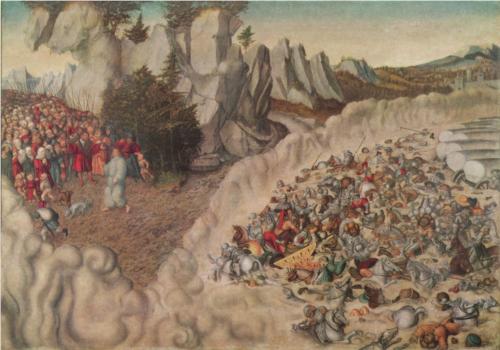
Lucas Cranach the Elder 'Untergang des Pharao im Roten Meer' (Germany, 1530)

Does God rejoice at the downfall of the wicked? Surely He wants the good to prosper and the wicked to perish. Yet, the destruction of God’s own creatures, regardless of some poor choices they may have made in the past, is also not a cause for Divine celebration. If one wishes to ascribe to a logical, binary scheme, the answer to this question can either be “yes” or “no”.  But this is the Talmud Blog, where a rabbinic “yes, but…” / “no, but…” will do just fine.  Indeed, rabbinic literature contains both views.  On the one hand, R. Ishmael confidently  responds to his students (preserved at Sifre Numbers 117) that indeed, God is happy when those who anger Him perish, while we also have a moving, anthropomorphic portrait of God’s pain at the wicked’s demise (mSan 6:5).

One of the better known talmudic passages that deals with this subject appears at bMeg 10b – towards the beginning of the so called Babylonian Esther Midrash (bMeg 10b-17a) which I am now teaching in the Hebrew University Talmud Department. The Babylonian Esther Midrash is a unique corpus. It is apparently the only complete midrash on a biblical book that was compiled in Babylonia, and as such it affords a rare window into Babylonian midrashic imagination. Scholars like Eliezer Segal have produced significant and lasting scholarship on the Bavli’s Esther Midrash. The primary tool in these scholarly endeavors is a kind of comparative criticism, that unfortunately ends up seeing the Bavli’s Esther Midrash as an essentially tone-deaf, pale reflection of Palestinian midrashic poetics.  Blame it on postmodernism, but I see in the Bavli’s ‘belatedness’ the beauty of the mosaic, pastiche – in short, a textual realization of Late Antiquity.

The passage that interests me appears towards the beginning of a long list of ‘petihtot’ to Esther, which Segal has demonstrated derive mainly from Palestinian exemplars. Indeed, the vast majority of tradents are Palestinian sages.  Further, in his assessment the full poetic punch of these petihtot is often effaced in the Bavli. This is true, but only if you consider Palestinian synagogal poetics as the sole form of legitimate poetry. Arguably, there is another kind of poetry that takes place in the processes of deconstruction and subsequent reconstruction which the Bavli performs on its Palestinian rabbinic heritage.

The point I have to make is a relatively, small, philological one.  But I do think that it partially explains a formerly incomprehensible Yerushalmi and also contributes to a deeper understanding of the development of two passages in the Bavli.  In any event, it has been far too long since the Talmud Blog had a post about a close, original reading of a sugya.

ר’ יהושע בן חנניה פתח לה פתחא להאיי פרשתא מהכא: והיה כאשר שש ייי עליכם להיטיב אתכם ולהרבות אתכם כן ישיש ייי עלי[כ]ם להאביד אתכם וג’

ומיחדי הקב’ה במפלתן שלרשעים 

והכת’ בצאת לפני החלוץ ואומרים הודו לייי כי לעולם חסדו ואמ’ ר’ יוחנן מפני מה לא נאמ’ כי טוב בהודאה זו לפי שאין הקב’ה שמח במפלתן שלרשעים

ואמ’ ר’ שמואל בר נחמני אמ’ ר’ יונתן מאי דכת’ ולא קרב זה אל זה כל הלילה באותה שעה ביקשו מלאכי שרת לומר שירה לפני הקב’ה אמ’ להן הקב’ה מעשה ידי טובעין בים ואתם אומרים שירה לפני

אמ’ ר’ יוסי ביר’ חנינה הוא אינו שש אבל אחרים משיש דוקא נמי דכת’ ישיש ולא כת’ ישוש שמע מנה

R. Yehoshua b. Hanania introduced the section from here: ‘And it shall come to pass that as the Lord rejoiced over you to do you good, so the Lord will rejoice over you to cause you to perish’ (Deut 28:63). 

Now does the Holy One, blessed be He, rejoice in the downfall of the wicked?

Is it not written, ‘as they went out before the army, and say, Give thanks unto the Lord, for his mercy endureth for ever (2 Chron. 10:21)’, And R. Yohanan said: Why are the words ‘for he is good’ omitted from this thanksgiving? Because the Holy One, blessed be He, does not rejoice in the downfall of the wicked? 

And R. Shmuel b. Nahamani said that R. Yonatan said, What is the meaning of the verse, ‘And one came not near the other all the night (Ex. 14:20)’?   At that time the ministering angels wanted to chant their hymns before the Holy One, blessed be He, but He said, The work of my hands is being drowning in the sea, and shall you chant hymns before me?

R. Yossi b. R. Hinana replied: He himself does not rejoice, but he makes others rejoice.  This is indicated also by the text, which writes yasis and not yasus, which proves [what we said]. 

(bMeg 11a, following MS Columbia; translation based on Soncino)

The opening verse is taken from the so-called “rebuke” section of Deut 28.  The link between this verse and Esther seems to center on the threatening verb “cause to perish (להאביד)” in Deut 28:63 and its ubiquity in Esther, for example at 4:7.  Apparently, R. Yehoshua understood the near destruction of the Jews in Esther as a realization of the Deuteronomic rebuke.  Judging from the first three petihtot of Esther Rabbah which cite Deut 28:66-68 and other later Palestinian midrashic parallels, this was apparently not an unusual way of introducing the Scroll of Esther.

The rest of the passage, however, is somewhat peculiar, and as such has gained the attention of generations of scholars.  I will focus on two issues:  The Talmud objects to the depiction of God as rejoicing over causing the destruction of the wicked, since two midrashic interpretations demonstrate that God does not rejoice when the wicked are punished (following Yehoshafat’s defeat of the Moabites; and after the drowning of the Egyptians in the Red Sea – the latter an example of a startling Babylonian reversal which was used in medieval times to justify the absence of Hallel recitation after the first day of Passover, but that is for another time).  The contradiction is resolved via a closer reading of the original verse from Deuteronomy, where God is now said merely to cause others to rejoice yet not rejoice Himself.  In other words, the entire sequence was generated by an apparent misinterpretation of the original verse that did not conform to midrashic traditions about God not rejoicing at the downfall of the wicked, and the conclusion is essentially to read the verse more carefully.  Further, as others have already pointed out (for example, E. Segal), the formulation of the original question “Now does the Holy One, blessed be He, rejoice in the downfall of the wicked,” is somewhat jarring, since nowhere in rabbinic literature do we find an entire generation of Jews referred to as “wicked”.

The passage bears a strong connection to a parallel at bSan 39b:

ויעבר הרנה במחנה

אמ’ ר’ אחא בר ר’ חננא באבוד רשעים רנה ובאבוד אחאב רני רינה

ומי חאדי הקב’ה במפלתן שלרשעים

והא כתי’ בצאת לפני החלוץ אומרים הודו ליי’י כי לעולם חסדו

ואמ’ ר’ יוחנן מפני מה לא נאמר כי טוב בפרשה זו לפי שאין הקב’ה שמיח במפלתן שלרשעים

ואמ’ ר’ שמואל בר נחמני אמ’ ר’ יונתן מאי דכת’ ולא קרב זה אל זה כל הלילה באותה שעה שטבעו מצרים בים ביקשו מלאכי השרת לומ’ שירה אמ’ להן הקב’ה מעשה ידי טובעין בים ואתם אומרים שירה לפני

א’ר יוסי בר’ חנינה הוא אינו שש אבל אחרים משיש דוקא  נמי דכת’ ישיש ולא כתי’ ישוש שמע מינה

‘And there went out the shout throughout the camp’ (1 Kings 22:36).

R. Aha b. R. Hanina said: ‘When the wicked perish, there is song (Prov. 11:10)’, and when Ahab perished there was ‘song of songs’ (following MS Yemenite, hagadot hatalmud, and others).  

Now does the Holy One, blessed be He, rejoice in the downfall of the wicked?

Is it not written, ‘as they went out before the army, and say, Give thanks unto the Lord, for his mercy endureth for ever (2 Chron. 10:21)’, and R. Yohanan said: Why are the words ‘for he is good’ omitted from this thanksgiving? Because the Holy One, blessed be He, does not rejoice in the downfall of the wicked? 

And R. Shmuel b. Nahamani said that R. Yonatan said, What is the meaning of the verse, And one came not near the other all the night (Ex. 14:20)?   At that time the ministering angels wanted to chant their hymns before the Holy One, blessed be He, but He said, The work of my hands is being drowning in the sea, and shall you chant hymns before me?

R. Yossi b. R. Hinana replied: He himself does not rejoice, but he makes others rejoice.  This is indicated also by the text, which writes yasis and not yasus, which proves [what we said]. 

(b. San 39a according to another Yemenite MS, MS Herzog).

This passage appears at the end of the fourth chapter in tractate Sanhedrin, where the Mishna describes how, after conveying a sense of seriousness to witnesses, the court reassures them that their task is essential and worthy.  One of the verses recited for the witnesses is Prov. 11:10: “when the wicked perish there are shouts of joy”.  At bSan 39b, the Talmud cites a verse from I Kings (22:36) that describes the news spreading of (the wicked) King Ahav’s demise.  R. Aha b. R. Hinina cites the verse from Prov and adds that when Ahav died there was even greater rejoicing.  Note that the Yemenite MS Herzog is vocalized רִנֵי רִינָה.  This leads into the same sequence that appears at bMeg 10b.

It is now easier to understand why the passage refers to “the wicked” – for Ahav’s wickedness was infamous. Yet, in certain respects the bSan passage is even more problematic than its bMeg parallel. The verse from Deuteronomy is not even quoted, but is nevertheless presumed in R. Yossi’s closing exposition.  And the opening question (‘Now does the Holy One…rejoice in the downfall of the wicked’) is almost incomprehensible, for where do we see God himself rejoicing at Ahav’s death?  On the other hand, there is reason to assume that the bSan passage is “primary” to the one in bMeg in the sense that the initialbuilding blocks of the passage were composed within the discursive context of bSan (yes, I am aware of Zvi Septimus’ article). This can be demonstrated since specifically bSan seems to have developed out of a parallel Palestinian passage preserved in the Yerushalmi that also appears as a comment on the same Mishna:

כת’ “ויעבר הרינה במחנה”.

מהו “הרינה”. הריני.

וכן הוא או’ “בצאת לפני החלוץ” וגו’. ללמדך שאף מפלת הרשעים אינה שמחה לפני המקו’ם.

It is written ‘And there went out the shout throughout the camp (1 Kings 22:36)’. 

What is “the shout” – hareni.

And it also says, ‘as they went out before the army (2 Chron. 10:21)’ etc. To teach you that even the downfall of the wicked is not a joy before Omnipresent. 

It seems clear that there is some relationship between the ySan and bSan passages. The Yerushalmi comments on the same Mishna, quotes the same verse from 1 Kings and then cites the same midrash on 2 Chron 10:21 (which first appears in the Mekhilta Beshalah, Shira parsha 1, p. 118).  Yet, on the whole, the meaning of this short Yerushalmi passage has eluded interpretation, particularly the first line.  What does the word הריני mean here, and what does it add to the verse from 1 Kings?

Not surprisingly, the traditional commentators try to apply the Bavli parallel to the Yerushalmi, and they suggest that the definite article (הרינה – the shout of joy) is interpreted here to refer to the great joy felt at the demise of the wicked.  Neusner’s translation emends the text accordingly “What is this cry (HRYNH)? Lo, it is a song (HRY RYNH).” On the other hand, the Mohr Siebeck translation suggests a reading of חרון – anger.  This seems to be based on the second line of the Yerushalmi, which cites the Mekhilta about God not fully rejoicing at the defeat of Moab.  Since the latter is apparently linked to the first line with the words “and it also says (וכן הוא אומר),” one might assume that the first line about “the shout” should also convey the same message of Divine displeasure at the downfall of the wicked.

In fact, the words “וכן הוא אומר” should actually be read “וכאן הוא אומר” (“and here it says”), and they merely represent a direct though shortened quotation of the Mekhilta passage according to the best witnesses. As for the first sentence “מהו הרינה – הריני”  the final word might perhaps be read as הרינו and represent a regressive assimilated form of הפעיל צווי הרנינו – ‘(you, pl.) Rejoice!’  As such, the Yerushalmi interprets 1 Kings 22:36 to mean that God is telling the Jews to rejoice (הרנינו) at Ahav’s death.  This then is juxtaposed to the midrash from the Mekhilta where God does not fully rejoice at the defeat of Moab.  The tension between these two positions, however, is unresolved.

This brings us back to the bSan parallel. If the original, Palestinian set of amoraic comments on mSan 4:5 contains two apparently unreconciled views of the Divine reaction to the demise of the wicked, the Bavli turns this material into a dialectical sequence.  Thus, originally, the comment on the verse from 1 Kings attributed to R. Aha b. Hinina (אחא בר חננא  – a name which looks suspiciously close to “” אחאב רני רינה as indeed is made clear in a variant preserved in geniza fragment CUL: T-S Misc. 28.201) apparently refers to God commanding rejoicing at the demise of the wicked Ahav. Notwithstanding the vocalization of MS Herzog, perhaps originally the term was to be read רנו רינה and similarly represent a regressive assimilation, now of the פיעל צווי form רננו.  Either way, the Bavli explicitly interrogates this midrashic understanding of 1 Kings, since in two places God is seen as not rejoicing at the downfall of the wicked.  The Bavli’s answer, based on Deut 28:63, now works perfectly.  God himself does not rejoice, but he causes others to rejoice – precisely as we see in the midrashic reading of 1 Kings 22:36 explicitly preserved in the Yerushalmi though only residually in the Bavli.

In short, we have a passage at bSan 39b that seems to, artfully, make use of a cryptic Palestinian text that juxtaposes God’s command to rejoice at Ahav the wicked’s death with his lack of joy at Moav’s defeat. This is turned into a series of questions that clarify where Divine joy at the downfall of the wicked is to be located – not within the godhead itself, rather in divine encouragement to rejoice. A philosophically fascinating proposition.

At last, this sequence intersects with bMeg 10b, where the citation of Deuteronomy 28:63 as a frightening petihta to Esther seems to elicit the need to ‘soften’ the troubling notion that God Himself rejoiced at the near destruction of the Jews in the Purim story.  No, God Himself did not rejoice. But he did encourage others to do so in carrying out their awful, destructive task.

Standard