Conferences, English, Guest Posts, Readings

Babylonian Talmud, Yoma 18b and Yevamot 37b: is this temporary marriage?- Guest Post by Zvi Septimus and Lena Salaymeh

Zvi Septimus and Lena Salaymeh are currently (at the time of publication) giving a lecture entitled “Marriage for Sex in Medieval Jewish and Islamic Legal Debates” at The Jewish Law Association’s 17th International Conference, going on now at Yale University.  This post is a summary of their talk and an opportunity to participate in the discussion. 

Two well-known and seemingly anomalous lines in the Babylonian Talmud have troubled many Talmud commentators for the last thousand years—yet these lines were notably ignored by the Gaonim: “When Rav came to Ardashir, he announced, ‘Who will have me for a day?’  When Rav Nahman came to Shkentziv, he announced, ‘Who will have me for a day?’”  What do these proclamations mean? The subsequent give and take of the Talmud implies that both Rav and Rav Nahman were the equivalent of modern-day rock stars.  They would send their entourage to the next stop on their tour in order to scout out groupies willing to engage in casual sex—or a temporary marital relationship—during their stay in various cities.  After their encounter they would be on their way, off to the next city to be coupled with the next willing set of groupies.  Had these rabbis actually been modern-day rock stars, these stories would probably not trouble us or the medieval commentators, many of whom felt forced to sanitize them.  But these stories are about rabbis.

The trouble with the rock star metaphor is that it implies that sexual relationships, or any relationship for that matter, between men and woman in the ancient world were anything like the way they are today, or even the medieval Christian and Muslim worlds in which medieval Talmud commentators lived.  The story we will now tell is about the evolution of the contexts in which these two Bavli lines were positioned from the time of their first appearance as historical anecdotes of the near past to the time when, as part of a Talmudic sugya, they needed to be incorporated into the complex web of rabbinic legislation.

The two statements of these rabbis appear in succession at two very different locales in the Talmud.  The first, in the order of tractates, and, as we argue, the development of the sugya, is at Yoma 18b and the second is at Yevamot 37b.  The Yevamot context is far more expansive and has therefore generally received more attention from traditional jurists seeking to contextualize the statements legally—to make laws for their contemporaries based on the way the Talmud discusses them.  At stake, for jurists like Alfasi, Maimonides, the Ravad, Nahmanides, the Rosh, and the Tur, is the legislative approach they would take toward casual or time-bound sexual relationships in their own eras in light of both the Talmud’s attitude toward such relationships and their own social and religious realities.  While traditional marriage may receive the most attention, there are many types of sexual relationships between men and women discussed in the Talmud.  Indeed, considerable effort is expended fleshing out sexual relationships between men and women outside of the standard permanent marriage arrangement, including conditional marriage and divorce, levirate marriage, servant marriage, slave marriage, concubines, casual sex, prostitution, and incest.  The Bavli’s discussion of these varieties of sexual relationships is reflective of late antique Near Eastern customary practices.  The question we would like to pose today is: To which of these categories did the Bavli’s redactors and the rabbinic commentators assign the relationships expressed by the stories of Rav and Rav Nahman?

Even within the Bavli itself, the statements of Rav and Rav Nahman—”who will have me for a day?”—can be seen in multiple contexts.  The first is to look at the statements themselves as actual stories recorded at or slightly after the times of their occurrence.  The second is to view them in the context of the extended sugya at Yoma 18b.  And the third is to understand them within the framework of Yevamot 37b.  When looked at this way, the stories can have three separate meanings.  To compound matters, there are numerous manuscripts containing alternate versions and textual variants.  Each of these, in addition, portrays different attitudes toward the story itself.  Of primary concern is the question of what type of relationship is meant by the words “who will have me for a day?”  Is it casual sex, a form of pilegesh relationship, or a temporary marriage?  If it were a pilegesh relationship, then was qiddushin performed?  Was nissuin performed?  Was there a ketubbah?  Is it realistic to think that the rabbis would be willing to pay the 100 or 200 zuz marriage settlement for a day’s worth of enjoyment, or, from a different perspective, a day’s worth of abating sexual urges in a legitimized manner?  Secondly, was the marriage for a day or “days”?  The manuscripts contain both readings.  If “days,” then was the marriage for a specific amount of time or just designated as temporary in some non-specific way?  If for a pre-determined amount of time, was this marriage naturally dissolved or was a get required?  If for a non-specific amount of time, could either party leave at will or was the husband the sole authority in determining the marriage’s end?  Further does the term yiud in these Bavli passages refer to non-sexual seclusion or is it a term referring to designating the woman as a partner, perhaps a pilegesh, where there would be neither qiddushin nor a ketubbah?  These questions are not only of interest to modern academic analysis of the positions of the authors of each sugya, or versions of the sugya preserved in a manuscript tradition, they also drive the medieval commentatorial tradition of those sugyot and the efforts of the codifiers and jurists in trying to incorporate these sugyot into their legal systems.

The inconclusiveness of these narratives and the widespread Near Eastern practices of temporary marriage suggest that at the time of the Bavli’s redaction, some form of temporary marriage was being practiced.  Indeed, Yaakov Elman argues that these “two prominent rabbis contracted temporary marriages in accord with the Sassanian institution.”  So, if rabbinic Jews practiced temporary marriages in late antiquity, then did these Jewish temporary wives receive a ketubbah?  Moreover, how did these temporary marriages end?  Did the rabbis in Yoma 18b or Yevamot 37b deliver divorce decrees or was a divorce effected at the moment of their departure or the conclusion of the day(s)?  This is of course probably depends on whether these temporary arrangements were actual marriages or merely pilagshut. The Bavli does not provide a clear answer on any of these technical details.

This leads us to wonder, how did the Gaonim understand this rabbinic practice of temporary marriage considering their context of Islamic debates about it?  It was not until the late 8th or early 9th century that a majority of Muslim scholars prohibited temporary marriages; prior to that time, temporary marriages were widely practiced and debated.  There is a notable geographic distribution, with Muslim jurists from Mecca generally permitting temporary marriage and jurists from Iraq and Medina opposing it.  Since the Gaonic academies were located in Iraq, it is quite likely that the Gaonim were exposed to these debates about temporary marriage among Muslim jurists.  There are three different forms of temporary marriage in the late antique Near Eastern world.  First: the Shīʿī version, in which the temporary marriage contract specifies the duration of the marriage, which ends automatically without a divorce declaration.  Second: the Sunnī version, in which the temporary marriage contract does not specify the duration, but the husband and wife or one of them intend to divorce and this type only ends with a divorce declaration.  The Sunnī version is a legal fiction because the husband and wife may have agreed upon the specific duration of the marriage, but simply did not specify it in the contract; in addition, in the Sunnī version, either the husband or the wife may intend to divorce the other without this affecting the validity of the marriage.  The third version may be understood as one component of the second version: the uninformed temporary marriage mentioned by Rabbi Eliezer Ben Yaaqov, in which the husband intends to divorce the wife with a get, but has not informed her.  Yet, somewhat surprisingly, there is little Gaonic discussion of the Yoma 18b or the Yevamot 37b sugyot.  Why is it that the “Who will have me for a day?” statements in the Talmud did not generate Gaonic commentary?

We want to end with this question and encourage those of you who are able, to attend our panel at the Jewish Law Association meeting or continue this conversation in the comments section of The Talmud Blog.

Lena Salaymeh is Robbins Post-Doctoral Fellow at UC Berkeley School of Law and recently earned her PhD in the History department at UC Berkeley; and Zvi Septimus is Anne Tanenbaum Post-Doctoral fellow at the University of Toronto. He was previously Alan M. Stroock Fellow for Advanced Research in Judaica at Harvard University and received his PhD in Jewish Studies from UC Berekely.
Standard
English, General Culture

Reading the Talmud in (The Islamic Republic of) Iran – Two Documents

One of the central interests of this blog is the relatively recent scholarly trend of ‘Reading the Talmud in Iran’ – that is, the practice of locating the Talmud in its Iranian context by highlighting connections between it and the Late Antique Iranian world from which it emerged. But we are also interested in the way the Talmud is read today – from Northern California to Korea. With all the excitement of recovering the composition of an ‘Iranian’-Babylonian Talmud, we must not ignore the experience of reading the Talmud in the Islamic Republic of Iran today.

The Vice President of Iran, Mohammad Reza Rahimi’s recent remarks that “the prevalence of narcotics and drug-addition throughout the world finds its roots in the wrong teachings of the Zionists’ religious book, Talmud (paraphrased by Farsnews)” was particularly troubling for us. Not only are his comments (and ‘retraction’) offensive in the extreme, they are entirely ignorant of the role that Iran played in producing the Talmud.

It is no secret that Iranian Jews, along with other non-Muslim minorities in Iran, frequently find themselves in precarious positions in the Islamic Republic. For Jews, one of the most disquieting matters concerns the Islamic Republic’s alleged contrast between Jews and Zionists – a distinction made by Khomeini to a delegation of frightened Jews sent to Qom on May 14, 1979, which is frequently transgressed by both the non-Jewish Iranian public and, as we recently saw, government officials.  That said, the experience of Jews in Iran today is by no means black-and-white, and Iranian Jewry’s complicated and fraught relationship with Zionism and the State of Israel must be parsed with the utmost care.

Notwithstanding the media coverage of Rahimi’s comments, there remains an extreme dearth of information regarding the state of Iranian Jewry today. We thought that it would be useful to provide our readers with two documents culled from the recent affair – a pair of letters sent by and to the Jewish community in Tehran concerning the Vice President’s offensive statements about the Talmud. The letters were posted to the Tehran Jewish community’s website and were kindly translated from the Persian by our friend and colleague Dr. Thamar E. Gindin. Needless to say, the appearance of the documents here is by no means an endorsement of their contents. Instead, we post them for posterity and discussion:

Dr Homayun Same-yah

Tir 91 (June 2012)

Mr. Mohammad Reza Rahimi
Honorable First Vice-President of the Islamic Republic of Iran

With greetings and honor,

Following the speech delivered by his honor, as quoted by the Persian news agency, on the international day against drug abuse, and his expressing an opinion about the holy book of the Talmud, I hereby state: The valuable treasure of the Talmud of the Jews includes manners of carrying out the verdicts and laws of the holy Torah. Its composition began about 1800 years ago by the Jewish sages, and took about 300 years to complete. This collection, besides discussing matters of religious law, also describes the lives of the sages and prophets, aspects of proper moral and behavior, and matters of health and medicine, within the limits of that time’s science.
The Talmud, compiled in 37 volumes, holds a very detailed, specialized, and massive text and content, which, regrettably, has not been translated to Persian to this day.
What is certain is that at the times of the Talmud, drugs for abuse were practically unknown, and had no use. Moreover, in the centuries that follow, no Jew has been known or arrested as a drug smuggler.
Since exact research and correct and valid description of affairs is every speaker’s duty and every listener’s right, when the matter is discussed by a high official authority, it especially raises the expectations in this arena. Additionally, the confusion and lack of distinction between the two matters – Judaism as a divine, monotheistic religion, and Zionism as a political party, is a big mistake, standing in contrast to the saying of the great leader of the revolution, his holiness Imam Khomeini (BM), who said “Judaism counts separately from Zionism”. Especially in this sensitive time, when the foreigners and the enemies sit in ambush to defame and create a hostile propagandistic atmosphere toward our beloved country. Therefore, the community of Jewish Iranians demands its right – the rectification of words said.
His honor Mr. Rahimi, because the Tehran Jewish Committee is certain that your honor’s sayings have been based on views of people unaware and unknowledgeable of the holy treasure of the Talmud, the Committee expresses its readiness to explain to his honor the very valuable doctrines of this book, especially doctrines dealing with love for others.
Moreover, the Committee announces that it has always kept in mind the administrations of his holiness the late Imam (Khomeini – ThEG), and likewise the valuable words of the leader of the Islamic republic of Iran regarding unity of speech (i.e. complete compliance with the supreme leader’s words – ThEG) and harmony in the great and powerful country of Iran, and expects each and every Iranian to also respect this right.
With honor,

Head of the Tehran Jewish Committee

Dr. Homayun Same-yah

———————————————————

The Vice-President’s office reply July 16, 2012

Dear Mr. Dr. Homayun Same-yah,
Honorable head of the Tehran Jewish Committee,

With honor, with peace and greetings to all the divine prophets, especially the prophet of Islam, of great dignity, and his holiness Moses who spoke with God.

In reply to your honor’s letter nr. 17326 dated 3/4/1391 (23/6/2012; sic), I hereby say:

Following the speech of the honorable first vice-president at the “international day against drug abuse” ceremony (6/4/1391 [26/6/2012; sic]), the foreign media, especially media linked to the world-arrogance (the West – ThEG) and to the Zionist regime, have selected and distorted parts of his speech, launched a propagandistic tumult, and with this excuse, put the high officials of the sacred regime yet again to under attack.

As your honor rightfully mentioned in your letter, according to the doctrinal principles of the Islamic Republic regime and the commands of the Deceased Imam (Khomeini – ThEG) and the supreme leader, “Zionism” and “Judaism” are two completely different matters. The leaders of the regime have from the very beginning of victory of the Islamic Revolution, always differentiated between the true followers of his Holiness Moses (BM) as a divine monotheistic religion, and the current of “World Zionism”. Today, the Muslim nations of the world hold the Jewish religion and its followers in great respect, but know that Zionism is a satanic doctrine, characterized by traits such as occupation and proliferation-ambitions, and strives to achieve its goals and control the world’s sources. In the past 32 years, World Zionism and its agents have never let go of their misconception against the Islamic Republic regime. They have always strived, by means of the media related to them, to distort the facts, divert the world public opinion, and attribute to Iran and to Muslims faults such as support of international terrorism, fundamentalism, deprivation of human rights, proliferation ambitions etc.
The last hustle and bustle about the words of the honorable First Vice-President are also – like dozens of the previous false clamors, from the fatwa issued by the Holy Imam (BM) (Khomeini – ThEG) against Salman Rushdie, to the studious question of the honorable president about the Holocaust – based on distortion and lie. Regretfully, the leaders of the ruling regime, who are themselves of the main architects of racism and genocide in the world, have titled this speech “anti-Jewish and racist”. The first Vice-President, in the aforementioned ceremony, has elaborated on some matters as an opinion holder in an academic and logical discussion, regarding Zionism and their misuse of some of the sanctities of Judaism. He is the author of the book “Land Wound”, which describes the history of the formation of Zionism, the genealogy of the Islamic Resistance Movement etc. The book was published by the Center for Scientific Research and Middle East Strategic Studies in 1388 (2009-10), and for authoring this book, he has been hailed by Palestinian and Syrian elites and academics. Reviewing the text of the First Vice-President’s speech, it can be seen that he has announced “Zionism” as an agent of proliferating drugs and other corruptions in the world, and explicitly distinguished between “authentic Jews” , who are followers of Holy Moses (BM), and “the Zionists”. But agents of the Arrogance, who are terrified that the hands of World Zionism behind the curtains may be exposed, immediately tried, by distortion and partial quotations of some of the parts, to launch another propagandistic turmoil against the regime of the Islamic Republic of Iran.  We appreciate the consciousness of the Tehran Jewish Committee in recognizing the political atmosphere of the country and the world in the present situation, and thank this committee for its perseverance in observing the administrations of his Holiness the Deceased Imam, and the statements of the supreme leader of the Islamic Revolution regarding unity of speech and harmony in our beloved country. It should be noted that in reply to the demand of the community of Jewish Iranians and in order to rectify the misconceptions arising from the speech delivered by Dr. Mohammad Reza Rahimi, First Vice President of the Islamic Republic of Iran, a statement has been put at the disposal of internal and foreign media. At the end, we ask the Lord Almighty for the success of our Jewish compatriots.
Mozaffar Torabi

Thamar E. Gindin is an Iranian linguist. She’s a research fellow at the Ezri Center for Iran and Persian Gulf Studies in Haifa university, teaches Persian to private groups and in Tel Aviv University, lectures about present day and ancient Iran in various settings, and is the author of “The Good, the Bad and the Universe – a Journey to Pre-Islamic Iran. She intends to be Israel’s first cultural attaché to a friendly Iran.

Standard
Announcements, Conferences, English

Rabbinics in the International Meeting of the Society of Biblical Literature

The international meeting of the Society of Biblical Literature will be held next week (July 22-26) in Amsterdam. As always, many sessions will be devoted to rabbinic literature; most notably this year are two multi-session units that will focus on (1) the Tanhuma midrashim and (2) on the dynamics between verse and prose in late antique Jewish and Christian texts. In addition, a session of the Judaica unit will be devoted to Midrash. So if you are heading to Amsterdam, prepare yourselves for a feast of five days of rigorous discussions of rabbinic literature in different contexts and settings. If you’re not, at least you’ll know what you’re missing! Full details concerning the sessions and the papers (including abstracts) can be found here.

Monday

9:00-12:00

The Tanhuma – Text and Story I

Gila Vachman, Hebrew University- The charachteristics of the later layer of the Tanhuma literature as demonstrated in Geniza fragments

Paul Mandel, Schechter Institute of Jewish Studies- The Religious World of Midrash Tanhuma: A Comparison with early aggadic midrashic parallels

Dov Weiss, University of Illinois at Urbana-Champaign- Confrontational Theology in Tanhuma-Yelammedenu

13:30-14:30

Judaism in Transition: Cultural Changes of the Byzantine Era

Marc Bregman, University of North Carolina at Greensboro- From Synagogue Sermon to Literary Homily The Early Stratum of Tanhuma-Yelammedenu Literature

15:00-16:15

The Tanhuma – Text and Story II

Elisha S. Ancselovits, Pardes Institute of Jewish Studies, Jerusalem- Hukkim as Inexplicable Laws: An Ideological Innovation of the Tanhuma

Yehonatan Wormser, University of Haifa- Early and Late Layers in the Tanhuma-Yelammedenu Literature – The Linguistic Aspect

Tamas Biro, University of Amsterdam- May I circumcise myself? On rituals and “halakhically incorrect” cognition in midrashic exegesis

Tuesday

9:00-12:00

Dynamics between Verse and Prose: General Approaches and Case Studies

Marc Bregman, University of North Carolina at Greensboro- The Metastructure of Midrash and Piyyut

Moshe Lavee, University of Haifa- The Art of Composition: Common Aspects of Rabbinic Homilies and Qerova Poetry

Michael D. Swartz, Ohio State University- Becoming Spirits: On the Functions of Angels in Piyyut and Esoteric Literature

Yehoshua Granat, The Hebrew University- Retelling the Jonah Story in Early Medieval Hebrew Prose and Verse

15:00-17:30

The Story of the Ten Martyrs between Verse and Prose – A Textual Workshop

Raanan Boustan, University of California-Los Angeles; Ophir Münz-Manor, Open University of Israel and The Talmud Blog

15:00-18:00

Tanhuma and Its Milieu

Rivka Ulmer, Bucknell University- The Yelammedenu Unit in Midrash Tanhuma and in Pesiqta Rabbati- a Text Linguistic Inquiry

Arnon Atzmon, Bar-Ilan University- The Tanhuma and the Pesikta

Amos Geula, The Hebrew University, Jerusalem- The relation between two lost Midrashic compositions: the lost Midrash Yelamdenu and Midrash wa-yehullu

Orly Amitay, University of Haifa- The Midrash of Ten Kings

Wednesday

9:00-12:00

Dynamics between Verse and Prose: A Comparative Outlook

Kevin Kalish, Bridgewater State University- Eve Lamenting Her Sons: Ephrem Graecus’ Re-imagining of Genesis 4

Peter Sh. Lehnardt, Ben-Gurion University of the Negev- Bound to Be Unbound: Genesis 22 in Early Jewish and Christian Liturgical Poetry

Laura S. Lieber, Duke University- “The Play’s the Thing”: Theatricality in Aramaic Piyyutim

15:00-18:00

The Reception of Tanhuma

Moshe Lavee, University of Haifa- Ten Dinars for the Talmud, a Fifth for the Tanhuma- Assessing the Cultural Value of a Literary Work

Shalem Yahalom, Bar Ilan University- The Tanhuma in a New Shell: Incorporating the Tanhuma in the Latter Midrash Rabbah Texts

Ronit Nikolsky, Rijksuniversiteit Groningen- The Tanhuma Material in Sefer Maasiot

15:00-17:45

Judaica – Midrash

Shamir Yona, Ben-Gurion University of the Negev and Ariel Ram Pasternak, Ben-Gurion University of the Negev- The “Better” Proverb in Rabbinic Literature

Katharina Keim, University of Manchester- The Function of the Rabbinic Attributions in the Pirke deRabbi Eliezer

Deborah A. Green, University of Oregon- Expelled from the Garden Again: Eve and Shekhinah in Genesis Rabbah

Barak S. Cohen, Bar-Ilan University- ‘Forced’ Amoraic Interpretations of Biblical Sources: A New Methodological Perspective

Aaron Koller, Yeshiva University- Redeeming the Queen: Rabbinic Readings of the Book of Esther

Thursday

9:00-10:15

Dynamics between Verse and Prose: Piyyut, Midrash, and Targum

Gila Vachman, Hebrew University- From Piyyyut to Midrash: The Dedication Offerings in Midrash Chadash

Jan-Wim Wesselius, Protestantse Theologische Universiteit- The See-Saw between Poetry and Prose in the Targumim to the Poetic Books of the Bible


Standard
Around the Web, English, Technology

Some Useful New Websites

Some new sites have gone up over the past couple of weeks that might be of use to our readers.

The first, brought to our attention by Talmud Blog reader and commentor Zohar, is the Israel National Library’s new website of Rabbinic Manuscripts. This site replaces the old one (www.jnul.huji.ac.il/dl/talmud) with a new interface and- perhaps most importantly- the Leiden manuscript of the Yerushalmi, browasable by the pagination of the Venice edition.

The site is still in beta version and they are looking for feedback. Feel free to leave your thoughts on the interface here in the comments section and we’ll make sure to pass them on to the library. Personally, I would prefer an option to search the Yerushalmi by chapter and halakha, and also that they list the folio numbers of the manuscripts. Regardless, users should be aware that much higher quality images of the Leiden manuscript are availble on the website of its home library (easily accesable here). The only problems with that site is that it’s hard to navigate and the pictues take a long time to load- ideally one could find the folio that she needs using the NLI interface, and then just open up the bigger picture on the Leiden site if need be. Also, for manuscripts with wide lines (like Leiden), the viewing window is relatively small. [The site still isn’t linked to that of the Munich library, whose manuscripts can be accesed from there or via the NLI catalog].

The Syriacists over at Harvard’s Dumbarton Oaks research institute have compiled a useful site: “Resources for Syriac Studies– an annotated collection of free and open source books, journals, and more related to the study of Syriac.” Kishmo kein hu– the site lists and describes dozens of PDFs of books available for free online that relate to all aspects of Syriac. I haven’t gone through everything yet, but it seems like they did quite a good job of finding all that’s out there. Many of these items should be of interest to Talmudists, from those who are just getting interested in Syriac (for whom I’d suggest starting with Brock’s A Brief Outline of Syriac Literature), and to those who already turn to Syriac frequently (see R. Payne Smith’s Thesaurus Syriacus).

Enjoy!

Standard
English, Ruminations

On the Arabic Talmud

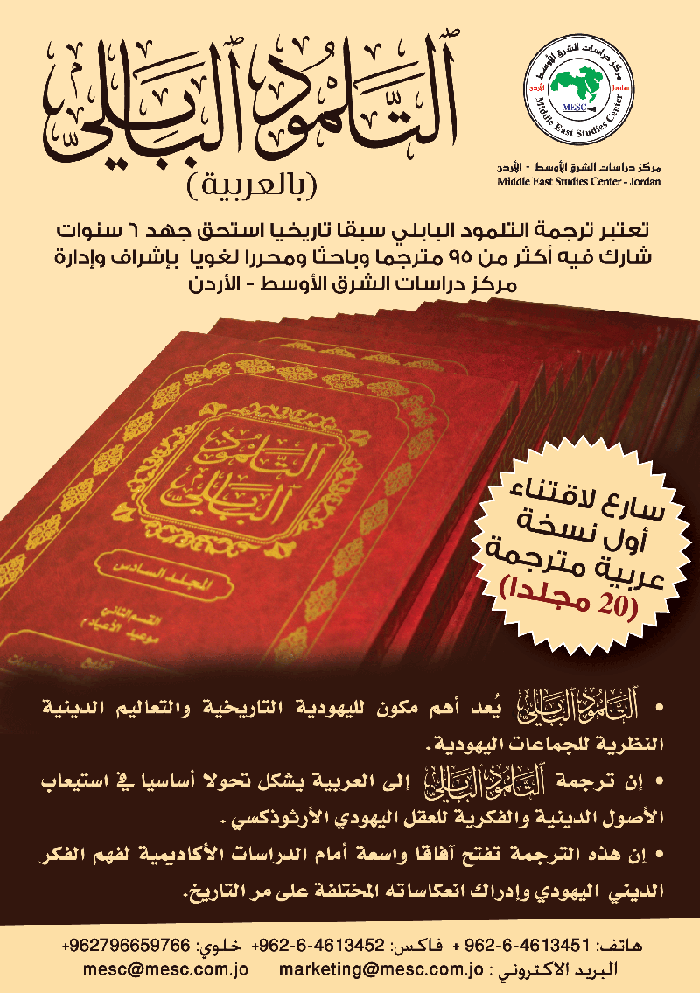
I cannot remember exactly when I initially heard about the first complete translation of the Babylonian Talmud into Arabic, but I can remember what I felt: excitement, bewilderment, curiosity, and, I must confess, the quickening of my liberal heart.  From the first reports in the Western media, it soon became clear that the translation was not just a rip-off of prior renditions, but a massive and utterly serious undertaking.  Yet like a summer rain that sweeps in to ruin an otherwise joyous party, many of the articles in the newspapers included the comments of a number of Israeli Middle East experts who, to put it mildly, raised doubts about the ecumenical nature of the translation.  As a certain Dr. Esther Webman ominously intoned:

“The Talmud in the Muslim world is considered to be the main source of Jewish iniquity,” she said. “They highlight aspects of it which are not so flattering and put it at the forefront of their presentation of it. Essentially, they use the Talmud as a tool to accuse Jews of certain habits and traits, so it is portrayed as the epitome of the Jewish and the Zionist mentality.

And yet, I wondered then and I still wonder now why such immense financial and intellectual resources would be poured into this translation if the intent was merely to propagate anti-Semitic ideas about the Talmud.  If the whole thing was just about antisemitism, well then anyone with a modem, the requisite computer savvy to cut and paste, and proximity to Kinkos can produce an impressive neo-classical anti-Talmudic tract within a few hours. Why the official backing of the Arab League, the hundreds of thousands of man-hours, and the purple prose?

Soon after the initial announcement, the Talmud Blog got to work. An Arabic translation of the entire Talmud was big news, with all sorts of political, theological, and scholarly implications (just think of how the Talmud can now be brought back to Iraq in the local language, and less romantically, of what this could ultimately do, in a different world, for the comparative study of Geonic and Islamic law).  We contacted the Amman based Middle East Studies Center which was responsible for the translation and learned of how much the Talmud set costs (a prohibitive, if understandable $750.00). We then spoke with people connected to the National Library of Israel and Harvard’s Widener library about purchasing a complete set; we found someone studying in Amman who could enquire into whether a single copy might be purchased for a lower price and brought to Israel for Passover (it could not); we had the original advertisement translated into English; with the help of another scholar we discovered a link that contained much of the introductory material online; we were contacted about a working group forming at the National Library to assess the quality of the translation; and mainly, we waited.

In the meantime, subsequent news reports moved in two different directions. On the one hand, Aryeh Tuchman, who is an expert in anti-Semitic and anti-Talmud propaganda, found that the introduction to the translation was literally littered with classic anti-Semitic and anti-Talmud tropes.  At the same time, the earnestness and unprecedented scope of the project – which supposedly included Christian speakers of Neo-Aramaic – came into relief.  A working group to analyze the translation at the National Library of Israel is finally taking shape, and surprises may still await. But where do things currently stand?

For one, the ADL machine is up and running. I am well aware that the threat of a major, semi-official Arabic translation of the Talmud backed by official organs of Arab countries is not just an academic occupational hazard.  Presumably, the Arabic translation of the Talmud will be the window by which most scholars, Islamic jurists, and plain old curious souls in the Arab world will access this central Jewish text.  Accordingly, the ADL has issued a statement that briefly outlines some of the problems of the introduciton, and has even sent a dispatch to the Jordanian government requesting that immediate action be taken. And yet, the way this whole affair went down seems so very predictable: Arabs produce a translation of the Talmud with an introduction that states its aim as an endeavor to explain why the Zionists make life for Palestinians in the territories so miserable.  The ADL condemns the translation, op-eds appear in the Jewish press, and we all go home. The fact that just last week, the vice-president of Iran, Mohammad-Reza Rahimi, delivered a totally confused (and, from a certain perspective, hilarious) discourse about  how the Talmud encourages Israelis to flood Iran with narcotics (temporarily forgetting that Afghanistan borders Iran to the East) has seemed to confirm this narrative – even if Rahimi certainly did not read the Talmud in translation, Arabic or otherwise.

From my view, there is still plenty of room for further reflection on this affair, at least in two related respects.  For one, consider for a minute the uses, in certain quarters, of Islamic studies in the West since 9-11.  At some think-tanks and research centers, Islamic studies has come to center around a very specific set of questions, especially: ‘why do those turban-heads[sic] blow themselves up in crowded marketplaces and crash themselves into US and Israeli targets?’  The intriguing spiritual and intellectual history of Islam and the central role it has played in the evolution of rationalism (especially in Judaism!), its startling mysticism, etc etc etc are simply of no concern in those settings.

A personal anecdote: Some time ago I published an article in a popular Jewish magazine. My article was juxtaposed to a lengthy and fascinating piece on the massacre of the Jewish tribes in Medina – no doubt a worthy and important topic in Early Islamic history. But appended to that article was a very specific, directed discussion of why the violent aspects of Islamic history (and they are, to be sure, many) essentially precludes the possibility of any form of coexistence with Jews – particularly in regards to the Palestinian-Israeli conflict.  The pair of articles drew a very straight line between a late antique massacre and the modern conflict. And my protestations won me a funny sort of ‘concession’ – the ability to draft an article about Jews and Sufis in a later issue of the magazine.  In any case, this sort of thinking plagues a lot of the current discussion, even beyond the Arab world – such as in regards to Iran.  It is all too easy to pontificate on the current tensions between Iran and Israel by elegantly referring to Iran’s pre-Islamic dualistic ‘us-them’ heritage, thereby skipping over thirteen hundred years of effervescent and incessant re-configuring of Iranian and Islamic culture in Iranian lands.  I wonder, for just a moment, whether the Arabic translation of the Talmud is engaging in much of the same.  As Aryeh Tuchman put it in that Jerusalem Post op-ed

Studying the Talmud to understand the mindset of modern Jews, let alone irreligious modern Jews, let alone the government of Israel, is like trying to understand the mindset of modern Catholics by studying Augustine.

A second point has to do with the way the Talmud is described in the ADL press release (and in the Arabic translation!) – “a sacred collection of Jewish law, ethics, philosophy and history.”  It is certainly sacred and holy to the countless Jews who gave their sweat, tears, lives, and souls to plumbing its depths.  But still, ‘sacred’ is a funny marker for the Talmud to anyone who knows it (or ‘her’, in the traditional androcentrism) intimately.  The Talmud is not a pristine collection of canons containing stale legal pronouncements and theological reflections, but something far more dynamic, irreverent, and, sometimes, problematic. I know I am taking a risk here, but one would have be a pious fool to deny the fact that the Talmud does indeed house some of the problematic statements  that anti-Semites ascribe to it – just as Patristics and Early Islamic literature offer up plenty of dubious things themselves.  Once again, context is key.

If some Arabic-speaker living in the Middle East has even the beginnings of a desire to venture into the Talmud’s water with a charitable curiosity, he or she will certainly not understand the Palestinian-Israeli conflict any better. But what just might come into view is the complexity and beauty of a robust Jewish culture in late antiquity – and today. (Incidentally, some of the better Islamic studies programs in the academy have accomplished just that for non-Muslims studying Islam).  Just maybe, the very desire that powered a massive translation project to render the Talmud in Arabic will actually engender the beginnings of an appreciation of the rabbinic mind – at least of the 99.99 percent which has nothing to do with the hermeneutics of שבו פה עם החמור.  If something like that could happen with the Abbasids, maybe there is still hope today.

Standard
English, Ruminations

What is a Redactor?

We are often told that a good scholar has to consistently and continually question the validity of his/her basic assumptions. The problem is that many times an assumption is so inherent to our thinking, that it is easy to mistake it for a universal, objective truth and not an assumption, which is by definition subjective. One way to locate these assumptions, in order to  question them, is to look at their “signs” – the habits in academic writing, the terms we use matter-of-factly. Once we shed light on a term of this sort, we can see which view it represents, and ask ourselves whether we can or should justify its use.

After all, we all have our writing habits. Some are the fruits of extensive academic training, but others are simply the expression of personal preferences. This seems particularly true when it comes to terminology. For example, some scholars, when writing about Roman Palestine, will use the term “Eretz Israel” rather then “Palestine”. Some will use the term stammaic and others will instead use post-amoraic. There are numerous other examples. Choosing one term over another signifies a (silent) agreement with a certain view, position, thesis, theory, or politics.

So, one of my terminological habits, as I realized recently, is to write “redactors” almost each time I refer to the, well, redactors of a talmudic or midrashic text: The redactors of the sugiya, the redactors of the teaching, the redactors of the pericope, the redactors of the midrash. I don’t know exactly when we started using this term in talmudic scholarship but it seems to me a relatively recent convention that some scholars follow quite religiously while others not so much or not at all. I belong to the first group, more or less.

I don’t know exactly what it was, but something has drawn my attention to this writing habit, and signaled it as one. Maybe it is the fact that my fellows in the research center, who work on other, non-Jewish and non-rabbinic texts from late antiquity, never use this term when talking about the people who produced their texts. And it made me wonder – what does my and others’ use of the term “redactors” say about our conception of the agency behind rabbinic texts?

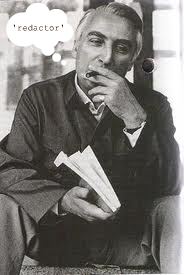
I realized that when I use the term “redactors” I have two others terms in mind, from which I do not wish to chose – author and compiler. Using the term “author” would assume that there is a person or a group behind the text, that has an intention, a message to transmit. This person or group is “responsible” for the text, and as Michel Foucault has shown, this responsibility creates a subject, who can be admired, criticized or condemned. Using the term compiler, on the other hand, would assume a very feeble agency behind the text. The person or group who compiled a text do not bear full responsibility for it. They have simply chosen all the texts that were available to them and put them together. They do not constitute a subject. In the terms of Roland Barthes, they are more “writers” than “authors”.

The problem is that rabbinic texts are both “authored” and “compiled” – the people behind them had a message to transmit, but at the same time they were compiling old traditions and edited them inside their own text. They did not only represent themselves, but also a tradition that they inherited, as well as invented. In the texts they authored, they had to include teachings for which they were not responsible, even when they did not agree with them.

This is perhaps the nature of the activity of those who produced the rabbinic texts, from the level of the midrashic unit, and even the single pericope or saying, to the level of the well developed sugiya.  A rabbinic text can be more compiled or more authored, but often it is both. It is a text that has a variety of agents behind it; each one of them is trying to convey a message that has to be understood in a particular context. It is a text which is a battleground, staged by the final redactor, of several views, often including that of the redactor himself.

Some scholars, and the first name that comes to my mind is Barry Wimpfheimer, have studied and examined the techniques and methods used by the redactors in order to negotiate between the different views and to create their own legal and ideological narrative. But it seems to me as important and fruitful to think of the activity of the redactor himself in these terms, as a hybrid author/compiler whose job is, indeed, a different job than that of the pure author or the pure compiler. In order to fully understand the inherent tension that characterizes rabbinic texts we have to understand that it reflects a drama inside the redactors’ mind who, on the one hand wants to conserve a culture and on the other hand wants to invent one, or to adapt the old culture to their experience, to their views.

The redactors of the rabbinic text always oscillate between tradition and invention in order to create something that is both old and new. Their responsibility for the text is, therefore, multilayered and complex; it is dialectic, as is the text itself.

Standard
English, Recent Publications

Shavua haSefer 2012

With the heat intensifying, the first of the summer groups arriving, and the stirrings of social-protest demonstrations, there is no question that the Israeli June is here. For this writer, and I imagine for many readers of the blog, the most exciting part of the month is the multi-week long “Shavua haSefer” (granted, it’s also known as “Hebrew Book month”)Here’s a list, organized according to publisher, of some of the academic books that will be on sale this month at reduced prices, along with other tips about making the rounds at the various fairs to take place around the country. Many of the books are also available at reduced prices through the websites of the publishers, but there is nothing quite like jostling for new books under a bloated Jerusalem moon suspended in the starry summer night sky:

Magnes

Magnes Press publishes dozens of books related to Rabbinics. Unfortunately, especially now that they are pushing e-book sales, they rarely reprint their older books. One has to be careful to purchase them before they run out.

Some books that will probably run out soon include:

  • Daniel Boyarin et. al, Atara L’Haim (עטרה לחיים). I found this festchrift for Prof. Dimitrovsky in the press’ catalogue and was pretty surprised to see that it was still available. When I went to their offices to pick it up, so were they.
  • David Weiss Halivni’s Sources and Traditions: Bava Metzia (מקורות ומסורות בבא מציעא).
  • Abraham Goldberg’s Tosefta Bava Kamma: A Structural and Analytic Commentary with a Mishnah-Tosefta Synopsis (תוספתא בבא קמא: פירוש מבני ואנליטי). 
  • Ta-Shma’s The Old Ashkenazi Custom (מנהג אשכנז הקדמון), although they’ve been pretty good about reprinting his books.

During Book Month Magnes is running a few different sale models, depending on the book. New books only get 20% off, meaning that some of their books most relevant to Talmud are still pretty pricey. These books include:

These are just some pointers. Magnes has many other volumes, both new and old, that should be of interest to our readers. They also distribute books published by the World Union for Jewish Studies, meaning that, although they have yet to add it to their online catalogue, they may be selling Emmanuel’s Responsa of Rabbi Meir of Rothenburg (reviewed here by Pinchas Roth) at their stands.

Bar-Ilan

Besides the recently reviewed Sperber volumeGreek in Talmudic Palestine, Bar-Ilan’s catalogue is mainly filled with older volumes, such as:

Yad Yitzchak Ben-Zvi

  • Sussman’s Thesaurus of Talmudic Manuscripts (אוצר כתבי-היד התלמודיים) is without a doubt the most important book for talmudists on sale this Shavua haSefer. While I hope that we can fully discuss the book in a later post, here’s a brief description. The first two volumes list, alphabetically according to library, all of the manuscripts and manuscript fragments in the world of the Mishnah, Tosefta, Yerushalmi, Bavli and Ri”f. The entries are numbered, and contain a description including the exact contents, and references to secondary literature which may have dealt with them. The third volume contains a few introductory essays- mainly previously published articles of Sussman- and multiple indices. The most important indices, of course, are those that are organized by work. For example: if one is studying m. Bava Bathra 2:7, one can look up the mishnah in the proper index and see the numbers of all of the entries of manuscripts or fragments that transmit that mishnah. One can then look up the entries in the first two volumes, and then look up the manuscripts or fragments themselves. The same is true for halakhot in the Tosefta, and folios of the Yerushalmi, Bavli, and Ri”f.
  • In the field of Geonica, YBZ recently published Shraga Abramson’s edition of Rav Hai’s Mishpatei Shavuot, brought to press by Robert Brody and David Sklare (see here for the table of contents and Brody’s introduction).

Bialik

Mosad Bialik, publisher of classics like Albeck’s Mishnah, Zunz’s Derashot biYisrael, and Urbach’s The Tosaphists, has some new books that may be worthwhile purchases:

Bialik also has a number of volumes of collected essays, such as those of Ta-Shma (Studies in Medieval Rabbinic Literature, in four volumes), and Moshe Bar-Asher’s essays on Rabbinic Hebrew.

JTS-Schocken

Schocken distributes JTS’ books in Israel, and is probably the easiest and cheapest place to buy their books anywhere. Here too, one can find a nice mix of new and old books. Besides the classics (Lieberman’s books, the various editions put out by JTS, etc.), one should look out for:

Over a year ago at the International Book Fair, the Schocken stand had a few copies of Abraham Goldberg’s commentary to Mishnah Shabbat. Apparently, they had found some box of them after thinking that they were long sold out. A few months later they were still selling copies during Shavua haSefer and it still appears in their catalogue. To be honest, this saddens me a bit. The commentary, the work of an important teacher and scholar, should be in the library of all those who dabble in academic Talmud.

Miscellany

This list is not meant to be exhaustive. Anyone who knows of any other academic books that should be on our radar is invited to write about them in the comments sections below.

Standard
English, Guest Posts, Reviews

Daniel Sperber’s Greek in Talmudic Palestine- Review by Yair Furstenberg

Daniel Sperber, Greek in Talmudic Palestine, Ramat Gan: Bar Ilan University, 2012

How much Greek in Jewish Palestine? Were Samuel Krauss to address the question titling Saul Lieberman’s seminal essay of half a century ago, we could expect in reply a most precise datum: 2370. Krauss compiled the dictionary for Greek and Latin loanwords in rabbinic literature (Griechische und Lateinische Lehnwörter im Talmud, Midrasch und Targum) published during the last years of the 19th century, and this is the number of Greek entries in this work (if we are to believe those who counted). However, this enormous number, which supposedly signifies the scope of Greek knowledge in rabbinic circles, would certainly not satisfy Lieberman.

Besides the fact that the Lehnwörter was most fervently criticized early on by linguists and classicists, who rejected a substantial share of its etymologies (between 30-50%) and valued it only as a comprehensive collection of the relevant passages, Lieberman’s major concern in identifying these foreign words laid elsewhere, beyond the realm of lexicography. In the above-mentioned essay, as in his earlier books Greek in Jewish Palestine and Hellenism in Jewish Palestine, he sought not only to identify within rabbinic literature traces of Greek presence, but to map out the types of rabbinic encounters with this culture and the intensity of the exposure. Thus he claims, for example, that whereas philosophical terminology is completely absent from Talmudic literature, which befits the rabbis’ complete disinterest in foreign wisdom, issues such as law, government, and rhetoric are well represented in rabbinic vocabulary.

In the last few decades, contemporary scholarship moved even farther away from the lexicographic endeavor, as it shifted from a philological paradigm in which related words serve as signifiers of sporadic cultural interaction to a broader cultural paradigm that seeks to identify shared structures of thought within the common Greco-Roman environment. From this perspective, even if spoken in the most Rabbinic Hebrew, Talmudic laws, narratives and anecdotes may sound to some like Greek. However, paradoxically, the evolution of new broader scholarly approaches has only reinforced the need for a clearer exposition of the actual contexts and agents (including people, words and institutions) through which such cultural exchange took place. Due to the incompleteness of earlier projects, some fundamental questions have yet to be systematically addressed: How “Greek” is each of the rabbinic compilations? Can we identify different trends or stages in the exposure to Greek language and culture? How should we account for the broader use of Greek in later sources? Did Christianity play a role in the distribution of Greek language and ideas in Palestine? How does the rabbinic exposure to Greek compare with that of other Aramaic and Syriac speaking groups in the eastern Mediterranean?

In his latest book, Daniel Sperber contributes to this endeavor by laying out some of the main findings of his two esteemed masters, Krauss and Lieberman, and by commenting on the challenges which, in his eyes, their works hold for future scholarship. Thus, in the first part, “Greek and Latin Words in Rabbinic Literature: Prolegomena to a New Dictionary of Classical Words in Rabbinic Literaute” (a reprint of two of his articles from the seventies), Sperber surveys the problems and methodological concerns which await the compilation of an improved dictionary, more than a century after Krauss. In the second part, “Rabbinic Knowledge of Greek in Talmudic Palestine”, he readdresses the fundamental question posed by Liebermen: “How much knowledge (and we may add, and of what nature) of the world which surrounded them did the builders of Rabbinic Judaism possess?”. To that end, he adds to Lieberman’s exposition some further examples of his own, relating to regional differences, knowledge of pagan ritual, rabbinic acquaintance with Roman legal and military terminology, and the use of Greek in magical texts.

Those who follow Sperber’s work will identify his examples from the many publications he contributed on the issue of Greek in rabbinic literature during the last three decades. Most prominent of these are his books, in which he not only offered solutions to textual cruxes by deciphering the Greek or Latin etymologies, but in which he sought to classify all foreign terms according to subject matters: A Dictionary of Greek and Latin in the Mishna, Talmud and Midrashic Literature (1984); Nautica Talmudica (1986); Material Culture in Eretz Israel (1993, 2006); Magic and Folklore in Rabbinic Literature (1996). In a way this is the most conspicuous of Sperber’s contributions, in which he dismantled the over-whelming question of Greek in Rabbinic literature into manageable, specific contexts and fields of practice.

The current book is of a different nature, and its purpose is more modest. It advances Sperbers general scholarly approach, which incidentally is largely based on that of Liebermen. However, in the margins, the unique and extremely important aspect of Sperber’s contribution does emerge in this latest book as well. Thus for example, to the list of more than 280 new words which he adds to Krauss’s dictionary (thanks to his elaborate use of critical editions and sophisticated assessment of manuscripts variants) he appended a subject index, which “highlights to us that in certain socio-cultural areas there was a greater penetration of Greek terms… administration, army and weaponry… employment, occupations and professions… building, tools or utensils” (p. 81).

But as the examples in the book demonstrate, the issue at hand is not only in what fields were the rabbis exposed to Greek, but the nature of their proficiency. Thus, the most enjoyable examples are those which not only incorporate Greek terminology but cunningly manipulate the languages through wordplays and puns. It takes an expert to identify those, today as well as back then. Therefore, although we are not surprised to find R. Abbahu in third century Caesarea proving his competence in Greek with a clever wordplay, it is no less than astonishing to find it in other, unexpected contexts. Such is the following case, my personal favorite, (discussed on p. 136) taking us back to the presumably ancient mishnah, which records the halahkhic dispute between the Pharisees and Saduccees (m. Yad. 4:6):

The Sadducees say we cry out against you, O ye Pharisees, for ye say ‘The Holy Scriptures render the hands unclean and the writings of Homer do not’. Rabban Yochanan ben Zakkai said “Have we naught against the Pharisees save this? For lo, they say ‘The bones of an ass (עצמות חמור) are clean and the bones of Yochanan the High Priest are unclean?

As Sperber points out, quoting Chaim Rosen, there is much more to the comparison of texts (Scripture/Homer) to bones (High Priest/ass) than the halakhic issue of impurity: behind the word “עצמות חמור” [“the bones of an ass”] there lies a Greek expression referring to Homeric poetry itself – an expression which has been doctored in a “cacophonistic” manner for the sake of derision and disparagement – “aismat homerou” – viz. “the songs of Homer”. And we can only thank the Pharisees for purifying these bones and songs, reluctantly admitting the enduring influence of Greek language and culture.

Yair Furstenberg is a Mandel scholar at the Scholion Interdisciplinary Research Center in Jewish Studies at the Hebrew University. He lectures in the university’s department of Talmud and Halakha.

Standard
English, Piyut, Readings

Two Unusual Traditions in Piyyutim for Shavuot

Shavout is just around the corner and I present in this post two most unusual traditions that appear in piyyutim for the holiday:

Were Hillel and Shamai brothers?

On June 8, 1951 Menachem Zulay published in the Israeli newspaper Ha’aretz two late antique piyyutim for Shavuot that rather astonishingly suggest that Hillel and Shammai were brothers. The first piyyut relates in great detail the chain of tradition of the Torah according to Mishna Avot. Towards the conclusion of the poem we read:

 וכמו קיבלוה מראש שני אחים

כן נמסרה בסוף לשני אחים

That is, at Mount Sinai (‘the beginning’), the Torah was given to two brothers, Moses and Aaron, and at the conclusion of the process it was handed to yet another two brothers. “But who are these two brothers?”, wondered Zulay. The second piyyut has a straightforward answer to this question:

שמעיה ואבטליון מיהרו לדרוש בדת רשומיי

וקיבלו מהם שני אחים הלל ושמאי

According to this piyyut Sh’maya and Avtalyon studied the Torah while two brothers, Hillel and Shammai, received it from them. Two years after the publication of the piyyut in Ha’aretz, Zulay complained that scholars paid little attention to his curious discovery.  He also rejected a suggestion made by the poet Aaron Zeitlin to regard the poems as metaphorical. Zulay then wrote the following the comment, which to a large extent is still relevant today:

It is about time that our learned persons should know that the common way to settle contradictions between payytanic and rabbinic texts is not a scientific one, and at any rate it is unacceptable in regard to the piyyutim in the Cairo Genizah. The naive assumption is that the entire corpus of Jewish texts was fully preserved and that any source that does not agree with the canonical sources is mistaken or the illusion of the author.

Indeed!

Why didn’t the Patriarchs receive the Torah?

Ela’azar birabi Qilir was the first poet to dedicate a special section of the Shavuot piyyutim to the question of why it was Moses who received the Torah and not one of the patriarchs. The section describes God and the Torah as king and  daughter, and in the course of the piyyut God presents to the Torah a set of potential grooms (Adam, Noah, Abraham, Isaac and Jacob).  The Torah refuses since in her view they all sinned. She describes – at great length – these sins and after dismissing all of the suitors she finally chooses Moses. This literary unit is unparalleled in any other source (that is, outside of the payytanic corpus) and I wish to provide one example, that of Abraham. In one piyyut by the Qilir, Abraham is blamed for doubting God at the ברית בין הבתרים (Covenant of the pieces) – as he asks ‘O Lord GOD, whereby shall I know that I shall inherit it?’ (Gen. 15:8).  Admittedly, this is a rather subtle critique. However, in another piyyut the Qiliri is much more daring.  He describes how Abraham hastened to bind Isaac and adds:

עניין כרחם אב על בנים בשכחו / עטיפת תחינה היה לו לערך בשיחו

The Torah claims that Abraham forgot the rule that a father should have mercy on his son  and that he should have prayed before God – apparently to cancel the commandment to slaughter Isaac! A later payytan by the name Yochanan Hacohen (ca. eight century) went even further and wrote:

אבל על יחידו לא קנה רחמים / ושלח יד כאכזר לשפוך דמים

וכל כך לעשות רצונך בלב תמים / ובטוח כי אתה טוב ומלא רחמים

אבל היה לו להתחנן לפניך ולבקש רחמים / ולחשוך יחידו מאש פחמים

הוא לא ריחם לולי ריחמתה, בעל הרחמים

(But on his single one he did not have mercy / and stretched his hand like a cruel man to shed blood

And all that in order to fulfill Your will with an honest heart / and he was sure that You are righteous and full of mercy

But he had to beg before You and ask for mercy / and to save his single one from the fire of coals

He did not have mercy, but you did, O Mercy One.)

Such blames continued to be rephrased in piyyutim for Shavuot in the High Middle Ages in the East as well in the West and it is undoubtedly a striking example of the boldness of these poets. Interestingly, many of the piyyutim that criticize the patriarchs were censored in medieval manuscripts. For many years it was assumed that the censorship was due to the discomfort of medieval Jewish sages who did not want to defame the patriarchs. More than a decade ago, I suggested that they were censored because contemporary Christian apologists attacked the (Jewish) patriarchs by using similar claims to the ones found in the piyyutim. The article was published in Tarbiz 70 (2001): 637-644 and can be downloaded here.

On a parting note, for those of you who would like to delve into the piyyutim of El’azar birabi Qilir for Shavuot I highly recommend Shulamit Elizur‘s critical edition published by Mekizei Nirdamim in 2000; in her introduction Elizur discusses – among other things – the piyyutim that were presented in this post.

And until next time, wishing all celebrants a wonderful holiday of Torah study, milk and honey.

Standard
English, Guest Posts, Reviews

Revolution or an Evolution? A Review of Bar Ilan Responsa Project 20- Guest Post by Josh Yuter

At the end of tractate Horayot (14a), Rabbi Yohanan recounts a Tannaitic dispute between R. Shimon Ben Gamliel and his colleagues over which type of intelligence is superior: being knowledable in the sources or being “able to move mountains” through analytic reasoning.  Generations later, this question was answered in favor of the well-read scholar on the grounds that, “all depend on the master of the wheat.”  After all, even the greatest legal mind needs to process the correct material.

Perhaps the greatest contribution to the production of “wheat-farmer” Talmudists has been the Bar Ilan Responsa Project.  While the project  officially began in 1963, the first version in its most identifiable commercial form was released 20 years ago in 1992 as a CD that not only compiled major Jewish works, but also included a powerful search engine ideal for most classical Jewish text research.  Subsequent upgrades have primarily consisted of additional texts – to the point where the Responsa Project has spun off cheaper versions for those who do not need as much material – and either adding new features or improving earlier ones such as increased hyperlinking within texts that allow users to quickly look up most biblical or rabbinic citations from other sources.  As such, although the project itself was revolutionary, each upgrate is more often than not evolutionary.

The most recent 20th version has some new features which regular users may appreciate, though much of this depends on taste.  Since I spend most of my time with Talmud searches, I’m partial to the embedded references.  For example, double clicking on a Tanna or Amora will display a brief but useful biography of that sage.  There are also tooltips for expanding abbreviations and translating Aramaic to Hebrew, including names which at times conflicts with the aformentioned biographies [Note: screenshots of these and other features are displayed in the slide-show below].

In a feature introduced for this new version, Bar Ilan 20 includes the tzurat hadaf, which allows the user to view a page of Talmud as it appears in the de facto standardized Vilna edition of the Talmud.  You will notice that the editors did not select the clearest or sharpest typesetting, but I would suspect that this would be irrelevant to the average user who insists on the tzurat hadaf – after all the plain Hebrew text is just a few clicks away.  What is important is that the tzurat hadaf is not merely a static image like a PDF, but the text operates as if one were viewing the plain text.  Most notably, hyperlinks are maintained as are their dictionary tooltips.  Speaking of layouts, Bar Ilan 20 also includes a “Recommended Layout” option for all text windows which increases the margins and line spacing, which some users may find clearer.

In terms of functionality, one new feature which stands out is the new default “Natural Language Search.”  Admittedly, I am more used to searching by idioms and grammatical variants such that I have not learned how to take advantage of this feature as it was intended.  Furthermore, I noticed the inclusion of a “Mishna and Bavli Chapters” reference which alphabetically lists all the chapter names in the Talmud.  Since it is not unusual for commentaries to reference Talmud based on page number – especially for those who lived before the tzurat hadaf was formalized – having the index would be useful for tracking down the citation in the original.  However, since most of these commentaries cite at least a few words from the Talmud in the process, it is a simple exercise to simply run the regular Bar Ilan search for those words.  (Speaking of which, here is a pro tip for users: highlight the words for which you wish to search, press Control-R and the highlighted phrase will automatically be placed in the search box.)

Are these upgrades worth the cost? Based on the upgrade pricing scheme, it is always cheaper to postpone upgrading since the improvements are cumulative.  Personally I try to skip no more than two versions since some changes are “under the hood,” like the option (available since at least 17) to install and run searches off of the hard drive instead of the disc itself.  However, if there is a new feature or new sources which are of immediate use, then quicker upgrades could be worthwhile.

Since its initial release, the Bar Ilan CD has been one of the most powerful and versatile tools for Jewish research.  But like any tool, its real value of utility is determined by the needs and skills of the end-user, not to mention the ability to read and comprehend the material.  For what good is it to be a master of the wheat if we do not know how to harvest.

This slideshow requires JavaScript.

Rabbi Josh Yuter is the rabbi of the historical Stanton Street Shul in New York’s Lower East Side. He blogs at YUTOPIA (www.JoshYuter.com), and tweets @JYuter.

Standard