
“Pumbedita & Vilna in Silicon Valley” is the title of the opening session in a series of five public meetings at the National Library of Israel. The series aims to investigate the relevance of the Bavli in the 21st century. Baldly, the first session asks: “Is the Babylonian Talmud relevant to the secular-western society in which we live?” Continue reading
Author Archives: The Talmud Blog
In Your Neighborhood- The Talmud Blog Live IV
It has been some time since the Talmud Blog community – at least its Eastern branch – has gotten together for a live event. So we are particularly excited to announce the fourth ‘Talmud Blog Live’ gathering, which will be held in Jerusalem at the end of June. We look forward to hosting two rising academic stars from neighboring disciplines who will participate in a conversation that introduces ‘their’ texts and methods to Talmudists. The discussion will also considers intersections between different Sasanian – and disciplinary – communities. Mark you calendars, RSVP via our facebook page, and spread the word. We look forward to seeing you!
The Talmud and its World:
Reading the Bavli Alongside its Late Antique Neighbors
A Text-based Conversation with Iranist Yuhan Vevaina (Stanford) and Mandaic Scholar Charles Häberl (Rutgers). Facilitated by Shai Secunda (Hebrew University).
The event will take place on Thursday, June 27, 2013 at 17:00 in Rabin Building 2001 on Hebrew University’s Mount Scopus campus. This evening is generously sponsored by the Martin Buber Society of Fellows, is geared towards Talmudists and is held in conjunction with the Hebrew University Talmud Department.
The Talmud Blog Live: Dr. Ron Naiweld on “The Torah as the Divine Logos in Tannaitic Literature”
We are excited to announce the Talmud Blog’s third “live” event, which will take place next Tuesday, December 25th, 7:30 PM at Ohel Moshe 5, Jerusalem. We’ll be hosting our very own Dr. Ron Naiweld, a contributor to the blog. Ron will be speaking (in Hebrew) on “Beyond the Letter and the Spirit: The Torah as the Divine Logos in Tannaitic Literature”. More information on his talk, including an abstract, can be found on the event’s Facebook page.
Reader’s interested in attending are invited to RSVP either by emailing us (thetalmudblog [at] gmail [dot] com) or, preferably, via the event page.
Review: Maggie Anton’s Rav Hisda’s Daughter- Guest Post by Ilana Kurshan
At our Talmud Blog-Jerusalem event, we described some of the ways that the TB community can participate in the larger conversation that we hope to foster here. At the top of the list is writing posts for the blog. And so we are happy to present a short review written by Ilana Kurshan, a friend, devoted reader of the blog, and member of the Talmud Blog community, about Maggie Anton‘s latest novel, Rav Hisda’s Daughter. The review was published in Lilith Magazine (Fall 2012; 37.3) and is cross-posted from Ilana’s blog.
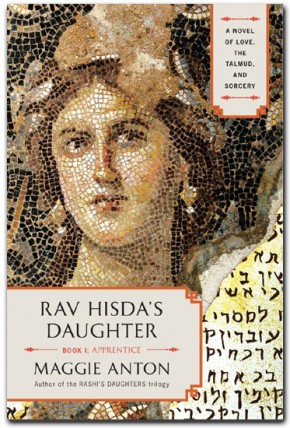 Towards the end of Rav Hisda’s Daughter (Plume, $16), Maggie Anton’s eponymous heroine returns to her home in Babylon after four long years in the land of Israel and is greeted by her father with the words, “Blessed are You, Adonai…. Who revives the dead.” Anton has made quite a career out of reviving the dead, first with her trilogy of novels bringing to life Rashi’s three daughters, and now with her imaginative tale of the daughter of the third-century Talmudic sage Rav Hisda.
The novel’s opening scene is closely based on the Talmudic story in which Rav Hisda’s young daughter sits on her father’s lap while his two leading students stand before him. Rav Hisda asks his daughter which one of them she would like to marry, and she greedily responds, “both of them.” One of the students—arguably the more quick-witted—immediately pipes up, “I’ll go second!” This story sets the stage for Anton’s tale, in which Hisdadukh—Anton invents her name, which is Persian for “Daughter of Hisda”—is betrothed first to Rami bar Chama, the love of her youth and the father of her two children. Following Rami’s tragic and sudden death after just five years of marriage, Hisda is betrothed to the other student, the harsh and hardened Rava. The novel follows Hisdadukh not just from one husband to another, but also from her home in the Babylonia, where she is one of two daughters and seven sons in an illustrious rabbinic family, to the Galilee, where she mingles with amulet scribes, early Christians, and the great scholars of Tiberias, Caesaria, and Sepphoris. It is in Sepphoris that Anton imagines that Hisdadukh serves as the model for the iconic “Mona Lisa of Galilee,” a floor mosaic that remains a popular archeological attraction in Israel today.
Many of the conversations and characters in this novel are lifted straight of the pages of the Talmud. But as the Talmud is not a work of history—Anton may be the first to call it “historical fiction”—even these elements of the novel may raise eyebrows: “Everyone knew that the Evil Eye was responsible for a great deal of misery in the world. Rav, Father’s teacher, once went to a cemetery and cast a spell that let him talk to the dead. Ninety-nine told him they’d died from the Evil Eye and only one from bad air.” We must be as skeptical of the historicity of Anton’s account as we are of the Talmud’s narration of this incident in tractate Bava Metzia. And so in terms of authenticity, perhaps Rav Hisda’s Daughter has an advantage over Rashi’s Daughters, since there is no pretense that the former is based on historical sources. When Anton succeeds best, she brings Talmudic debates to life by showing the very human personalities and passions behind the various legal positions. And so when Rami and Rava debate the laws of inheritance, Anton suggests that they are in fact really fighting over Hisdadukh; thus their battle of wits is also a sort of romantic duel.
Anton’s novel is rooted not just in the soil of the Talmudic text but also in the field of academic Talmud study today, which is apparent even without glancing at her impressive bibliography or the list of illustrious international scholars she acknowledges. Hisdadukh is a student of Torah arguably modeled on her Palestinian counterpart Beruria, but she is also an enchantress who makes magical incantation bowls of the sort discovered by archeologists in the area that is now Iraq and Iran. The discussions that come alive in this book are Talmudic as well as academic, which may explain why this novel will have so much appeal for readers like myself who are steeped in the Talmudic text and the scholarship about its context. For readers who do not experience the pleasure of the familiar in its fictionalized form, Anton’s novel celebrates our rich and colorful textual heritage and reminds us that feminist history is often a return to the material and the real – to the beer the scholars drank, the springs in which they bathed, the cycle of blood that dictated their most intimate relationships, and the rooms in which they studied texts that occasionally refer to wives and daughters whose lives we can at best imagine.
The Talmud Blog Hosts Michal Bar Asher-Siegal
 In a beautifully appointed Jerusalem home, and framed by some Avigdor Arikha, Michal Bar Asher-Siegal led an extremely animated discussion that compared many of the motifs comprising the Bavli’s Resh Lakish story cycle with similar elements from Syriac Christian hagiographical texts. Like those cool guys from Chicago, Michal was on a mission to convince scholars of the significance and necessity of reading the Talmud alongside these (then) very popular Christian works. And in our humble opinion, she succeeded marvelously. For those of you who want to see if you’re convinced, we’ve uploaded the audio of the lecture here, and the handout here. Let us know what you think!
W(h)ither Rabbinics
As contemporary academics, many of us are both cursed and blessed with a chronic condition of acute-hyper-self-awareness. We cannot simply do what it is that we do. We must question, prod, examine, and analyze our vocation and ourselves to death. A pair of recent articles published by two prominent Talmudists aid us in this sorry task. Both take on the state of Rabbinics, and interestingly enough arrive at different destinations. The first essay, by David Stern, “Rabbinics and Jewish Identity: An American Perspective,” appears in the just released Ben Gurion University volume, Jewish Thought and Jewish Belief (ed. Daniel J. Lasker), which is based on a 2010 conference held at BGU (the audio of Stern’s lecture is available here). The second, by Ishay Rosen-Zvi “לחלן את התלמוד” (‘Secularizing the Talmud’) appears in Teuda 23 (2012). We’d like to invite our readers to read these essays, and in the coming days weigh in on the important issues they raise. To get us going we are happy to present a rather provocative reaction by Michael Satlow, who has just joined the Talmud blog as a contributor. Enjoy the essays, read Satlow’s reflections, digest, and then join us in a spirited conversation in the comments section below!

Going…Going…Where? “Rabbinics” according to Google’s ngram
Rabbinics Must Die
In our line of work, the word “rabbinics” hardly raises an eyebrow; it is, after all, what we “do.” When pressed by our colleagues for a quick word or phrase to describe what we do, many of us (and I include myself here) frequently say that we are “in rabbinics.” The term has long nagged me. Recently, though, having read two excellent and complementary essays by our esteemed colleagues David Stern and Ishay Rosen-Zvi on Shai and Yitz’s recommendation, I have finally been able to articulate why I am so uncomfortable with the term.
Stern’s essay is a personal reflection on the trajectory of “rabbinics” that nevertheless advances a strong explanatory argument. Contrary to all reasonable expectations, the study of rabbinics in America has flourished, both within Jewish studies and more widely throughout the academy. There are several reasons for this, Stern argues, but the primary one is the distinctive way in which American colleges and universities organize knowledge. Rabbinics, Stern writes, “has been decisively, fundamentally, shaped by currents in the American academy and its peculiarly inter-disciplinary – or post-disciplinary – fluidity” (19). At the same time, this fluidity has brought a wider academic audience to rabbinic literature.
Rosen-Zvi’s essay also focuses on the relationship between the study of rabbinic literature (מחקר התלמוד, which I take to be functionally equivalent to rabbinics) and its wider context, but this time in the Israeli academy. Rosen-Zvi is most concerned with the blurry line between the “secular” and non-secular study of rabbinic literature. While on the one hand he appropriately recognizes that the study of this literature, like everything else, can never be entirely “pure” and disinterested, he also calls on his colleagues to remain conscious of the values – if not religious, then cultural, apologetic, or national – that they bring to their scholarship. The purpose of this awareness, it would seem (although Rosen-Zvi does not explicitly say this), is to make the study of this literature more “secular” or “normal.”
Stern and Rosen-Zvi appear to agree that the application of modern, secular academic approaches to rabbinic literature is intellectually productive and worthwhile; that rabbinic literature has much to contribute to the wider academy; and that there is a (perhaps decreasing) difference between how American and Israeli academics study this literature that is based on both wider cultural issues and the organization of the academies themselves. While I disagree with a point here and there in these essays, I am fully on board with their larger appraisals.
These essays are more descriptive than prescriptive, but they raise the question of how we might continue to further the flourishing of “rabbinics” within the academy, both in Israel and America. One thing that I believe we can do to accomplish this is, paradoxically, to kill “rabbinics,” a category that Stern and Rosen-Zvi largely take for granted.
The fundamental problem is that “rabbinics” implies both a body of literature and a distinctive methodology or approach to that literature. In some quarters in Israel this perhaps accurately describes, for good or bad, how rabbinic literature is studied (e.g., philologically in a “department” of Talmud). In the American academy, however, “rabbinics” is not a discipline. Those of us who primarily use rabbinic literature are situated in departments of religious studies (most frequently), language and culture, and history. We are scholars trained in a particular discipline who use rabbinic texts for our data. I do not “do rabbinics.” I “do” Jewish history in antiquity, using rabbinic texts as one (even if it is the primary) set of sources.
This might seem like the kind of inconsequential terminological squabble in which scholars regularly engage, but I think that there really is something at stake. To assert, even in a lazy and casual way, that there is a distinct area of study called “rabbinics” works against our desire to normalize rabbinic texts and their study within the academy. When a colleague says that I work in “rabbinics” they are also implicitly asserting that I do not primarily work in “late antique religions” or history. Despite the many successes rightly held up by Stern, the study of rabbinic literature and its authors remains fairly tightly circumscribed within the academy: few scholars who specialize in rabbinic writings, for example, can be found in comparative literature or philosophy departments, although both disciplines can profitably be applied to them. To see oneself, and to be seen, as a scholar of literature who specializes in rabbinic texts presents a different profile than as one who does rabbinics.
Here we might draw a lesson from our colleagues who used to be in the field called “patristics.” Over the last few decades, the scholars in this field have themselves largely killed it, transforming it into the study of “late antiquity.” They find themselves as scholars of religious studies, history, and classics (an academic division with its own complicated problems). They have largely left it to the theologians to preserve the traditional modes of reading the Church fathers. I think that most would consider this terminological and conceptual transformation to have been largely successful; it has both enlarged their own conception of their academic field and has helped them to grow within the context of the American academy. I think that we have something to learn from their experience.
I am not arguing that those of us who apply different disciplinary frameworks to rabbinic literature have nothing in common and cannot learn from each other, only that the supercategory “rabbinics” obscures boundaries that ultimately are useful to us. As Stern emphasizes, the American academy allows and at times encourages academic work across traditional disciplinary boundaries. (I will leave it to my Israeli colleagues to comment on how this plays out in their context.) Just as there is an organization that facilitates discussions among those who utilize Shakespeare in different disciplinary frameworks, so too we should continue to facilitate interdisciplinary discussions among those who deal with rabbinic literature. And just as the North American Patristics Society brings together secular and religious academics, so too frameworks exist to enable this kind of discussion among those who work on rabbinic literature. Let’s just, as Rosen-Zvi urges, be clear about what we are doing.
“Rabbinics” has led a long and productive life. It is now time, however, for it to pass the way of patristics.
Introducing the ‘Real’ Talmud Blog: Two Events in NYC and Jerusalem
The Talmud Blog is a place – a virtual one, that is – where regular writers and guest authors gather to talk about everything and anything relating to classical rabbinic literature and its effect on Jewish culture. Ultimately, we hope that the blog serves as a kind of scholarly community – a virtual one, that is – for specialists and interested laypeople alike. But there is no doubt that virtual space can sometimes seem cold and impersonal.
For that reason we’re happy to announce two upcoming ‘real’ events that we’ll be hosting later in October on both sides of the Atlantic. Both events will feature two young and cutting-edge scholars of the Babylonian Talmud, an opportunity to socialize with the people you may know only virtually, and a chance to hear about some of The Talmud Blog’s plans. We ask you, loyal reader, to join us for an event (if you live nearby) and to spread the word to potentially interested friends and colleagues.
Join our growing list of co-sponsors for only a hundred dollars. Contributions of other sizes are, of course, also welcome. Those interested are invited to contact us at thetalmudblog [at] gmail [dot] com.
- On Tuesday, October 16, at 7:15pm, Zvi Septimus will be leading a discussion on “Was Resh Lakish the Gladiator an Ascetic or a Hedonist? How the Bavli Conveys Meaning” at Drisha, 37 West 65th Street, 5th Floor, New York.
- On Tuesday, October 23, at 8pm, Michal Bar-Asher Siegal will be leading a discussion in Hebrew on “The Babylonian Talmud and Christian literature: Resh Lakish and the Monastic Repentant Robber”. The event is being graciously hosted by the Pomrenze family at their home, 6 Crémieux Street, German Colony, Jerusalem.
PLEASE JOIN US AND RSVP either by emailing us at thetalmudblog at gmail dot com, or by signing up on the Facebook event pages (New York event page; Jerusalem event page).
The Talmud in the Digital Age: Fragments From the Cutting Room Floor- Shai Secunda and Elli Fischer
The most recent issue of the Jewish Review of Books is now on the stands and online. On the cover of the magazine there is an endearing drawing (below) by Mark Anderson of three cheder kids completely entranced by an iPad running a Talmud application. The image was commissioned by the JRB to illustrate a review of the ArtScroll Talmud App co-authored by our own Shai Secunda and Elli Fischer. The article is not just a review of a piece of technology, but a meditation on revolutions in Jewish learning media and the future of Talmud study in the digital age.
The topic is as massive as it is important. Inevitably, not everything could be included in the final draft, and given the medium, sources and references were not cited. In the following post, the Talmud Blog includes some thoughts from the ‘cutting room floor’ on digitization, media saturation and their implications for Talmud study. An upcoming post will list some of the many articles and books that functioned as dialogue-partners for the review.

The advent of the printing press in the fifteenth century had famously revolutionary effects in the Christian world (think Martin Luther), and less known but still substantial repercussions in Jewish culture. Yet, the next truly dramatic innovation in the media of Jewish study was inaugurated only in 1963. It was then that a project got underway at the Weizmann Institute in Rehovot, Israel to digitize rabbinic texts, mainly responsa, for the purpose of historical research. By 1979, the project had migrated to Bar Ilan University and its database was available at terminals on and off campus. The real breakthrough came in the early 1990s when the entire database was made available on a compact disc. Not only were the contents of a formidable Judaic library encoded in a small bit of plastic, but these contents were searchable. The vast erudition that characterizes the greatest talmudic scholars could now be replicated by a computer, inducing anxiety on the part of rabbis.
The Bar Ilan Responsa Project is now on Version 19 20 and is considered an indispensable tool for teachers, scholars, and indeed rabbis, though one can still hear occasional polemics about reaching halakhic conclusions based on keyword searches. In truth, though, by now the Bar Ilan Project is a small part of the mind-boggling volume of data that is easily accessible and fully searchable using basic internet search engines. PCs and especially laptops have lessened the physical exertion and dampered the thrill of accumulating and working through a mountain of tomes in search of a solution to a particularly thorny exegetical riddle. For those who availed themselves of the digitized Torah libraries (and it should be acknowledged that many traditional Talmudists did not) the frenetic activity of the traditional study hall ground to a halt. There is no longer any need to consult the bookshelf or library when everything is a few clicks away. There is also little room for a study partner or any sort of live conversation when seated at a computer desk. The vast differences between the quiet library and the noisy beit midrash have been lessened somewhat. Not long after the release of the Bar Ilan CD, its traditionalist opponents complained that the classical notion of ‘toiling in Torah’ would go missing if Talmud scholars began learning off of computers. We laughed then, but from this vantage point, one begins to wonder.
The Bar Ilan CD is no doubt a powerful reference tool that supports and enhances the study of printed texts. Yet, it keeps users tethered to the computer screen. Digitization and searchability may have changed the nature of talmudic and halakhic research, but they did not replace the book. This is actually the legacy of media saturation, the shockingly recent transformation of everyday life into a wired reality of screen ubiquity and wireless connectivity. Now, the computers are actually tethered to us, and they simultaneously tally Syria’s dead, recall the date of Shakespeare’s birth, and ferry messages to and fro. Our mobile devices are little more than sleekly packaged portable brains in jars. Actually, they are far more. The grey matter in my pocket is magically, creepily connected to the brains in yours.
The mobility that the portable devices introduced to the experience of Talmud study seems like a relatively minor addendum to digitization, but its effects are profound. It is no longer necessary to stay confined to the beit midrash, like Bialik’s pale-skinned matmid, when the the bookshelf can be transported to the beckoning outdoors. There is something unprecedented in the presence of massive digital libraries on small portable devices. Within the dark confines of a pants pocket, a movable Borgesesque talmudic bibliotheca has grown up.
Media theorists and New Yorker cartoonists have been diligently documenting the diverse cultural changes heralded by this newest wrinkle in the digital revolution. It is the transformation of the book that for many causes the greatest unease. To be sure, digitization has not yet finished off the physical book – and certainly not rabbinic texts – but that honor may well go to the e-reader and tablet computer, and soon. Along with the demise of the traditional book, bibliophile Luddites also fear for our brain chemistry and our family life. Media saturation with its ubiquitous hypertext links, pop-up ads, and assorted bells and whistles has pulled our attention in a thousand directions, making it difficult to pursue any one subject with single-minded focus. Educators, including Talmud teachers, lament their students’ lack of interest in the subject matter, offering Lamarckian theories about how skimming and skipping through material renders one unable to actually read. How can the mind that absorbs information in packets of no more than 140 characters be expected to get through War and Peace, with its one hundred thirty characters?
Concerns have also been raised about what media saturation is doing to the fabric of the modern family. Many of us cannot pull our eyes away from Retina™ displays long enough to look into our children’s faces. This sorry if ubiquitous state of affairs has recently received thought-provoking artistic expression by the contemporary Armenian artist, Tigran Tsitoghdzyan. One powerful image from his ‘Millenium’ series (2012) plays with the intriguing feature of many classical madonna icons in which strangely, to modern sensibilities at least, Mary looks off to the side of the frame, apparently ignorant of attachment parenting’s most sacred rule – ‘lock thy gaze’. In this untitled artwork, Tsitoghdzyan depicts a modern madonna looking to the left, past the baby seated on her lap; her eyes and fingertips fastened to a smartphone. In the far right of the frame one can make out the dark edge of a television, which captivates the baby’s attention.
But all this is old hat. Intellectuals, especially public Jewish ones, have for some time been whining about the disappearance of the book, the death of the publishing industry, and other assorted textual tragedies. Peddling dystopia is easy, and words weary. As we have seen, this is not the first time that changes in technology have altered the way humans obtain and process information, nearly always to the chagrin of the old guardians of knowledge. Perhaps the human mind is simply freeing itself from the illusion that ‘books’ ever really stood alone – hypertextuality makes intertextuality obvious – and rebelling against McLuhanian “hot” books that insist on progressing linearly. Is it possible that an entire generation has been misdiagnosed with Attention Deficit Disorder? Alternatively, is it possible that a brain wired to rapidly shift between stimuli is not disordered at all, and in fact better equipped to excel in a media-saturated environment?
Despite the modern air-brushed veneer of Tsitoghdzyan’s madonna, which seems to preach to us about modernity and its discontents, the traditionalist iconography reminds us that we have been here before. As any voraciously reading, bookish parent knows, even prior the advent of the mobile device, texts of all types – magazines, newspapers, books, and really anything fit to print – fought for attention with the loving flesh and blood beings who make life worthwhile. In some ways, media saturation has simply made this bad habit a more common ill.
In traditional Jewish society, a scholar who carries around a small volume of Talmud to peek at during spare moments is actually not deemed rude or distant, but industrious. He is really just an evolved form of the Jewish walking book – the “reciter” of the Geonic academy. At the beginning of the seventeenth century, due to certain technological and religious developments, highly portable talmudic tractates perfect for reviewing studied texts began to appear on the European continent. These quaint little books encapsulated a rabbinic ideology that hearkens back to Deuteronomy 6 and its exhortation to speak the Divine commandments “when you sit at home and when you walk along the road, when you lie down and when you get up.” Until recently, the modern version of these slim volumes were commonplace on New York city trains, Jerusalem buses, and London cues. Now, they are increasingly replaced by mobile devices that house unadorned digital Torah libraries.
Digital mobility has now freed the Talmud from the study-hall; digital connectivity, from the sometimes isolation of Talmud study; and the hypertextual architecture of the web from the linearity of the traditional printed book. If only someone would design an app that could realize the explosive potential residing in the Talmud. Now that, would be ‘cool‘.
Recent Dissertations and Theses
Even if papers remain ‘owed’ and exams still need to be graded, by most accounts the 2011-2 academic year is through. Below we have posted the most recent yield of dissertations and theses that deal with rabbinic literature. Please, if you are so inclined, use the comments section to discuss the dissertations. And if you wish your thesis to appear here, send an email to the Talmud Blog. The list will be updated over the next few days.
Stephen Hazan Arnoff, Memory, Rhetoric, and Oral-performance in Leviticus Rabbah, The Jewish Theological Seminary of America, 2011.
Oral-performance represents the pedagogical experience of the rabbinic class in the period in which Leviticus Rabbah takes shape. While written materials within this oral matrix are essential cogs in the wheel of rabbinic cultural production, contemporary scholarly assumptions concerning the balance of written and oral influences underestimate the oral practices crucial for the composition of LR and similar rabbinic endeavors as well the ways that orality defines and is embedded within surviving rabbinic written texts themselves. Performance, artificial memory systems, and writing all participate in the reception, storage, transmission, and meaning-making natural to the milieu of LR. Analyzing LR through the multilayered lens of these oral-memorial technologies and in context of contemporaneous patristic and pagan rhetorical pedagogical systems sharpens understanding of its mechanics and meaning, while also highlighting the core pedagogical systems and structure of the rabbinic movement of Late Antiquity as a whole.
Meir Ben-Shachar, Biblical and Post-Biblical History in Rabbinic Literature: Between the First and Second Destruction, Hebrew University 2011.
Eszter Katalin Fuzessy, Dialogues Between Sages and Outsiders to the Tradition”: Creation of Difference as a Literary Method of Religious Polemics in Rabbinic Literature, The University of Chicago, 2011.
My dissertation addresses the “historical” problem of the emergence of “rabbinic” Judaism out of the many post-biblical Judaisms. It studies, on the example of a specific group of texts, the portrayal of this “historical” transformation on the literary, discursive level of the text in rabbinic literature. The argument throughout the dissertation is principally literary; however, through analysis of literary texts I strive to give answers to basically “historical” questions.
Texts found in abundance in rabbinic literature in which a dialogue is portrayed between a Rabbi and an “Outsider to the tradition” can, if studied collectively as texts belonging to a specific literary genre, be considered as reflecting the discursive transfer in rabbinic literature from a world of different Hellenistic Judaisms to the world of rabbinic Judaism that considers and portrays itself as the sole, “normative” form of Judaism. These texts, among many others, attest to the process of creating “rabbinic” identity in the cultural discourse of rabbinic literature. Thus, the main concern of the dissertation is to study this process of transformation; the main literary question of the dissertation is concerned with the way this transformation is accomplished and portrayed in the discourse of rabbinic literature.
In reading specific texts in rabbinic literature I try to trace the vestiges of the creation of “rabbinic” identity in the literary discourse; thus I go against the presupposition that such an identity already existed and the texts only mirror it. On the contrary, the texts are proof to the process, not the end result of, this transformation.
The main “historical” question the dissertation strives to give an answer to concerns the point in history after which we can speak of rabbinic Judaism. In the dissertation I hope to find an answer to the how and the why the change from a “pluralism of Judaisms” to a “Judaism of pluralism” happened at that specific point in “historical” time.
Chayuta Deutsch, Encounters between Sages and Matrons: Fixed Patterns and Variations, Bar-Ilan University, 2011.
Ryan Dulkin, The Rabbis Reading Eden: A Traditions-Historic Study of Exegetical Motifs in the Classical and Selected Post-classical Rabbinic Sources on Genesis 1-3, The Jewish Theological Seminary of America, 2011
This dissertation establishes an in-depth traditions-history of a representative sample of major themes in the Eden traditions of rabbinic literature, paying special attention to its development throughout the major corpora of the classical rabbinic sources. This study demonstrates that rabbinic literature on the Eden narrative cannot be perceived as an undifferentiated monolith, but must be understood as a dynamic process which developed over the course of many centuries. It shows that a core of Adam traditions crystallized in the period of the redaction of the major Palestinian amoraic corpora and were recycled and/or expanded in later sources. Using Genesis Rabbah as a base source, this study focuses on five key sets of scriptural verses in the Eden narrative which comprise the arc of the biblical story, from the events that lead to humanity’s creation to the judgment and punishment of Adam and Eve: the creation of humanity (Gen 1:26-28; 2:7, 21), Adam’s exalted stature in prelapsarian Eden (2:8, 15–17), the description of the serpent as the craftiest of creatures (3:1a), the transgression sequence (3:1b-7), and the enumeration of the punishments inflicted upon the progenitors (3:16-19). These themes are chosen for their centrality to the Eden narrative and for their evidence of significant development in the classical sources.
These themes are analyzed diachronically in the following strata of rabbinic literature: tannaitic literature (ca. second-third c. C.E.); Palestinian amoraic midrashim (primarily Genesis Rabbah , Leviticus Rabbah , and the Palestinian Talmud) [ca. fifth c.], the Babylonian Talmud (ca. sixth-seventh c.), and the gaonic collections Tanhuma (both the Warsaw and Buber editions), ‘Abot de-Rabbi Nathan , and Pirqe Rabbi Eliezer (ca. eighth-ninth c.).
This dissertation focuses primarily on the intra-rabbinic development of these themes, yet recognizes that rabbinic literature did not develop in a cultural vacuum. Where necessary, it address outside influence, e.g. Christianity and/or Islam, especially with respect to the later strata of the selected rabbinic sources. This dissertation employs literary, redactional, and traditions-history criticisms as its major methodological tools.
Jason Mokhtarian, Rabbinic Portrayals of Persia: A Study of Babylonian Rabbinic Culture in its Sasanian Context, University of California, 2011
This dissertation examines the ancient Iranian context of the Babylonian Talmud, the vast compendium of Jewish law and lore that the rabbis produced while living under the Persian Sasanian Empire (224-651 C.E. ) whose official religion was Zoroastrianism. While for decades scholars in Rabbinics have written prolifically on the Greco-Roman and early Christian contexts of Palestinian Rabbinic Literature, by comparison the study of the Persian context of the Babylonian Talmud has been relatively understudied. My dissertation contributes to Talmudic Studies by exploring aspects of Babylonian rabbinic culture from a comparative perspective that draws heavily from primary and secondary sources in Ancient Iranian Studies. The overarching question that I explore in this work is what role the ancient Persian Empire, as both a real socio-historical force and imaginary literary interlocutor, played on the Babylonian sages’ constructions of a group identity and authority vis-à-vis “Persian others.” With this basic problem permeating my dissertation, each chapter explores the representations of a different “Persian other” in the Talmud–namely, the Persians as an imperial ethno-class, the Sasanian kings Shapur I and II, and the Zoroastrian priests.
Chapter one in this dissertation outlines the methodology that I employ in the study of the Sasanian context of the Talmud. In this chapter, I situate my dissertation within the field of Rabbinics and describe both the prospects and inherent limitations in the integration of Ancient Iranian Studies into Talmudic Studies. Chapter two of this dissertation analyzes the generic representations of “Persia” or “Persians” in the Talmud in light of the question of to what extent the Babylonian sages possessed knowledge of Persian culture. After giving an overview of the Talmud’s images of Persians as an imperial ethno-class, as well as the Middle Persian loanwords in the corpus, I evaluate three talmudic texts that shed light on the complex ways in which the rabbis discussed and absorbed Persian civilization. In chapter three of this work, I examine the ways in which the Talmud’s depictions of the Sasanian kings Shapur I and II relate to Sasanian royal narratives and Zoroastrian historiographical trends that viewed the kings as icons of authority. In the final chapter of this dissertation, I explore the socio-cultural interface between the Babylonian sages and Zoroastrian priests. Through a detailed analysis of the administrative and religious functions of the Zoroastrian priesthood, I delineate the ways in which the Sasanian world impacted the Talmud’s portrayals of Zoroastrian priests.
Yael Wilfand Ben Shalom, Poverty, Charity and the Image of the Poor in Rabbinic Texts from the Land of Israel, Duke University, 2011.
This study examines how rabbinic texts from the land of Israel explain and respond to poverty. Through this investigation, I also analyze images of the poor in this literature, asking whether the rabbis considered poor persons to be full participants in communal religious life. Within the context of rabbinic almsgiving, this study describes how Palestinian rabbis negotiated both the biblical commands to care for the poor and Greco-Roman notions of hierarchy, benefaction and patronage.
The sources at the heart of this study are Tannaitic texts: the Mishnah, the Tosefta and Tannaitic midrashim; and Amoraic texts: the Yerushalmi (Palestinian Talmud) and the classical Amoraic Midrashim – Genesis Rabbah, Leviticus Rabbah and Pesiqta de Rab Kahana. Other texts such as Babylonian Talmud, non-rabbinic and non- Jewish texts are included in this study only when they are able to shed light on the texts mentioned above. In reading rabbinic texts, I pay close attention to several textual features: distinctions between Tannaitic and Amoraic compositions, as well as between rabbinic texts from the land of Israel and the Babylonian Talmud, and evidence of texts that were influenced by the Babylonian Talmud. This method of careful assessment of texts according to their time of composition and geographic origin forms the basis of this investigation.
The investigation yields several key findings: I suggest various factors that shaped Palestinian rabbinic approaches to poverty and almsgiving, including: the biblical heritage, the Greco-Roman and Byzantine environments, the diverse socio-economic status of the rabbis, and their adherence to “measure for measure” as a key hermeneutic principle.
The study also portrays how the rabbinic charitable system evolved as an expansion of the biblical framework and through engagement with Greco-Roman notions and practices. This unique system for supporting the poor shows evidence of the adoption of select Greco-Roman customs and views, as well as the rejection of other aspects of its hegemonic patterns. We have seen that the language of patronage is absent from the Mishnah’s articulation of the rabbinic charitable model.
Several of the texts analyzed in this study indicate that, for the rabbis, the poor were not necessarily outsiders. Following the main stream of biblical thinking, where the ordinary poor are rarely considered sinners who bear responsibility for their abject situation, Palestinian rabbinic texts seldom link ordinary poverty to sinful behavior. In these texts, the poor are not presented as passive recipients of gifts and support, but as independent agents who are responsible for their conduct. Moreover, rabbinic teachings about support for the poor reveal not only provisions for basic needs such as food, clothing and shelter but also attention to the dignity and the feelings of the poor, as well as their physical safety and the value of their time.
Pinchas Roth, Later Provençal Sages – Jewish Law (Halakhah) and Rabbis in Southern France, 1215-1348, Hebrew University of Jerusalem, 2012.
The South of France had a strong and significant Jewish presence in the Middle Ages. This area, often known as ‘Provence’ though it contains several political units besides the County of Provence, had been a part of the Roman Empire. The Jewish presence in the South of France began in the Roman period, and Jewish settlement in the area reached its peak in the 12th and 13th centuries. Important Jewish figures that emerged from this area include philosophers, scientists, physicians and poets. At the same time, many local sages devoted their efforts to the more traditional fields of Talmudic exegesis and legal decision-making (Halakhah).
In the academic field of History of Halakhah, the Halakhic works of Southern French sages play a minor role. For the most part, scholars have focused on the sages of Ashkenaz (Germany) and the Tosafists of Northern France, and to a lesser degree, on the rabbis of Andalusia and Christian Spain, while Provençal figures are usually mentioned only in passing. When they are actually mentioned, it is usually 12th century sages that receive attention. The only sage from a later period who is routinely mentioned in modern scholarship is Menahem ha-Meiri, who lived in Perpignan in the second half of the 13th century.
This dissertation is devoted to shedding light on the Halakhic community of Southern France in the 13th-14th centuries, to adding to the historical knowledge available about the sages of this community, and to identifying the characteristics of their approach to Halakhah. The dissertation focuses on practical law (applied law, as found in responsa, or legal codes), as opposed to exegetical works on the Talmud, and it deals with the areas of Languedoc and Provence, from 1215 until the arrival of the Black Death in 1348.
Samuel Frank Thrope, Contradictions and Vile Utterances: The Zoroastrian Critique of Judaism in the Škand Gumānīg Wizār, Graduate Theological Union and University of California, Berkeley, 2012.
My dissertation examines the critique of Judaism in chapters Thirteen and Fourteen of the Škand Gumanig Wizar. The Škand Gumanig Wizar is a ninth century CE Zoroastrian theological work that contains polemics against Islam, Christianity, and Manichaeism, as well as Judaism. The chapters on Judasim include citations of a Jewish sacred text referred to as the “First Scripture” and critiques of these citations for their contradictory and illogical portrayals of the divine. This dissertation comprises two parts. The first part consists of an introductory chapter, four interpretative essays, and a conclusion. The second part consists of a text and new English translation of Škand Gumanig Wizar Chapters Thirteen and Fourteen.
My first essay presents a new approach to the relation between the citations from the First Scripture in the Škand Gumanig Wizar and Jewish literature. Previous scholars have tried to identify a single parallel text in the Hebrew Bible or rabbinic literature as the origin for each of citation. Borrowing approaches developed by scholars of the Qur’an and early Islamic literature, I argue that the Škand Gumanig Wizar’s critique draws on a more diverse and, likely, oral network of traditions about the biblical patriarchs and prophets.
My second essay contains a close reading of three linked passages concerning angels in Škand Gumanig Wizar Chapter Fourteen. I argue that the depiction of angels in these passages responds to a widespread Jewish belief in Metatron, an angelic co-regent whose power equals God’s. This essay analyzes these angelic passages in light of the traces of this belief that can be found in the Babylonian Talmud, Jewish mystical literature, and other texts.
My third essay concerns one of the longest citations in the critique of Judaism, a version of the story of the Garden of Eden from the first three chapters of the Book of Genesis. This essay demonstrates that this citation is one of a motif of connected and mutually illuminating garden passages found throughout the apologetic and polemical chapters of the Škand Gumānīg Wizār. I argue that gardens’ prominence in the critique of Judaism, and the Škand Gumānīg Wizār as a whole, derives from gardens’ symbolic role in Iranian culture.
My final essay compares the critique of Judaism in the Škand Gumānīg Wizār to a Zoroastrian anti-Jewish text from another Middle Persian work, the Dēnkard. Whereas the earlier Dēnkard depicts Judaism mythically, relating the story of Judaism’s creation by an evil demon, the Škand Gumānīg Wizār depicts Judaism textually, as citations from the First Scripture. I argue that the Škand Gumānīg Wizār’s presentation of Judaism as a text is an interpretative key for understanding the Zoroastrian work as a whole.
MA Theses
Neri Yeshayahu Ariel, The Case of a Genizah Monograph: Towards a Methodology of Identification, Hebrew University of Jerusalem, 2011.
During the late Geonic period, commentaries appeared in Judeo-Arabic on halakhic topics concerning formal and informal duties of the judges. In this thesis I challenge the attribution of several Genizah fragments of these documents made by prominent modern scholars and contend that the inaccuracy of their conclusions stems from inadequate standards and lack of clear-cut criteria in modern research. I analyze the aforementioned fragments in light of a methodological framework which has been developed for this purpose, but which can be applied to the study of Medieval Judeo-Arabic halakhic literature written in Muslim environments in general. Thus, the contribution of the present work to this area of knowledge far exceeds the analysis of the texts under discussion, in that the theoretical model proposed in it has ramifications for future research, in particular in the setting of standards and criteria.
It is far from my intention to claim that this study has made it possible to attribute henceforth every single fragment to a specific author or commentary, or even to identify it as belonging to the genre of “Judges’ Duties.” Rather, it points to a need for a fundamental inquiry and puts forward a number of guidelines upon which such an inquiry should be based. I have endeavored here to publish one single Genizah fragment and to identify it unequivocally, based on a clearly circumscribed set of criteria. The substantial difficulties encountered in identifying the document in question indicate that further research is required and that the standards outlined in this thesis need to be refined.
Hallel Baitner, Sifre Zutah on Parshat Parah – Studies in Text, Exegesis, Language and Structure, Hebrew University of Jerusalem, 2012.
In my MA Thesis, Sifre Zutah on Parshat Parah – Studies in Text, Exegesis, Language and Structure (under the supervision of Prof. Menahem Kahana), I dealt with one section of the Midrashic work “Sifre Zutah” to Numbers – a Tannaitic Midrash from the Midrashic school of the students of Rabbi Akiva. Although this Midrash was known to medieval sages, the success of its “big brother” – Sifre to Numbers – led to its rejection and eventual disappearance at some point during the Middle Ages. Various testimonia of this Midrash have reached us via the “Yalkut Shimoni”, penned by Rabbi Shimon haDarshan of Frankfurt (13th cent.), and the “Midrash haGadol” of the Yemenite Rabbi David Adani (14th cent.).
Only two original fragments of this Midrash survived in the Cairo Genizah. The larger fragment, which I dealt with extensively, is located in the Firkowitz collection in St. Petersburg and includes most of the Midrash’s commentary on the portion “Hukkat”, which discusses the laws of the Red Heifer and corpse-impurity. This fragment was already published, along with an introduction and commentary, by Yaakov Nahum Epstein in 1930. I attempted in my thesis, to the best of my abilities, to reach an additional level of understanding of this Midrash in the subjects of textual versions, language, content and structure.
Avigail Bamberger (Manekin), Parallels between Aramaic Incantation Bowls and Rabbinic Texts, Hebrew University of Jerusalem, 2012.
The texts written upon the Aramaic incantation bowls are of considerable importance to rabbinic studies as they constitute the only Jewish epigraphic material that exists from Babylonia at the time of the editing of the Talmud. Despite this fact, there is no comprehensive study on the many parallels between these bowls and the Talmud. Rabbinic elements in the bowls have been discussed only briefly by various scholars. Recently this trend seems to be changing, with the recent publication of various editions of newly discovered bowls and with the future publication of hundreds of new bowls by Prof. Shaul Shaked and others.
In my thesis I discussed the nature of these parallels, which, I argued, occur mainly in three areas: magic, liturgy and legal terminology. My thesis focuses on the third area, demonstrating many verbal parallels between the divorce formula in the Talmud and bowls that contain formulas to divorce demons. The study of these parallels is significant as it sheds light on the diffusion of rabbinic teachings beyond the beit-midrash and teaches us firsthand about the beliefs and practices of the non-rabbinical Jewish population at the time of the Talmud.
Amit Gvaryahu, Tannaitic Laws of Bodily Damages, The Hebrew University of Jerusalem (completed, not yet submitted).
Almost as famous than the dictum “an eye for an eye, a tooth for a tooth,” is the apologetic that the rabbis were appalled by this “barbaric” law and circumvented it. This thesis examines the rabbis’ approach to the seemingly unequivocal biblical texts that prescribe the laws of bodily damages. The thesis concludes that not only did the rabbis continue to engage with these verses well into the late tannaitic period, but that they were a point of contention between the school of Rabbi Ishmael and Rabbi Akiva, with practical ramifications. The thesis then examines the process by which “an eye for an eye” was supplanted by pecuniary damages, and concludes that this process preceded the rabbis by many generations, and was perhaps supported by a homiletical reading that can be reconstructed through a careful reading of the pertinent halakhic midrashim.
Yakov Meir, The Creation of a Hasidic Way of Study – A Bio-Bibliography of R. Yitzḥak Isaac Safrin from Komarno between 1832 and 1853, The Hebrew University of Jerusalem, 2012.
This work is devoted to examining the production, i.e. writing, revision, collection of approbations and money, ordering, and printing of three commentaries written by R. Yitzḥak Isaac Safrin from Komarno on Seder Kodashim. During the 30’s of the 19th centur, after his Rabbi’s – R. Tzvi Hirsh of Zhidachov (Żydaczów) – death, R. Yitzḥak Isaac left Galicia and toured the lowlands of Hungary. During those years he was writing Asirit HaEifa (Lvov, 1849), his commentary on the Sifra, and a few years after that his commentary on Tractate Shekalim known as Penei Zaken (Lvov, 1851) and a commentary on Mishna Kinnim he titled Nidvat Pi (Lvov, 1853) which marks the end of an exegetical trilogy devoted to sacrificial laws. The commentaries are polemical: R. Yitzḥak Isaac deals and critics the Korban Aharon commentary of the Sifra and the Gaon from Vilna‘s hagahot on Yerushalmi Shekalim. The polemic statement is not the only goal of the works, rather, there is a biographical one as well. R. Yitzḥak Isaac describes his trilogy as a series of writings that are “necessary for my soul.” The analysis of these works will teach about the development of R. Yitzḥak Isaac’s scholastic method, about his “commentaric indentity”, and about the numerous and varied ways in which this process fits into his biography.
Solidarity and Redemption at MetLife Stadium: Notes from the Siyum Ha-Shas- Guest Post by David J. Landes
The second post in our series on Daf Yomi comes from field notes taken by Dr. David J. Landes, an anthropologist who has worked on Orthodox Jewish study culture. David was present at the central Siyum held at MetLife stadium last Wednesday night.

The 12th Siyum haShas celebration at MetLife stadium in New Jersey on August 1, 2012. Photo courtesy of Menachem Butler.
Over the past several decades a new ritual has taken hold within the Orthodox community, the daily learning of a prescribed daf, or double sided page, of the Talmud Bavli. The nature of this ritual, though, has yet to be fully investigated. On the one hand, it would seem to be purely a matter of study, of acquiring knowledge of God’s Torah. However, the pace of the learning and the limited amount of time that participants in the program generally allot to it – as far as I know, no daf yomi shiur exceeds one hour in length, and 45 minutes seems to be the preferred “shiur” (measure) – makes it impossible to retain much of what is studied. Talal Asad has written that the original sense of “ritual,” before the adoption of the term by modern anthropologists, was “the apt performance of what is prescribed” which involves “abilities to be acquired according to rules that are sanctioned by those in authority.” According to Asad, ritual presupposed “no obscure meanings, but rather the formation of physical and linguistic skills.” Daf yomi would seem to fit Asad’s understanding of ritual quite well: for many it seems to be more a matter of performance akin to davening (daily Jewish prayer), than the acquisition and retention of knowledge. In any event, the performance of the ritual is particularly demanding of one’s time and intellect, and the day of the completion of the cycle was awaited with great anticipation and excitement.
“Achdus” (“unity”) was the major theme of Wednesday night’s spectacular siyum has-shas celebration at the MetLife Stadium thrown by the Agudath Israel of North America. At the beginning of the evening the Jumbotrons displayed the many locations throughout the world where other siyum celebrations were taking place, as well as videos of daf yomi classes from all different types of Orthodox communities. The refrain “ke-ish echad be-lev ached” (“like one person with one heart”) was repeated many times over the course of the long evening, especially by the representatives of the Agudah who addressed the crowd. The daf yomi program of study was declared to be the great unifier of ke’lal yisrael, with Yidden of every stripe studying the same page of the Talmud on the same day throughout the world. As one speaker put it, no matter what headgear the learners of daf yomi may wear – a black yarmulke, a kippah serugah, a streimel, or a baseball hat – they are united in the great project of learning through shas together, studying the very same text on a daily basis. The daf yomi program is built on an insight made famous by Benedict Anderson, that the reading by disparate individuals of the same text on a daily basis – for Anderson it was the daily newspaper – can be a key factor in generating the sense of an imagined community.
Emphasizing unity, the organizers were careful to avoid controversial, divisive issues. The evening’s master of ceremonies declared that we care for Jews everywhere, no matter where they may be, whether “in Postville, Bulgaria or North Carolina.” The many speakers did not stray from safe themes, such as love of learning and the miracle of Jewish continuity. The only speaker who touched on a political issue was Rabbi Malkiel Kotler who passionately reiterated that Jews who are committed to learning constitute the “tziv’os ha-shem” (“the army of God”) – an indirect comment on the efforts being made to draft yeshiva students into the Israeli army that probably went mostly unnoticed.
A genuine feeling of community was felt within the stadium. It was easy to strike up conversations with complete strangers, everyone seemed eager to share with one another where they lived and whether they were being me’sayem (completing the Talmud). The crowd was laid-back and comfortable. People mostly sat quietly and listened to the speeches, but there were many quiet conversations going on. On the playing field, where I was sitting, the aisles were filled with people milling about, chatting on their smartphones. Everyone seemed to be taking pictures. In front of the dais there was a constantly changing cluster of people jockeying for position in order to snap shots of the various gedolim.
With the vastness of the crowd and the captivating pageantry, which included live performances by popular chazanim, singers and bands, and slick videos on the huge screens, the feeling that one was part of something much larger than oneself, a collective that spans the globe and transcends time and earthly existence, was palpable. Through videos, speeches, and an el maleh, the martyrs of “churban europa” (the Jewish European holocaust) were repeatedly invoked. Those martyrs, we were told, were celebrating together with us, as were the neshamos (“souls”) of all of the past generations of Yidden. After Rabbi Kotler recited the hadran, and Jay Schottenstein, patron of the Artscroll edition of the Talmud, said the kaddish, a “collective effervescence” (to use Durkheim’s term) broke out. The band played, the chazzan sang, and for a good twenty minutes everyone who was lucky enough to have a seat on the playing field (which I did thanks to the generosity of my brother, a siyum-celebrant who flew in from Chicago) danced, and those who were sitting in the stands swayed together, arms around each other’s shoulders.
Everyone danced or swayed in their rows, except, of course, the women who were sitting very still in their seats high up in the third tier. The work of establishing solidarity is inevitably partial and obscures the work of exclusion that is its complement. It was a given that no women could participate in the learning of daf yomi – they were thanked, though, for making it possible for their men to learn — and there were no women in the program or in the videos, including the historical footage from pre-War Europe. While Modern Orthodox men were welcomed and the Agudah speakers marked their inclusion in the celebration and their participation in daf yomi learning, I have heard that Yeshiva University’s efforts to have one of their roshei yeshiva speak were rebuffed. The crowd was actually quite homogeneous, made up mostly of clean-shaven yeshivish ba’ale-battim (orthodox laymen). There were very few chasidim and a small contingent of Modern Orthodox. Jews of other denominations were not recognized in any way. The Noveminsker Rebbe stated in his speech that the continuity of the Jewish people was due solely to the merit of Yidden who learn Torah.
A sense of hierarchy was also subtly conveyed. Finishing shas by learning a daf a day was certainly celebrated as a great accomplishment, but at the same time some of the speakers hinted that real learning requires a good deal more than a quick run through a daf of gemara. Rabbi Shmuel Kaminetzky urged those who were being me’sayem now that they do it again, but this time with tosafos. Rabbi Yitzchak Steiner implored everyone to learn more deeply and with greater fervor, offering his recently-deceased rebbe, Rav Elyashiv, and Rav Elyashiv’s son-in-law, Rav Chaim Kanievsky, as persons to emulate. Another speaker suggested that people consider being regularly tested on their learning in the next cycle (which was met with audible shudders by many around me). It is noteworthy that none of the speakers gave a shiur or “spoke in learning,” which would seem to reflect an assumption that many in attendance either would not be interested or not be able to follow. While the daf yomi program was feted for being a great equalizer, unifying Jews of all types, the distinction between real talmidei chachamim and ba’ale-battim was maintained.
Establishing a sense of identity as a people committed to the study of God’s Torah also requires differentiation from without. The sharp words of the hadran, “anachnu mashkim, ve-hem mashkimim … anachnu ratzim ve-hem ratzim,” (“we awake, and they awake… we run, and they run”) were invoked, and the holding of a siyum ha-shas in a sports stadium was pointed to more than once as a demonstration of this difference between Jews and non-Jews. The venue being a stadium and it being Olympics season, the siyum was depicted as “sweet revenge” for the Olympics held in Berlin in 1936, which Hitler used as a platform to spew his anti-semitic venom. It would not have been appropriate, apparently, to explicitly make reference to the games going on in London, but the contrast was understood: while the non-jews were competing over there, God’s Olympics were being held here in the MetLife Stadium.
Nevertheless, despite the differences being drawn between Yidden who devote their lives to the study of Torah and worship of God, and the non-jews who “waste their time” in idle endeavors, it obviously took a great deal of familiarity with the “goyishe velt” (non-Jewish world) to pull off this kind of event, including intimate knowledge of stadium economics. Corporate sponsorships were prominently advertised and I am told that luxury suites were sold for over a hundred thousand dollars each. And it was apparent that for many of those present it was not their first time in a football stadium: a few rows in front of us a boy sat on a souvenir seat cushion from a recent Superbowl – after a few hours on a very hard seat I was quite envious. The financial and technical resources required to make this event possible are considerable and one cannot help but be impressed by the material power and worldly sophistication of the American Agudah community (it is hard to imagine an event of such scale being undertaken by the Haredi community in Israel.)
One of the functions of daf yomi is to redeem this immersion in non-Jewish culture and society. Participants in the daf yomi program take their gemaras with them when they leave for work in the morning, learn during their commute or during lunch and other free moments, and they take their gemaras with them when they go on vacation and even to ballgames. The glossy commemorative booklet that was distributed to ticket-holders contains an article on the planning of this “historic simchas hatorah.” The article relates that “Thomas M. Steinberg, President of Tisch Family Interests (owners of the New York Giants), once remarked that he finally understood why it had been necessary for him to devote 12 long years to the planning, design and construction of this brand new billion dollar stadium. It was so that tens of thousands of Yidden would have a place to gather for an unprecedented demonstration of kovod haTorah.” With daf yomi, everything in this world exists for the study of torah. Going to work or on vacation enables one to learn; the true purpose of a football stadium as a giant beis medrash is revealed. And on this muggy night in August, with 90,000 people filling the MetLife stadium, the Agudah made it all very believable.
David J. Landes is an independant academic living in the New York area. His dissertation, which he wrote in Princeton University’s Department of Anthropology, is based on fieldwork that he conducted at Yeshiva University and in the Modern-Orthodox community.
 The Talmud Blog