English, Guest Posts, Ruminations

The Flow of Things: Ruminations on Talmudic Layout

http://dianesamuels.net/Luminous-Manuscript.html

Diane Samuels, ‘The Luminous Manuscript’. Permanent exhibition of The Center for Jewish History, NY. Posted with artist’s permission.

As our readers may have noticed, we’ve recently adapted the blog to WordPress’ new “Twenty Fourteen Theme.” Besides exemplifying  WordPress’ sleek sense of style, the theme caught our eye in that it structures the homepage almost like a daf of Talmud, with the main text in the center and related texts surrounding it towards the margin. 

In celebration of The Talmud Blog’s redesign, I have been invited to offer some observations on the layout of the Talmud inspired by my background as a practitioner and scholar of the visual arts. This is a double honor for me as this is also my inaugural post. Thank you for the invitation.
Continue reading

Standard
English, Guest Posts, Reviews

A Review of Eyal Ben-Eliyahu’s “Between Borders”- Guest Post by Hanan Mazeh

Eyal Ben-Eliyahu, Between Borders: The Boundaries of Eretz-Israel in the Consciousness of the Jewish People in the time of the Second Temple and in the Mishnah and Talmud Period, Jerusalem: Yad Ben-Zvi Press, 2012, 348 pp. $27.

Eyal Ben-Eliyahu‘s Between Borders is the kind of book which deals with such fundamental questions that it makes you wonder how it is that they had not been seriously addressed before.  Based on his 2007 Hebrew University dissertation, the book aims to examine the territorial borders of the land of Israel as reflected in a wide array of Palestinian texts – from biblical books through the Amoraic era – and tries to formulate the different concepts of “Eretz Israel” that these borders represent.

Continue reading

Standard
Conferences, English

Thinking Legally vs. Thinking Historically: A Penn Conference- Guest Post by Chaim Saiman

UPDATE: AUDIO POSTED ONLINE

Tomorrow, Penn Law School will be hosting a workshop whose genesis is an ongoing discussion between myself and Shai, reflected in a previous post on this blog. The workshop is designed to look at the divide between academic and yeshiva approaches to Talmud through the prism of legal theory.  Continue reading

Standard
English, Guest Posts, Reviews

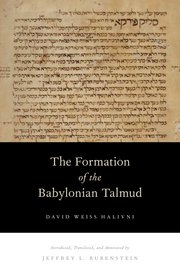
A Review of Weiss Halivni, The Formation of the Babylonian Talmud- Guest Post by Zvi Septimus

halivni picDavid Weiss Halivni, TheFormation of the Babylonian Talmud (trans. and ed. Jeffrey L. Rubenstein; Oxford: Oxford University Press, 2013). 312 (+35) pages

David Weiss Halivni began work on his Talmud commentary, Sources and Traditions, in 1968 with the publication of a volume on Seder Nashim. In the forty-five years since, Halivni has published an additional seven volumes, covering Seder Moed and Seder Nezikin. Continue reading

Standard
Dissertations, English

Recent Dissertations and Theses

Even in Israel, the new academic year is now in full swing. So this is a good time to look back at 2012-2013 dissertations and these that have been defended. Here at The Talmud Blog we’ll do our best to list the recently submitted ones that may be of interest to our readers. Please feel free to forward to us anything that we may have left out. We hope to update this post as we receive more material. Continue reading

Standard
English, Guest Posts, Reviews

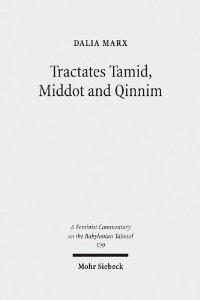
Fair and Fowl: A Review of ‘Tractates Tamid, Middot and Qinnim’ by Dalia Marx – Guest Post by Ilana Kurshan

marx reviewDalia Marx, Tractates Tamid, Middot and Qinnim. A Feminist Commentary on the Babylonian Talmud, Tübingen: Mohr Siebeck, 2013,  XII + 258 pages. €89.

A few weeks ago I was learning daf yomi while nursing my daughter when I came upon the following Talmudic passage, which begins with a quote from the Song of Songs: “‘Our little sister has no breasts.’ Rabbi Yohanan said: This refers to Eilam, who merited to learn but not to teach” (Pesachim 87a).” My infant daughter was lying bare-skinned on my breast, and I looked down at her as I puzzled over this passage. Why is having no breasts analogous to learning but not teaching? Continue reading

Standard
English, Events

The Talmud Blog LIVE- Tonight!

For those who won’t be able to make it in person, we’ll be live streaming the first session of a four part series taught by David Brodsky of Brooklyn College on “Rabbinic Literature and Its Dis-Contents: Situating the Genres of Talmud and Midrash in Their Civilizational Context.” This session is entitled “The Alexandrian School of Homeric Interpretation and the Origins of Midrash,” and will be streamed on the Drisha Institute’s ustream channel starting at 7:00pm EST. If you cannot make it live (physically or virtually), the class will be made available later for download. And as always, questions can be left in the comments section below.

Standard
English, Reviews

Daf Yomi 4 Kids: A Simulacrum of a Simulacrum of Talmud Study- Guest Post by Yoel Finkelman

dafyomikids1Recently, my seven-year old son was invited to his friend’s house on a Shabbat afternoon for a siyum. I asked this child’s father what the siyum was on. “Oh,” he responded, “He finished Berakhot in daf yomi.” My jaw dropped. He’s a bright kid and all, but I hadn’t realized what kind of a rare talmudic genius my son was playing soccer with.  Continue reading

Standard
English, Guest Posts, Reviews

Review of Elizabeth Shanks Alexander, ‘Gender and Timebound Commandments in Judaism’- Guest Post by Raphael Magarik

ShanksImplicit in the title of Elizabeth Shanks Alexander’s new book, Gender and Timebound Commandments in Judaism, is the question: What does gender have to do with “time-bound, positive commandments”? What motivates rabbinic texts to rule that women are exempt from those mitzvot? And as the phrase “in Judaism” implies, this question arrives entangled in important arguments over how Jewish women ought to practice today. Continue reading

Standard