English, Events

Coming Up

To build off of Shai’s list of upcoming Talmud related events in Jerusalem (and also off of his discussion of the place of Talmudic literature in the Israeli-Jewish Renaissance), Rehavia’s Adraba bookstore will host Prof. Avigdor Shinan of Hebrew U’s Hebrew Literature Department this Thursday night, July 14th. According to the announcement on the store’s site, Prof. Shinan will speak about rabbinic stories of the destruction of the Temple:

י”ז בתמוז בפתח ועמו מתחילים, לפי המסורת, שלושת השבועות המובילים בסופם ליום המציין את חורבן ירושלים, בימי בית ראשון ובית שני, הלוא הוא תשעה באב.

פרופ’ שנאן יתמקד בקבוצה של סיפורים מתוך ספרות האגדה העוסקים בחורבן הבית, סיבותיו ותוצאותיו.
במהלך הערב נשאל, בין השאר, האם יש בסיפורים רק הד לאירועי העבר שחלפו, או שמא יש בהם מסר לימינו אנו.

While you’re there, make sure to check out Yonatan and Rachel’s excellent collection of used and new books. Although the store’s specialty is not necessarily Jewish Studies, they regularly pick up quite an array of secondary literature pertaining to the Talmud (they sold me both Boyarin’s Carnal Israel and Epstein’s Introduction to Amoraic Literature). Also- space is limited, so try getting there early if you plan on attending.

Standard
English, Readings

A New Reading of 4Q251 8

Note: Events and reviews are the mainstay of the blog, but some original research and thoughts will of course be posted from time to time. The ideas in these posts are not finished pieces. Rather, they are ideas thrown out with the hope that they will generate comments and debate. This is a fragment I stumbled across while doing research for my MA thesis, supervised by Prof. Menahem Kahana. I thank Prof. Aharon Shemesh for the email conversation that sparked this post.

Several years ago, Aharon Shemesh (whose new book with Cana Werman was just published, and whose old books were recently reviewed by Beth Berkowitz) reread a Qumran fragment of what he termed “Midrash Mishpatim“. Designated simply and prosaically 4QHalachaa by its original editors, Shemesh was able to see through the holes in the fragment (and there were many) and posit an exciting new reconstruction of one pericope, a rewriting and commentary on Exodus 21:23.  His interpretation managed to make sense of the fragment while simultaneously reconstructing not only an interpretation of Exodus 21:23 (ונתן בפללים) heretofore unheard of, but also one that marks and explicates the exegetical element of the rewriting.

Speaking to Prof. Shemesh recently about the same fragment, I came across one other place where it is possible to offer a reconstruction along the same lines. Less exciting and revolutionary, but in this instance somewhat important, I believe, for the history of rabbinic legal history and biblical interpretation.

In the DJD reconstruction of the scroll, we read in fragment 8 (the asterisks mark letters that are not complete in the scroll, like the requisite circles above the letters in critical editions):

[כי יכה איש את עבדו או את שפחתו ]בעין [ או כי יפיל את שן]

[עבדו או אמתו לחפשי ישלחנ]*ו ונתן *ש*ב[תו ורפו]א ירפא

[תחת עינו או שנו כי יגח שור איש או ]*אשה והומת השור וסקלהו

As you can see, the words that remain in the fragment are בעין in l. 1, ונתן שב…א ירפא in l. 2 and אשה והומת השור וסקלהו in l. 3. The DJD editors decided that these words are the connection point between the midrash on Exodus 21:26-27 and idem, 28.

However, in a conversation with Prof. Shemesh, I suggested that בעין does not fit the role of the object of the blow quite well – one would expect את עינו as in MT or perhaps על עינו as in rabbinic Hebrew. בעין however is part of the talionic formula – not in Exodus, but in Deuteronomy 19:21, in the law of conspiring witnesses “עין בעין שן בשן יד ביד רגל ברגל”.

Beyond this “narrow” question of grammatical construct lies the wider question of the reliability of such reconstructions. The editors decided to read the fragment as commenting on the sequence Exodus 21:26-28, but this is but one option. The grammatical question can actually lead to the following reconstruction:

עין] בעין [ שן בשן  יד ביד

רגל ברגל כויה תחת כויה ] ונתן שב[תו ורפו]א ירפא

[כי יגח שור איש או ]*אשה והומת השור וסקלהו

This reconstruction (the DJD editors note that the first four reconstructed words in l. 3 don’t fit the estimated size of the fragment, and can be omitted) would have the fragment be the connection point between two laws that are not contiguous in the Biblical text: the law of the miscarrying woman, and the law of the goring ox. This reconstruction also lets the fragment answer an important question.

The formula “an eye for an eye” never appears as an integral part of a law in the Pentateuch, but rather has a way of being interpolated into an already existing law. As an exercise, try reading Exodus 21:22-25, Leviticus 24:16-22 and Deuteronomy 19:21 without this formula. The verses will stand on their own just fine.

4Q251 knows this, and might be creating a “new” law of assault in order to solve the problem (warning: unsubstantiated reconstruction!):

כי ינצו אנשים ונתתה עין] בעין [ שן בשן  יד ביד

רגל ברגל כויה בכויה ] ונתן שב[תו ורפו]א ירפא

[כי יגח שור איש או ]*אשה והומת השור וסקלהו

A more substantial reconstruction of line 1 might – perhaps read something like “when men fight together, and one hits the other and maims him, then you shall give eye for eye, tooth for tooth etc.”

In this new law, 4Q251 incorporates the talionic formula together with the law that compensation for lost time and medical expenses is given to the victim of a brawl (Exodus 21:19). This reading of Exodus 21:18-19 and 22-25 as parts of the same law is found in the Mekhilta according to Rabbi Ishmael (Nezikin 6 and 8 ) and the Mishnah (Bava Kama 8), and now – perhaps – also in 4Q251.

It should be noted that even if the DJD reconstruction is maintained, the inclusion of the formula from Exodus 21:19, ונתן שב…א ירפא means that Exodus 21:18-19 is read together with the other laws of injury, and not, for example, as part of the laws of murder. But I think the proposed reconstruction solves the grammatical problem and the legal problem in one swoop. It also does so more elegantly.

If so, this would be yet another example of possible connections between the school of R. Ishmael and other (almost contemporary) scripture-reading circles, such as Qumran.

Standard
English, Events

Talmud Today

Miami Boys Choir's classic album "Torah Today"

In a previous incarnation, I mentioned a symposium entitled “Talmud Now?” held at the National Library. That tireless recorder of the Israeli-Jewish Renaissance,  Menachem Mendel, has just noted that the the symposium was recorded and is now on-line. Watch it now, in all six parts.

Back in November when I posted the event, it generated a bit of discussion, particularly by mv who noted:

Two observations based on the identity of the panelists:

1. Two of the participants are rabbis, and the other two are also associated with institutions committed or associated with a religious form of Judaism (SHI, HUC). Casual Google prosopography (not serious research or personal acquaintance, so take this with a grain of salt) suggests that all come from the orthodox world.

I am not noting this to criticize the organizers or to complain against them: not every panel needs to be “representative” of the society it wishes to study or impact, but it is interesting that it includes no one from secular Israel, or at least from the institutions that identify themselves as secular (oh, one can think of Alma, a secular scholar from one of the universities, or even a poet or a novelist that is not connected with the religious institutions).

Even to the extent that this is somewhat undesirable, the blame must be shared with us secular Talmudists as well: for many years and with much resources, we have tried and failed to convince Israel’s cultural elite that the Talmud is a document worth engaging with. There are exception, of course; but Israeli culture largely ignores the Talmud, and when it does pay attention to it, it is mostly through “religious” mediators (think Kosman’s essays in one of the most prestigious fora of Israeli culture, Haaretz’s Tarbut we-Sifrut). In that sense, the panelists list itself epitomizes a problematic aspect of the issue it addresses.

Notice how Dr. Ruhama Weiss begins her remarks. After being introduced as someone who will describe Talmud study in non-religious institutions that do not feel bound by halakha, she rejects the distinction between “secular” and “religious” for her discussion.

And then, finally, listen to Dr. Yair Eldan who says precisely what was raised in the comments.  We still essentially have no true Hiloni Talmud renaissance. And on the other hand, the religious community is largely incapable of fully appreciating talmudic discourse in its great variety.

Standard
English, Events

Upcoming

Though not a Talmudist, few appreciated the dramatic potential of Summertime like Janis Joplin

It’s the summer, and some of you are swimming at the beach, hiking in the woods, and generally far away from the darkness of microfilm collections and poorly-lit reading rooms. Two upcoming events in Jerusalem will give your brain a chance to exercise and your pupils some time to readjust to the indoors.

First, tomorrow, Tuesday July 11  at 7:30pm at the Jerusalem theater, the Van Leer Institute and the Hebrew University of Jerusalem will be hosting a screening and discussion of Joseph Cedar’s Footnote – a film close to the heart of this blog and which I hope to write a review of (with Elli Fischer) for the Jewish Review of Books. Participants at the event will include Cedar himself, along with Hebrew U professors Israel Bartal, Shlomo Naeh, Avinoam Rosenak, and more.

Second, as Prof. David Halivni continues to push back the date of the redaction of the Babylonian Talmud, the renewed Jewish National Library will have Prof. Halivni give a talk next Sunday, July 17th at 1pm when he will finally ask “Was there a Redaction of the Babylonian Talmud?”

(You can submit events of interest to thetalmudblog[at]gmail[dot]com)

Standard
English, Technology

Getting the Most out of the Institute of Microfilmed Hebrew Manuscripts Catalog

Arguably the most important room in Jerusalem

This is the first of what I hope will be an ongoing series on how to use the various internet databases listed in our “Toolbox” section. Dr. Ezra Chwat of the IMHM helped me put together the instructions listed below.

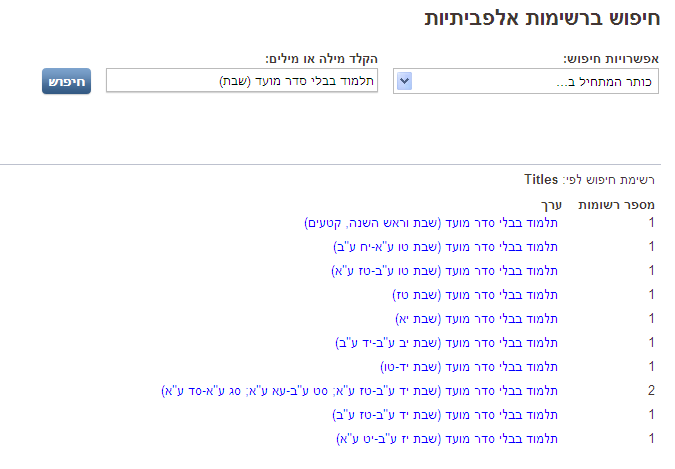
Arguably the most important room in Jerusalem, the Institute of Microfilmed Hebrew Manuscripts (IMHM) at the National Library of Israel only recently received the attention it deserves when it was featured prominently in Yossi Cedar’s film Footnote. Scenes of Professor Shkolink the father working studiously in the room’s dark lighting were more than enough to raise the excitement of philologists who for the first time truly experienced Lacan’s “mirror stage” through film. Yet so much of the information amassed by the Institute’s staff is accessible without having to deal with the odd lighting and clunky microfilm viewers. The catalog of manuscripts on its own holds a wealth of information, from the bibliographical to the codicological. The list allows you to find almost all of the textual witnesses available for the work you may be studying. For example, to find various manuscripts of Bavli Shabbat, all one has to do is click on “כותר המתחיל ב…”, and type in “תלמוד בבלי סדר מועד (שבת)”, and the catalogue immediately lists all of the complete and partial manuscripts of the tractate:

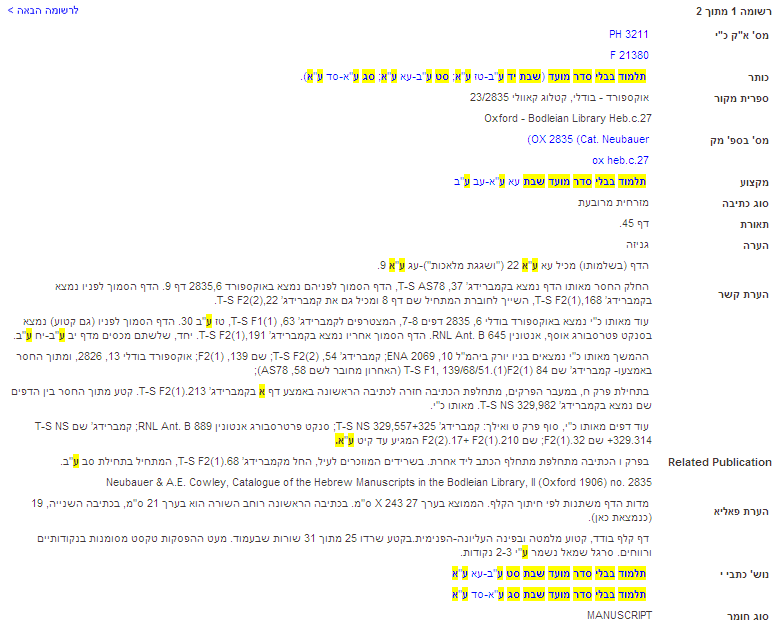
Even more importantly, the list already includes manuscripts reconstructed from various genizah fragments, with information about each part of the textual witness:

Through the advanced search (“חיפוש מתקדם”) one can even search directly for reconstructed genizah manuscripts. Within “מלים” type “מאותו כי”(make sure you don’t put a quotation mark and write כ”י), and then in the second field select “נושא כתב היד” and enter the tractate or other work that you’re trying to find genizah manuscripts for:

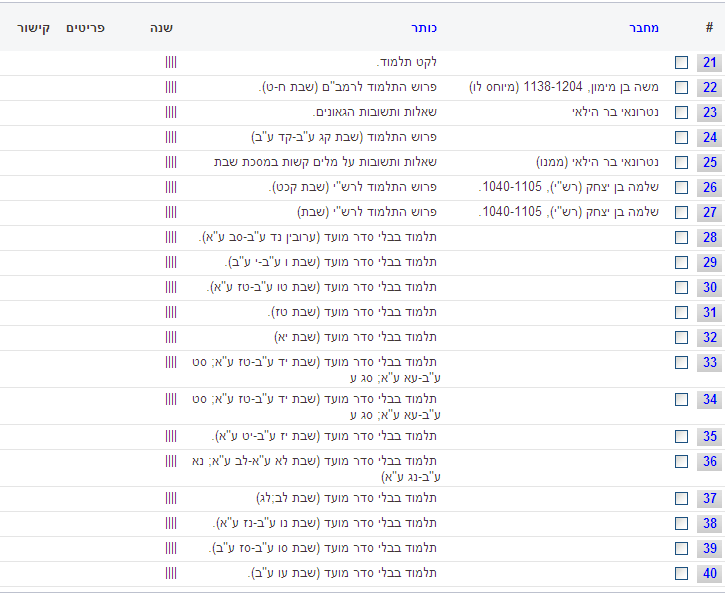
Clicking on the number that appears following the words “סך-הכול” will bring you to a list that also includes reconstructed manuscripts of commentators on the tractate you searched for:

Of course, the catalog is just a catalog, and except for textual witnesses available online (which will be hyperlinked from the results), one must get to a library with a microfilmed manuscript collection in order to make full use of the information obtained.

Standard
English, Reviews

Return of the Rabbis

In a thoughtful review of a recent translation of Benny Lau’s The Sages at Jewish Ideas Daily, Elli Fischer suggests that if we take Lau’s series for what it is – a “digest and interpretation of earlier histories, memories, and traditions in a manner that allows them to speak to the current moment” by “a 21st-century rabbi and leading figure in liberal Orthodox southern Jerusalem,” we will be rewarded.  At the very least, Lau

deserves to be treated as fairly as the rabbis of 5th-century Babylonia or 3rd-century Palestine.  That is to say, he should be read as a rabbi and not as a historian—an approach affirmed by the book’s origins as a Sabbath afternoon synagogue lecture series.

Indeed.

Standard
Conferences, English, Guest Posts

SBL Conference Day 1- Guest Post by Ari Lamm

1)     Given the quick-draw character of my notes upon which the following is based, I obviously do not claim to have represented accurately the views of the presenters or session participants themselves. These are merely my impressions of what was said. I have, on occasion, inserted my own views on various issues relating either directly or indirectly to the topic at hand. These instances have been noted.

2)     On a related front, my notes are intended primarily for my personal records. I therefore focused, for the most part, on the portions of the presentations that most interested me. If something crucial seems to be missing from my summary of given lecture, please bear in mind that this may simply reflect my lack of interest rather than the speaker’s rank incompetence, or some such.

3)     If anyone has any questions, please do not hesitate to get in touch. My email is arilamm@gmail.com

4)     As noted, the views contained herein do not represent the views of the seminar participants, nor do they represent those of the Society of Biblical Literature. All errors are, of course, society’s fault.

Immediately upon entering the Franklin-Wilkins Building of the King’s College London Waterloo campus, I remembered that I left my Tanakh at home. Serves me right, I thought, for leaving minyan a bit early to get downtown in time for the first session. Fortunately, however, we live in a digitized age, and I have the Mechon Mamre software on my computer. As the day wore on, my trusty ol’ laptop would prove crucial in providing me with the tools to follow the wide variety of (usually) excellent presentations at this year’s International Meeting of S.B.L. Incidentally, it would also allow me to take copious notes on each and every lecture I attended. These notes, I have been informed, are too lengthy for the format of this blog, so they have been substantially distilled in what follows. For those interested in the full version, stay tuned. Information on accessing them will be forthcoming.

Initially I had planned only to attend sessions related as closely as possible to my discipline (Second Temple Judaism, Rabbinics, Talmud studies, Sasanian Iran, etc.). But as soon as I set foot in the King’s College lobby and had a chance to survey the spectrum of scholars that had converged on my adopted (at least for the year) hometown, I decided to indulge my curiosity by attending as broad a variety of sessions as time and energy allowed. Not every session I visited, therefore, related strictly to the ostensible interests of this blog’s readers. I have been instructed, accordingly, to confine my remarks as much as possible to those interests. Again, those interested in the other sessions I attended should await the posting (either here or elsewhere) of the full version of my notes.

I began my day in the “Bible and Empire Consultation.” I heard several excellent presentations, including a scintillating exegesis of Isaiah 31 by a former professor of mine, Yeshiva University’s Shawn Zelig Aster, and a fascinating reinterpretation of the talion laws in Exodus 21 by Sandra Jacobs, a student of Bernard Jackson (formerly of Manchester University).

After Aster’s talk, I made my way down the hall to the “Hellenistic Judaism Section” just in time for Daniel Barbu’s (Universite de Geneve) paper, “The Invention of Idolatry.” Barbu examined LXX’s employment of the term eidolon to translate a wide variety of terms relating to foreign cultic items and ideas. Barbu traced the history of the word, noting its evolution from a term denoting an illusory image (e.g. the vision of a goddess in a dream) in Homeric Greek, to a byword for useless delusions, including false sciences and false pleasures, in the Platonic dialogues. After surveying its appearances in the LXX, Barbu noted that while Hellenistic readers would certainly have understood eidolon as a reference to cult images or false divinities, the term would have sounded slightly awkward. Barbu concluded that while eidolon is not always used uniformly to translate a given word, the fact remains that in developing a lexicon of sorts for referring to prohibited images, the LXX used eidolon to refer specifically to images of false divinities. It does not, on the other hand, use the term to refer to images of the true God (the crafting of which are themselves prohibited). This may sharpen our sense of the Biblical distinction between images of false gods on the one hand, and images of the true God on the other that some have seen as latent in the Second Commandment.

As soon as Barbu finished up, I dashed back up the hall to the “Epigraphical and Paleological Studies Pertaining to the Biblical World Section.” I had intended to catch Meir Lubetski’s (Baruch College) paper seeking to adduce fresh perspectives on the name Dmlyhw. It seems, however, that the schedule for this section had been re-shuffled. I was treated instead to a lecture by the indomitable Wilfred Lambert (University of Birmingham) on Babylonian demons in the Moussaief Collection (MC).

The first thing I noticed about Lambert was his absolutely stellar accent – I imagine Sideshow Bob would sound like this had he been born in Britain – and the age-defying sense of excitement and energy with which this near-nonagenarian delivered his talk.
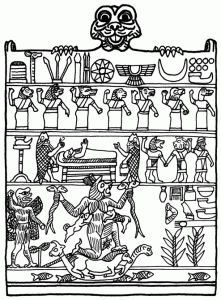
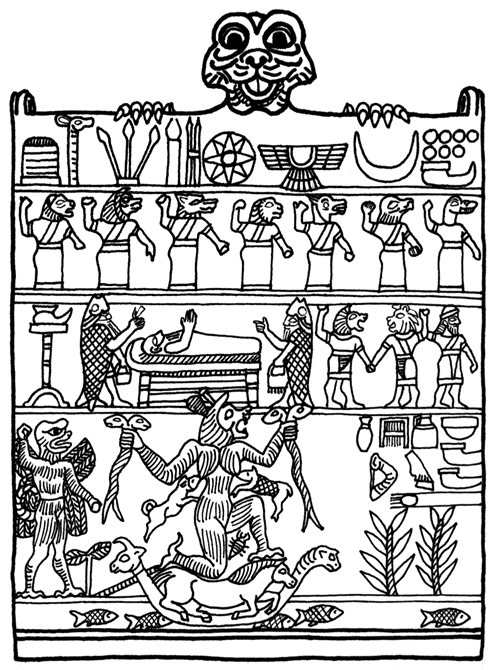
The Goddess Lamashtu, from Black and Green's Gods, Demons, and Symbols of Ancient Mesopotamia

The talk itself was, in fact, brilliant. He explored the variegated methods of depicting the demoness Lamashtu in ancient Babylonia, as exemplified by a slew of items from the MC. After explaining her identifying features – animal head, snakes held in hand, an accompanying dog and pig (whom she is sometimes suckling), etc. – Lambert pointed to what seems to be a very early depiction of Lamashtu from the 4th millennium BCE. Given that our knowledge of Lamashtu’s features are from the 1st millennium BCE, the fact that we might identify her via (some of) these very same features several thousand years earlier is quite remarkable. Lambert utilized this data to point to the Babylonian conservatism in preserving its demonological tradition. Later that day, however, one scholar at Lambert’s lecture expressed concern – apparently shared by some others at the session – over the provenance of the MC. There is much about the MC that we don’t know, he cautioned, and we should bear this in mind when discussing finds from its contents.

As the first session block came to a close, I trundled downstairs to pick up the kosher meal I had ordered when signing up for the conference, only to find that no such meals were being offered (at least at lunch). I never did find that kosher meal…

In any event, after a pleasant, if cibariously uninteresting lunch – during which I had the opportunity to meet Noah Hacham (and let him know that I used his article on III Maccabees and the Greek Additions to Esther as the basis for my dvar Torah at last year’s family Purim se’udah…) – I made my way to the “Qumran and the Dead Sea Scrolls Section.”

I only stayed for one talk: Hans Debel’s musings on the contributions of the Genesis Apocryphon and Joshua Apocryphon to our understanding of textual traditions in the Second Temple period. Debel made the point that even using the term “Apocryphon” to refer to these texts prejudices us in favor of what someone or other (I can’t recall his reference) called “the tyranny of canonical assumptions.” The rest of the lecture continued in this vein. His point struck me as either somewhat obvious, or exceedingly “meh”…depending on where you fall on the spectrum of scholars examining the role of canonicity in the Jewish textual tradition.

In any case, I took the opportunity of a five minute discussion period following Debel’s paper to hightail it for the “Assyriology and the Bible Consultation” – the first of its kind in the history of S.B.L. Space does not permit me to synopsize the many intriguing presentations delivered throughout this session, including a wonderful paper by another Yeshiva University faculty member, Shalom Holtz. Of greatest interest to me, however, was Sacha Stern’s (University College London) “bomb kashya” during the concluding discussion period.

After quietly imbibing the conclusions of a whole host of scholars seeking to explain the implications of Mesopotamian influence on Biblical traditions, Stern questioned the underlying narrative pervading these presentations, namely, that it makes sense to speak of influence between disparate ethno-cultural groups within some sort of area that we have termed “the Ancient Near East.” It is especially important, observed Stern, to be methodologically meticulous in this regard when one seeks – on the basis of some notion of “influence” – to establish a relative chronology for entire chunks of Biblical tradition, ranging from Leviticus, to Deuteronomy, to Ezekiel, and so on.

Chaos ensued as the room basically divided into two groups: those who thought that it’s, like, totally insane not to take “influence” for granted in the Biblical period (‘amiright folks?!’), and those who took the question a bit more seriously even if ultimately disagreeing. Among the latter group, Lester Grabbe led the charge in arguing that 1) there is nothing wrong with at least asking questions about similar phenomena that appear in different contexts, and 2) a sufficient number of parallels eventually make it appropriate to talk about “influence” even if we can’t show how it happened.

Stern responded by agreeing that, obviously, there is nothing wrong with asking questions. He noted, notwithstanding, that Grabbe’s criteria for positing a concept as methodologically fraught as “influence” seem particularly prone to abuse (e.g. parallelomania). My own sense is that while some scholars at this specific session – Holtz in particular – engaged admirably with the cross-cultural implications of his data set, scholars studying Rabbinics (understood broadly) have progressed way beyond Assyriologists in developing methodological safeguards for studying these sort of phenomena. And again, as far as this specific session was concerned, I had hoped – probably much like Sacha Stern – that at its inaugural event, participants would have spent at least a tiny portion of their time engaging these issues.

Eventually, we all began to shuffle out of the day’s final session. As I made my way up the Northern Line back to my apartment in Hendon, I could only smile in anticipation of tomorrow’s lectures, which promised to be even more exciting than those I attended today. On that note: stay tuned!

Ari Lamm is concluding a year as a Fulbright scholar based at University College, London and the School of Oriental and African Studies. 

Standard
Announcements, English

And We’re Off

I’m proud to announce the opening of a new collective Talmud Blog. Here scholars of rabbinic literature will find announcements (of articles, new publications, conferences, and more); a curated list of links (in the “tools” section) for aiding in talmudic research; original posts that present new research; discussions of critical methodologies, and of course the French import even more beloved than “freedom fries” – Critique.

Detail from Berakhot 2a

The Vilna edition of the Babylonian Talmud begins on page 2a. In Heder they told us that this was because there is always more to learn. Or we might retell the myth by saying that everything we encounter has a pre-history. This blog is a re-imagined version of my now defunct Talmud Blog. I do hope that you, reader, will join us in this exciting enterprise and that you will contribute to the dialogue by posting comments, and where appropriate, guest posting. In that spirit, The Talmud Blog will begin its operations with a series of guest posts by our friend Ari Lamm, who is currently attending the International SBL meeting in London.

We are all very excited about embarking on this journey together.

Standard