Announcements, English

Announcements Regarding The Talmud Blog Book Club (TBBC)

Talmud Blog reader Yael Fisch prepares for the TBBC

A little over a month ago we announced the first session of our “Book Club”.  While I’m sure many of our readers are just waiting for the moment to share their thoughts on Ishay Rosen-Zvi’s Demonic Desires, over here in Israel the first copies have only recently reached the desks of Talmudists.  For this, and other reasons, the discussion will not begin on December 15th as originally planned, but rather on January 2nd.

While everyone who has read the book and has what to say is encouraged to share, we have a few people in line to respond already: Eva Kiesele, from the Free and Hebrew Universities; Amit Gvaryahu, from Hebrew U. and The Talmud Blog; and Raphael Magarik, who has already reviewed the book for Jewish Ideas Daily. Other tentative respondents include Simcha Gross from Yale University and Noah Greenfield from UC Berkeley.

Shai will be MC’ing the discussion, and we’re hoping that the the author himself will respond once it finally winds down.  And of course you, dear reader, are invited to weigh in as well.

Standard
Announcements, English

The Academy

A lot has changed since my father called me into his office at Children’s Hospital, some two decades ago, to show me something called “The World Wide Web”. The adolescent gaming nerd that I was, I pictured some kind of apocalyptic computer game about venomous spiders that harbored imperialistic designs. Actually, the truth was far more eschatological, and depending on your perspective, apocalyptic, than I could ever have imagined. The Internet has changed Everything. It is the proverbial dramatic event that casts a shadow over every utterance, every thought in its wake.

Since its inception, the Talmud Blog has endeavored to create a new kind of discourse in the field of Rabbinics, and hopefully beyond. It partially grew out of a dissatisfaction with the spaces available for scholarly communication. For some of us, the sparring articles in journals and books, the hidden footnotes, the local symposia, and the bigger conferences, are too slow and not dynamic enough. With the development and perfection of social networking tools, the future is now.

As a portal to the future, The Talmud Blog is now hosting a number of “Special Projects.” Here, we’ll be presenting new spaces for dialogue. One is The Book Club, where we will be discussing recent books.  Another project is a new kind of forum for scholarly conversation among Talmudists, called ‘The Academy‘.  It is essentially a closed ‘circle’ on Google+, where free-flowing conversation can take place among specialists. We started a pilot version (The Academy 1.0) with a dozen guinea-pig Talmudists, and it has been quite a success. We’re now opening up the Beta version. If you’re a critically trained and producing (that is, publishing) Talmudist, now is the time to participate in this cutting-edge endeavor. And we need you to make this project a success.

To get started, open a Google+ account for yourself, and fill in your areas of expertise and/or academic interest in the relevant spots in your profile. Make sure you activate the ability to receive messages.  Create a Google+ circle called ‘The Academy.’  Then, search for “Resh Metivta”  in the Google+ search bar, and add him as a friend in the academy circle. Once you do that we’ll send you an e-mail with further instructions.  We look forward to seeing you at the Academy, where you can spin your own talmudic web.

Standard
English, Talk of the Town

Captivated

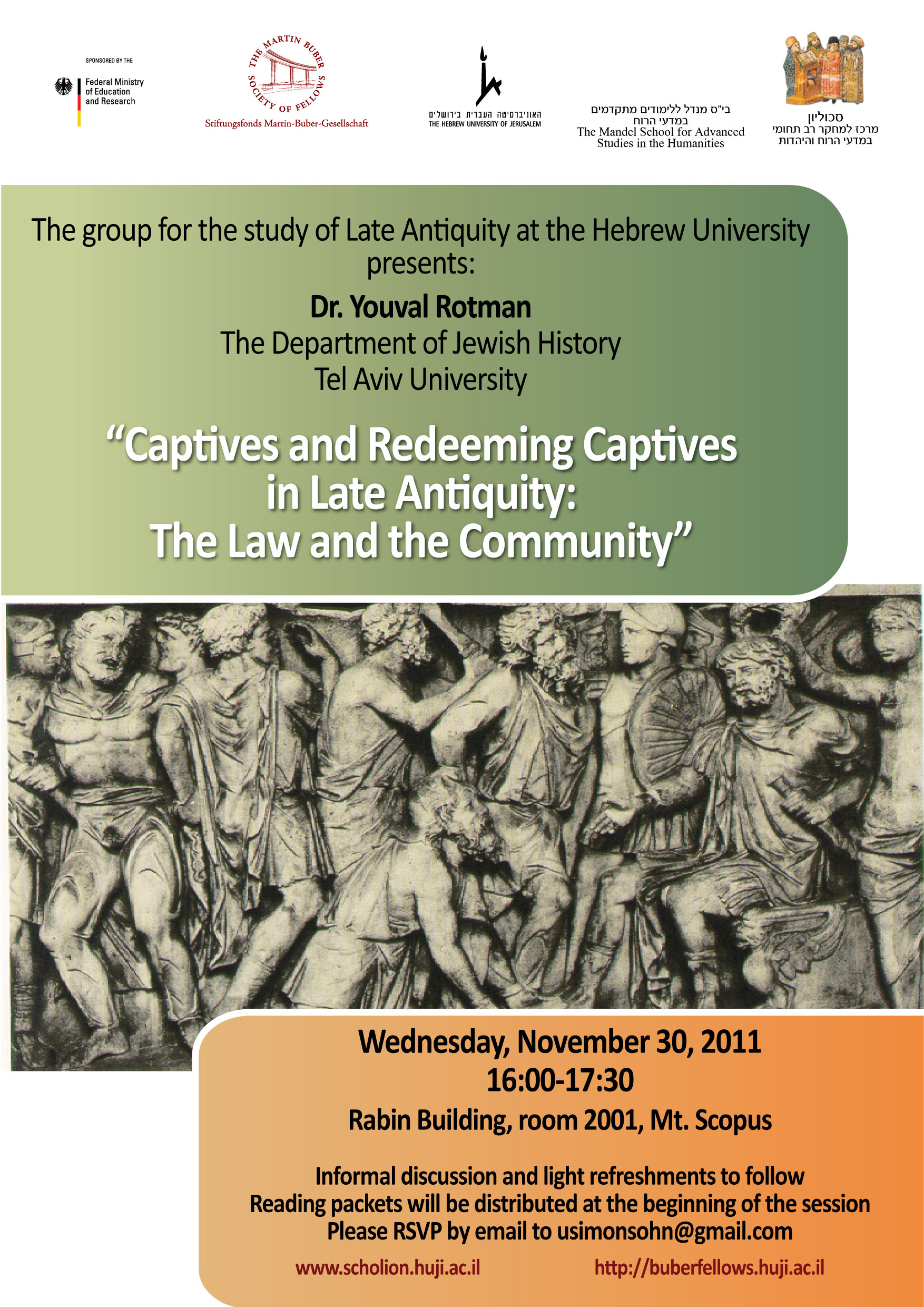
Last night, Dr. Youval Rotman of Tel Aviv University lead the inaugural discussion of Hebrew University’s  Group for the Study of Late Antiquity. The Group, which was started by Uriel Simonsohn and I in order to create an active scholarly community for researchers working on different corners of late antiquity, will be meeting monthly for group text-study and conversations, topped off by cheese, crackers, and Israeli wine as robust as the discussions.

Rotman’s topic was “Captives and Redeeming Captives in Late Antiquity: The Law and the Community,” and a crowd upwards of 30 (that’s in quantity, though I suppose also in age) read texts by Ambros, Tertullian (and more), along with rabbinic sources from the Mishna, Tosefta, and Babylonian Talmud (sources are available here).  A number of interesting trends were noted, included an apparent development in communal solidarity that turned captive redemption from a more private, family affair into a public,  community-based activity.  A connected issue that came up was the role of the state, or lack thereof, in redeeming captives.  Apparently, once you hit late antiquity Roman and Byzantine legislation forbids the state from redeeming prisoners of war.

I wonder whether the following, fascinating anecdote about Ifra Hormiz somehow reflects  those two points:

איפרהורמיז אימיה דשבור מלכא שדרה ארנקא דדינרי לקמיה דרב יוסף אמרה ליה ליהוי מצוה רבה יתיב רב יוסף וקא מעיין בה מאי ניהי מצוה רבה אמ’ ליה אביי מדתני רב שמואל בר יוסף אין פוסקין צדקה על היתומים ואפלו לפדיון שבוים שמע מינה פדיון שבוים מצוה רבה היא

Ifra Hormiz the mother of King Shapur sent a moneybag of dinars to Rav Yosef. She said to him: Let it be for a great mitzvah. Rav Yosef was sitting and looking into it –  what could be a great mitzvah?  Abaye said to him: Since Rav Shmuel b. Yosef taught that we do not levy money for charity from orphans even for the redemption of captives, it may be concluded that the redemption of captives is a great mitvah. (b. Bava Batra 8a-b; according to MS Hamburg).

The story is fascinating for a number of reasons. But in the meantime it is noteworthy that the talmudic storyteller has the queen-mother essentially delegating (and funding) rabbis to redeem (Jewish?) captives – as opposed to having the Sasanian state take care of it by itself. And it is the rabbis as a group who are in charge of captive redemption – as we also find at b. Taan 22a, where a case of captive redemption (apparently – though see the MSS) “visits upon” the rabbis, again apparently as a group.

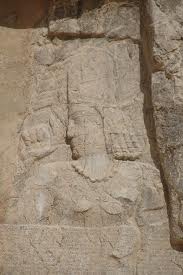
Next up is Prof. Shaul Shaked, who will be speaking on January 3rd on “Zoroastrianism: A Religion of the Book.” For that I leave you with the following, thought-provoking picture – courtesy of my friend Dan Sheffield who has been digitizing a treasure-trove of photograph’s by the late Mary Boyce.

Standard
Announcements, Around the Web, English

Around the Web and Around Town- November 30, 2011

Yes, we know, it’s been a while since our last around the web post.  This is mainly due to our Twitter feed, which has been covering a lot of internet based Talmudic going-ons.  If you want to stay up-to-date, make sure you regularly check the feed on the sidebar.

Princeton Tigers Logo.svgFirst, in local news, we’d like to give a big Talmud Blog welcome to the most recent addition to our staff- Sarit Kattan-Gribetz!  Sarit joins us from the Religion Department of Princeton University, where she is working towards her PhD.

Yeshiva University reference librarian Zvi Erenyl has put together a handy guide for users of his library looking to research Ancient Judaism.  Many of the links that he has compiled in the guide’s different sections (Primary Sources: Jewish, Epigraphy, Archaeology, etc.) are to fully open-access sites, and most of the rest should be accessible through any university library.  Along with Zvi’s blurbs on each resource, the site is a valuable tool for all.

As blogged by Menachem Mendel, The Schocken Institute for Jewish Studies of the Jewish Theological Seminary is now running an ebookstore.  The price is definitely right for the majority of the titles, for example: Moshe Assis’ A Concordance of Amoraic Terms, Expressions and Phrases in the Yerushalmi is selling for fifteen dollars a volume as an ebook, as opposed to the $145 for the three volume set in print.  Some books have also been out of print for sometime, such as Lieberman’s Sifre Zuta/Talmuda shel Keisarin, and the Facsimile edition of MS JTSA No. 44830 to Avodah Zarah prepared by Abramson.  It seems like they are still adding books.  Personally, I would love to be able to download Finkelstein’s facsimile of the Sifra according to Codex Assemani LXVI.  Menachem Mendel pointed out that the site doesn’t have any information on the electronic format of the books. I called Schocken up to ask them, and it turns out that the books are available in PDF.  Still, they weren’t sure about printing options, searchability, and whether one could open the files up on multiple computers.  After purchasing and downloading one of the files,  I can tell you that there is no search, but that the volumes can be opened on as many computers as you would like and can printed with no problem.

Two exhibits going on now in New York that are related to Talmudic literature should be of interest to our readers. They have both been covered heavily online over the past few months, but just in case you missed them, here they are:

1) “The Dead Sea Scrolls: Life and Faith in Biblical Times” exhibit at Discovery Times Square makes the Scrolls seem much more exciting than the Shrine of the Book does.  Even better, the exhibit saves the trip to the Kotel.

2) “Edge of Empires: Pagans, Jews, and Christians at Roman Dura-Europos” at the museum of New York University’s Institute for the Study of the Ancient World displays artifacts from the Yale University Art Gallery.  I managed to visit before I returned to Israel a few months ago and I highly suggest going.  While cleaning up the blog recently, we even came across the post-which-never-was:

“This is so incredible!”, sighed the pony-tailed man in the exhibition’s opening hall.  As the only other visitor there at the time, it was clear that he was talking to me, and I acknowledged the power of what was on display.  “And it’s so incredible that we’re here at the same time.  I mean, I’m an Orthodox priest, and you must be an Orthodox Jew- what better way to look at these artifacts!”.

After briefly sharing our names and points of origin- he had driven from North Carolina to see the exhibit- our conversation quickly turned to the Gospels’ Jewish context.  It turned out that my new friend the priest was a big believer in the importance of studying early Christianity’s Jewish context, and I got to telling him about the tenents of the Jerusalem School (I suggested he read Flusser and Notley’s The Sage From Galilee).  His exclamation that sparked the conversation was correct.  Seeing the map of Dura Europos and noting the proximity of the town’s synagoguehouse church, and Mithraeum, I couldn’t help but be impressed by the multiethnicity of the city’s blocks.

The exhibit’s two rooms are filled with quite an array of artifacts from Dura, displaying aspects of daily life in the city and especially, ritual life.  The collection, as has been noted on many other online forums, brings together objects from all diferent religious walks of life.  One room also is also lined with black and white photos of Yale’s 1930s digs, many of which are available on their site.

As the catalog admits, the exhibit’s goal is not “to provide a comprehensive historical overview of Dura-Europos”, but to focus on Dura “as a strategic Roman garrison-city, and the ways in which this role created a pluralistic urban society”.  The exhibit accomplishes this more modest goal exquisitely.

Standard
English, Recent Publications, Talk of the Town

Of Intertexts, Rugelach, and Marginalia: Discussing Boyarin’s Intertextuality upon its Appearance in Hebrew

As noted a few weeks ago on The Talmud Blog, Boyarin’s Intertextuality and the Reading of Midrash is now out in Hebrew, after a long wait. Last night, students, havrutot, friends, and admirers of Boyarin and Boyarenesque scholarship coalesced at Jerusalem’s Shalom Hartman Institute to celebrate the appearance of Midrash Tannaim – the Hebrew title of Intertextuality. The three speakers, introduced by Prof. Galit Hasan-Rokem, dealt with different parts of Boyarin’s Torah as it pertains to their own fields of expertise.

Professor Menahem Kahana, a scholar of Midrashic literature and the head of Hebrew University’s department of Talmud and Halakha (!), reminisced about the times when he and “Danny” (Hebrew- “Donny“) would engage in philological exploits into the depths of the Mekhilta. Such exploits engendered two very different scholarly tomes- Boyarin’s Intertextuality and Kahana’s Mekhiltot. Kahana, whose praises for Intertextuailty are listed in Ishay Rosen-Zvi’s afterword to Midrash Tannaim, chose to argue for more historical understandings than those presented by Boyarin in his early work. In his own words, “The multi-vocality of history is no less important than the multi-vocality of the text”. Of course, historically attuned readings are quite present in Boyarin’s later work, and the other speakers also struggled with critically engaging a book more than two decades after its initial publication, whose author no longer fully agrees with everything he wrote in it.

Dr. Dina Stein of the department of Hebrew and Comparative Literature at Haifa University also began with a personal story involving her and Boyarin. Years ago, she had purchased a copy of Todorov’s Symbolism and Interpretation from a used bookstore in Berkeley. She soon realized that the copy in her possession had originally belonged to Boyarin, who had referenced relevant rabbinic passages in the book’s margins, as can be seen in the picture to the right. Yet those passages, to the best of her knowledge, are surprisingly absent from Boyarin’s published work. Stein also pointed out that not only were those stories left out, but the book in which they were cited had left Boyarin’s library, first to a store that is no longer even open, and then, redemptively, to a fellow Rabbinics scholar. Indeed, those changes are perhaps symbolic of a deeper shift apparent in Boyarin’s scholarly output: A move from the semiotics of midrash, of understanding rabbinic hermeneutics to work in “an almost too perfect” way, to historicist readings of the rabbis. As Stein suggested, perhaps Intertextuaility is Boyarin’s Shir haShirim. In his response, Boyarin acknowledged that Socrates might be his Kohelet, but added that that is because the Bavli is the Kohelet of the Rabbis (“בעיניי, הבבלי הוא הקהלת של חז”ל”).

In his distinctly clear yet sharp style, Dr. Joshua Levinson of Hebrew University’s department of Hebrew Literature presented an overview of Intertextuality‘s continued influence on rabbinic studies. Instead of deciding what exegesis is and then asking whether rabbinic midrash fits the criteria, Boyarin took the text’s claim to be exegetical seriously and then asked what its hermeneutic methods are. Levinson then showed how such an outlook affected research into other genres of rabbinic literature, such as the exegetical narratives of Genesis Rabbah- Levinson’s own field of expertise in which he has pioneered new paths of understanding.

Although speakers came from as far away as Berkeley and Haifa, the evening’s overall atmosphere was characteristically Jerusalemite, and not just because of the rugelach from Marzipan or the classically South Jerusalem institution in which it was held. Rather, what created the special ambiance was the very presence of such scholars on the same stage, along with an audience of researchers and students of Talmud, Jewish thought, and literature in what seemed like a mixture that can only come into being in Jerusalem. Despite their differences, and regardless of which ‘Boyarin’ they prefer most, all in attendance seemed more than happy to gather in appreciation of their shared teacher.

Standard
Conferences, English

Next Month: AJS

In case you need some convincing to go to the AJS next month, here are some sessions that might persuade you to make the trip to DC.

Three trends of note:  (1) There seems to be new interest in thinking through the formation and construction of the self (the gendered self, the religious self, the embodied self), and the idea of personhood in rabbinic sources.  (2)  The recent fascination with reading rabbinic texts in conversation with legal theory and comparative legal systems has continued.  (3) Irano-Talmudica is still going strong, and there’s a “second generation” now!

Talmudic redaction, material culture, rabbinic exegesis, and rabbis in Greco-Roman and Christian contexts are also well-represented this year.  That means there’s something for everyone…

Sunday, 9:30-11am: The Androgyne: Breaking the Gender Binary in Rabbinic Law and Literature (Grand Hyatt Washington, Renwick)

“Defying the Binary?: The Androgynus in Tosefta Bikkurim,” Sara Lev (Reconstructionist Rabbinical College)

“Stoning the ANDROGYNUS: Subverting the Boundaries of Masculinity,” Max Strassfeld (Stanford University)

“Seed and Sexuality: Rabbinic Concerns about Female Semination,” Tirzah Meacham (University of Toronto)

Chair: Judith Hauptman (The Jewish Theological Seminary)

Sunday, 11:15-1pm: The Formation of the Religious Self in Ancient Judaism (Grand Hyatt Washington, Penn A)

Abstract: This panel examines ancient Jewish texts in an effort to reconstruct the regimen of pious behaviors they seek to inculcate. The ancient Jewish texts we explore advocate the repeated performance of certain behaviors and the avoidance of others. This panel explores what was at stake when they did so. We examine several regimens of pious behavior (disciplining the senses, training one’s vision and daily performance of the Shema rituals) and argue that these regimens regulated the interaction between practitioners and the world around them, even while they led to the creation of religious subjects. We note that regimens of pious behavior gradually transformed the subject by steering him away from postures that were deemed to be unproductive or harmful and towards those that were assumed to edify and ennoble. Rather than merely changing the external behavior of the practitioner, regimens of pious behavior effected a fundamental change in how the practitioner located himself within his environment. Regimes of pious behavior sought to form the self and subjectivity of the religious practitioner. The panel contributes to our understanding of the dynamics of ancient Jewish religion by 1) highlighting how religious life operates in the concrete physical and sensory domain, and 2) showing that cultivating patterns of behavior – rather than dictating doctrine – leads to the construction of the religious self.
Chair: Steven P. Weitzman (Stanford University)

“Sensory Disciplining and Construction of the Self in the Book of Proverbs,” Greg Schmidt Goering (University of Virginia)

“Prohibition and the Production of the Rabbinic Self,” Rachel Neis (University of Michigan)

“The Shema Rituals and the Embodied Self in Tannaitic Literature,” Elizabeth Shanks Alexander (University of Virginia)

Respondent: Steven P. Weitzman (Stanford University)

Sunday, 4:15-6:15: Materiality and Politics in Jewish Antiquity (Grand Hyatt Washington, Lafayette Park)

“Hellenistic Diaspora Narratives and the Construction of an Embodied Self,” Francoise Mirguet (Arizona State University)

“Idols in Color: Polychromy, Avodah Zara and Jewish Views of Imperial Roman Sculpture,” Steven Fine (Yeshiva University)

“Preliminary Observations on the Occurrence of Ritual Implements and Iconography at the Ostia Synagogue,” Joshua Ezra Burns (Marquette University)

“The Maccabean Revolt: Who Is to Be Blamed?,” Louis H. Feldman (Yeshiva University)

Chair: Hayim Lapin (University of Maryland)

Sunday, 4:15-6:15: Rabbinic Theology: Radicalism and Revisionism (Grand Hyatt Washington, Roosevelt)

“Season(s) of Judgment: Competing Notions of Divine Justice in m. Rosh Hashana 1:2,” Joshua Cahan (The Jewish Theological Seminary)

“Crumbling Walls & Faltering Houses: Aggadic Dialectic on Disaster, Merit, and Miracle in Bavli Taanit,” Julia Watts Belser (Harvard Divinity School)

“Cultural Enthusiasm: The Transmission of The Sugya of ‘AVERA- LISHMA’ (Transgress for God’s sake),” Yuval Blankovsky (Universitaet Potsdam)

“The Paulinian and Matthean Moments of Rabbinic QABBALAT HATORAH,” Aryeh Cohen (American Jewish University)

Chair: Michael Pitkowsky (Jewish Theological Seminary)

Monday, 8:30-10:30am: Theory and History of Talmudic Redaction (Grand Hyatt Washington, Renwick)

“Caesarean Revisions and the History of the Talmud,” Moulie Vidas (University of California, Davis)

“Stylistic and Mnemonic Factors as Clues to the Intellectual History and Evolution of a Talmudic Text,” Jay Rovner (The Jewish Theological Seminary)

“‘Impurity in Public is Overridden Because the Headplate Renders it Acceptable’ – On Bavli Reconceptualization of Tannaitic Legal Thought,” Leib Moscovitz (Bar-Ilan University)

“Mingling Moments: Conjunctive Time and Rabbinic Modes of Temporality in the Babylonian Talmud,” Lynn Kaye (New York University)

Chair: Yonatan Feintuch (Bar-Ilan University)

Monday, 11am-12:45pm: Rabbinic and Medieval Exegesis (Grand Hyatt Washington, Constitution C)

“Parsing the Poetic Genre of the Song of Songs in Early Rabbinic Interpretation,” Jonathan Kaplan (Yale University)

“Peshat in the Torah Commentary of Moses ben Nahman (Ramban),” Martin I. Lockshin (York University)

“Nahmanides’ Structural Analysis of the Pattern and Design of Biblical Narrative,” Michelle J. Levine (Stern College)

“The Apocalyptic Messiah in Pesiqta Rabbati,” Rivka Ulmer (Bucknell University)

Chair: Naomi Grunhaus (Yeshiva University)

Monday, 2-4pm: Studies in Irano-Talmudica: The Next Generation (Grand Hyatt Washington, Constitution B)

Abstract: The field of Irano-Talmudica, as it has been dubbed by Shai Secunda, is expanding at an ever more rapid rate, and this panel is primarily dedicated to introducing new faces in the field, including three doctoral candidates whose dissertations are nearly completed, and their work, and one more senior new face, that of Dr. Mahnaz Moazami, of Columbia University’s Center for Iranian Studies who also teaching Middle Persian at Yeshiva University.  Samuel Thrope, a doctoral candidate at the University of California at Berekeley, presents a study that involves a fresh rethinking of the way to view the Skand Gumānīg Wizār, the “Doubt-Smashing Document,” a Zoroastrian religious polemic against Judaism, Christianity and Manichaeism. Thrope examines its very polemical interpretation of the Garden of Eden story and explores what it reveals of the author’s wider intentions.  The other papers involve various aspects of the Zoroastrian legal system and their relations—convergent or divergent—to rabbinic concerns. Yishai Kiel of Hebrew University and Shanah Schick of Yeshiva University deal with question of liability and intention in ritual and legal contexts and compare Zoroastrian approaches to parallel rabbinic texts. Mahnaz Moazami of Columbia University and Yaakov Elman examine the intersection of rabbinic and Sasanian exegesis of their respective scriptures and legal/ritual issues.  Mahnaz Moazami of Columbia University and Yaakov Elman of Yeshiva University deal with an interesting case of the intersection of legal and exegetical concerns in the Babylonian Talmud and the Pahlavi Vidēvdād, both fifth-century Sasanian compilations.

“Bad Seed: Rewriting the Garden of Eden in a Zoroastrian Critique of Judaism,” Samuel Thrope (University of California, Berkeley)

“Intention and Negligence in Rabbinic and Zoroastrian Tort Law,” Shana A. Strauch Schick (Bar-Ilan University)

“‘Shared Liability’ in Rabbinic and Zoroastrian Literature: A Comparative Analysis,” Yishai Kiel (The Hebrew University of Jerusalem)

“Scriptural and Unscriptural Prohibitions: Zoroastrian and Rabbinic Sin-Counting and the Severity of Atonement,” Yaakov Elman (Yeshiva University) and Mahnaz Moazami (Columbia University)

Chair: Steven Fine (Yeshiva University)

Monday, 4:30-6:30pm: Gender and Genesis: An Interdisciplinary Approach to Rachel and Leah (Grand Hyatt Washington, Constitution C)

Abstract: Rachel and Leah are paradigms of sororal relationships in the Bible, and the authors of Genesis use their rivalry to propel the narrative and to ensure the fall of Laban. Rabbinic midrash excerbates or ameliorates the sisters’ rivalry to serve their exegetical needs. Medieval kabbalists invert the rivalry and place Leah in higher esteem than Rachel. This theological twist gave rise to innovative rituals first introduced in Safed, and still practiced today among some Hasidim. Male biblical authors, the Rabbis and Kabbalists used Rachel and Leah to serve their narrative, exegetical, and theological needs. Modern Israeli female poets reclaim Rachel and Leah and see them as part of a new sorority.

“Rachel and Leah: Dangerous Sisters and the Fall of the House of Laban,” Amy Kalmanofsky (The Jewish Theological Seminary)

“Strange Bedfellows: Rachel and Leah and Jacob,” Gwynn Kessler (Swarthmore College)

Respondent: Wendy Ilene Zierler (Hebrew Union College – Jewish Institute of Religion)

Chair: Wendy Ilene Zierler (Hebrew Union College – Jewish Institute of Religion)

Monday, 4:30-6:30pm: Rabbinic Rhetoric (Grand Hyatt Washington, Roosevelt)

Abstract: This panel will focus on rabbinic thought, with particular interest in the role rhetorical devices and rhetoric as a discipline play in the late ancient corpus of rabbinic texts in its
various genres, analyzed from literary, intellectual, and historical standpoints and contexts. We will begin discussion by setting up a theoretical and historical framework in which to illuminate the complex relationships between philosophical, rhetorical and rabbinic traditions in the scope of ancient and late ancient period. We will begin by setting up a theoretical and historical framework in which to illuminate the complex relationships between philosophical, rhetorical and rabbinic traditions in the scope of the late ancient period. The notion of truth in relationship to law will serve as a conceptual focus of the discussion in the panel. We will continue by exploring the relationships between philosophical truth and rhetorical readings of the text of the Talmuds through a case study of textual redundancy as a source of truth in interpretation. We will then broaden the scope of the discussion by looking into literary-rhetorical forms of the Babylonian Talmud as a whole in terms of finalized truth reached through seemingly open dialectical discussion in individual sugyot in contrast to overall open-endedness of the Talmud as a larger literary unit or a “book.” We will conclude by looking even more broadly into the role of the rhetorical device of refutation in making claims of the legal truth in Rabbinic tradition in the Mishnah, and its interpretation in the Bavli. Each paper will take up to 20 minutes, and the time that remains will be given to questions from the floor and to general discussion.

“Gorgias and the Rabbis: Rhetoric, Law, and Truth in the Talmud,” Richard Hidary (Yeshiva University)

“The Rules of Redundancy: How Changes in Rabbinic Rules of Exegesis Contributed to the Growing Complexity of Sugyot,” David Brodsky (New York University)

“Rhetorical Ends of the Talmud: From Local Conclusiveness to Metatextual Openness,” Zvi Septimus (Harvard University)

“PERITROPE (Self-Refutation) in Sextus Empiricus and the Rabbinic discourse,” Sergey Dolgopolski (University at Buffalo, SUNY)

Chair: Barry Scott Wimpfheimer (Northwestern University)

Tuesday, 8:30-10:30: The Making of Rabbinic Law, Power, and Authority (Grand Hyatt Washington, Renwick)

“Rabbinic Specialization,” Tzvi Michael Novick (University of Notre Dame)

“The Study of Tannaitic Law in its Ancient Legal Context,” Jonathan Milgram (The Jewish Theological Seminary)

“Narrating the Trial of Herod/Jannaeus: Late Antique Jewish Conceptions of Law and Power,” David C. Flatto (Pennsylvania State University)

“The Image of Moses in SIFRE ZUTA and the Construction of Rabbinic Authority,” Nehemia Polen (Hebrew College)

Chair: Christine Hayes (Yale University)

Tuesday, 10:45am-12:45pm: Comparative Contextualizations of Jewish Legal History (Grand Hyatt Washington, Independence I)

Abstract: This panel offers a critical comparison of historical moments of intersection between rabbinic legal culture and non-rabbinic contexts. Our objective is to situate specific rabbinic legal ideas within their diverse antique or late antique contexts through case-study comparisons with neighboring legal traditions. The panel’s theoretical goal is to assert that rabbinic and non-rabbinic legal similarities result not merely from “borrowing” or from “influence,” but from historical instances of dialectic interchange, from shared customary traditions, and from shared contexts.  Each of the three papers uses a doctrinal case study to address broad questions of comparison and contextualization. Two of the papers examine issues related to the legal treatment of the MOREDET (the recalcitrant or insubordinate wife) from the perspective of two distinct historical contexts: one Sasanian and the other Islamic. One paper scrutinizes the relationship between Sasanian and Jewish practices by exploring how the MOREDET is classified, what legal ramifications result from her status, and the procedure of document issuance. Another paper investigates how a Gaonic decree concerning the MOREDET has been interpreted within rabbinic historiography and seeks to historicize the relationship between this decree and its presumed Islamic context. The third paper continues the panel’s theme of comparative contextualization by examining the relationship between Roman and rabbinic discussions of animals as legal subjects, with particular focus on how the Mishnah’s treatment of the matter relates to Roman legal (and philosophical) ideas.  By presenting these three distinct perspectives on rabbinic law, this panel challenges some aspects of the emplotted – to use Hayden White’s terminology – historical narrative of Jewish law. In so doing, we seek to problematize the boundary between rabbinic and non-rabbinic in the historical construction of rabbinic legal authority.

“Animals as Legal Subjects in Roman and Rabbinic Law,” Beth A. Berkowitz (The Jewish Theological Seminary)

“The Disobedient Wife in Sasanian and Rabbinic Law,” Shai Secunda (The Hebrew University of Jerusalem)

“The Recalcitrant Wife in Jewish Law and Islamic Context,” Lena Salaymeh (University of California, Berkeley)

Respondent: Charlotte Elisheva Fonrobert (Stanford University)

Chair: Jeffrey L. Rubenstein (New York University)

Tuesday, 1:45-3:45pm: New Perspectives on Eating and Identity in Jewish Studies (Grand Hyatt Washington, Independence G)

“In Defense of Kosher Food: Ancient Apologies for KASHRUT,” Jordan D. Rosenblum (University of Wisconsin-Madison)

Tuesday, 1:45-3:45pm: Rituals and Ritual Concepts in Mishnah and Tosefta (Grand Hyatt Washington, Renwick)

“The Multiple Speech Acts of the Cemetery Blessing,” Yehuda Septimus (Brooklyn College / Touro College)

“Extending Greetings to the Other,” Michael Pitkowsky (Jewish Theological Seminary)

“Concepts of Pollution in Numbers 5 and Mishnah SOTAH,” Eve Levavi Feinstein (Independent Scholar)

Chair: Elizabeth Shanks Alexander (University of Virginia)

Tuesday, 4-5:45pm: Jews and Christians in Late Antiquity (Grand Hyatt Washington, Independence I)

“Performance and Piety: Theaters and Synagogues in Later Rabbinic Culture,” Loren R. Spielman (Portland State University)

“Shifting attitudes to time, society, and calendars in Jewish and Christian late Antiquity,” Sacha Stern (University College London)

Chair: Jonathan Milgram (The Jewish Theological Seminary)

Standard
Announcements, English

Pet Projects

I am involved in two new and exciting projects at Hebrew U that although at some distance from academic Talmud, may be of interest to some readers of this blog.  The first is the Group for the Study of Late Antiquity organized by Uriel Simonsohn and I.  This is a series of working seminars for late antiquists at Hebrew U and other Israeli universities to get together, read texts and discuss new research projects over wine and cheese.  Each meeting will be lead by a different scholar working on a different corner  of the field.  The first meeting will be held next week on Wednesday November 30.

With Domenico Agostini and Eva Kiesele I also have begun a project of reading and translating a fascinating Middle Persian text entitled Zand ­fragard ī jud-dēw-dād.  This text lay languishing in manuscript (and facsimile) until quite recently, when Goetz Koenig discussed it at an Iranian studies conference, and Yaakov Elman, P. Oktor Skjaervo, Mahnaz Moazami, Yishai Kiel, and I were drawn to it – mainly  on account of its legal sophistication. This is a work that bears some as yet undefined relationship to the Pahlavi Videvdad – a Zoroastrian Middle Persian translation and “midrash” on an Avestan book of that name largely concerned with the laws of ritual impurity. Aside from its rabbinic-like legal conceptualization and reasoning, I have already written about its great potential for illuminating the way in which Middle Persian texts were redacted during the Sasanian and early Islamic period, and perhaps even the Bavli. Before anything, however, we need to carefully read through all 250 pages of it.

Standard
Conferences, English

If You’re Going to San Francisco…

For those attending the SBL/AAR, here is a quick round up of rabbinics-related sessions and panels of interest.  And for those not attending, now you will at least know what people are talking about. Following the list, there are additional papers that are not part of rabbinics-only panels.  If there are papers missing, feel free to add them in the comments.  And if you’re at the conference, feel free to discuss the sessions as they happen. 

Friday, 8:20 to 10:25am: A Reassessment of the Synagogue in Late Antiquity: Between Continuity and Renewal 
Room: A30 Grand Ballroom

The session aims to explore developments relating to the primary and central Jewish institution of Late Antiquity, the synagogue, from the diachronic and synchronic perspectives.
Lee I. Levine, Hebrew University of Jerusalem, Presiding
Introduction (5 min.)
Jodi Magness, University of North Carolina,
The Chronology of Late Antique Synagogues in Palestine (20 min.)
Zeev Weiss, Hebrew University of Jerusalem,
The Synagogue in Ancient Palestine: Shaping Sacred Space in the Byzantine Realm (15 min.)
Lee I. Levine, Hebrew University of Jerusalem, The Flourishing of Jewish Art in Late Antiquity (15 min.)
Jonathan Price, Tel Aviv University,
The Place of Synagogue Inscriptions in the Epigraphic Culture of the Roman Near East (20 min.)
Ophir Münz-Manor, Open University of Israel, The Talmud Blog,
The Ancient Synagogue in its Byzantine-Christian Context: The Case of Hebrew Liturgical Poetry (Piyyut) (20 min.)

Sunday, 1:00 PM to 3:30 PM – S20-226: History and Literature of Early Rabbinic Judaism
Room: Grand Ballroom C – Intercontinental

Christine Hayes, Yale University, Presiding
Lee Levine, Hebrew University of Jerusalem
The Emergence of the Patriarchate: A Third or Fourth Century Phenomenon? (20 min)
Discussion (10 min)
Holger Michael Zellentin, University of Nottingham
No Exit: Punishment, Hell, and Early Byzantium According to the Talmud Yerushalmi (20 min)
Discussion (10 min)
Michael Rosenberg, Jewish Theological Seminary of America
On the Immersion of Proselytes: Identity Marker, or Purification? (20 min)
Discussion (10 min)
Discussion (10 min)
David Brodsky, Reconstructionist Rabbinical College
From Disagreement to Talmudic Discourse: Progymnasmata and the Evolution of the Talmudic Sugya (20 min)

Monday, 9:00 AM to 11:30 AM: From the Babylonian Exile through the Babylonian Talmud: An Interdisciplinary Approach to Ancient Judaism
Room: 3008 – Convention Center

The centuries between the time of the Babylonian Exile and the flourishing of rabbinic Judaism as embodied in the Babylonian Talmud were marked by wide-ranging religious transformations, literary developments, and social and cultural growth. The Journal of Ancient Judaism and the JAJ Supplement Series address this crucial period. Celebrating our first two years of publication we invite scholars in the field to discuss the concept of Ancient Judaism by asking for the distinctions and continuities between the Israel of Biblical times, Second Temple Judaism, and the Judaism that developed under the rabbis.

Maxine Grossman, University of Maryland College Park, Presiding
Armin Lange, Universität Wien, Presiding
Thomas Römer, Université de Lausanne, Panelist
James VanderKam, University of Notre Dame, Panelist
Lawrence Schiffman, Yeshiva University, Panelist
Christine Hayes, Yale University, Panelist
James Kugel, Bar Ilan University, Panelist

Monday, 1:00 PM to 3:30 PM – S21-221: History and Literature of Early Rabbinic Judaism
Room: 3000 – Convention Center

Theme: Review of Legal Fictions: Studies of Law and Narrative in the Discursive Worlds of Ancient Jewish Sectarians and Sages, by Steven Fraade

Alyssa Gray, Hebrew Union College – Jewish Institute of Religion (New York Branch), Presiding
Moshe Bernstein, Yeshiva University, Panelist
Charlotte Fonrobert, Stanford University, Panelist
Jonathan Klawans, Boston University, Panelist
Richard Sarason, Hebrew Union College – Jewish Institute of Religion, Panelist
Steven Fraade, Yale University, Respondent
Business Meeting (30 min)

Monday, 1:00 PM to 3:30 PM – S21-229: Midrash
Room: Mission II & III – Renaissance Parc 55

Theme: Egyptian Cultural Icons in Midrash
This panel discussion is devoted to the topic of the significance of Egypt in Midrashic texts, with a particular focus on a critical consideration of “Egyptian Cultural Icons in Midrash” by Rivka Ulmer.

W. David Nelson, Groton School, Presiding
Susan Tower Hollis, Empire State College, State University of New York, Panelist (20 min)
Isaac Kalimi, University of Chicago, Panelist (20 min)
Deborah Green, University of Oregon, Panelist (20 min)
Steven Daniel Sacks, Cornell College, Panelist (20 min)
Yaakov Elman, Yeshiva University, Panelist (20 min)
Rivka Ulmer, Bucknell University, Respondent (20 min)
Discussion (30 min)

Tuesday, 9:00 AM to 11:30 AM – S22-119: History and Literature of Early Rabbinic Judaism
Room: Sierra J – Marriott Marquis

Theme: Methodological Considerations for the Study of the Babylonian Talmud in Light of Syriac and Middle Persian Sources

Carol Bakhos, University of California-Los Angeles, Presiding
Yaakov Elman, Yeshiva University, Panelist (20 min)
Richard Kalmin, Jewish Theological Seminary of America, Panelist (20 min)
Prods Oktor Skjaervo, Harvard University, Panelist (20 min)
Michal Bar-Asher Siegal, Tel Aviv University, Panelist (20 min)
Richard Payne, Mount Holyoke College, Panelist (20 min)
Adam Becker, New York University, Panelist (20 min)
Discussion (30 min)

Tuesday, 9:00 AM to 10:30 AM – S22-127: Midrash
Room: Twin Peaks – Intercontinental

Theme: Meaning and Messianism in Midrash

W. David Nelson, Groton School, Presiding
Serge Ruzer, Hebrew University of Jerusalem
Comprehensive Messianic Midrash in the Making: From 1 Enoch to Gospels to Genesis Rabbah (20 min)
Rachel Adelman, Harvard University
Preempting the Redemption: The Bones of the Ephraimites and the Messianic Pretender in Midrash (20 min)
Jonathan Kaplan, Yale University
Finding the Elusive Lover: Early Rabbinic Re-reading of the Song of Songs as a Statement of God’s Abiding Presence with Israel (20 min)
Marc Bregman, University of North Carolina at Greensboro
The Early History of Midrashic Texts (20 min)
Discussion (10 min)

Additional papers of interest:

Sunday, 9:00 AM to 11:30 AM – S20-130a – Meals in the Greco-Roman World
Room: 3012 – Convention Center

Food and Identity in Early Rabbinic Judaism Jordan D. Rosenblum, University of Wisconsin-Madison

Sunday, 1:00 PM to 3:30 PM – S20-220a – Early Jewish Christian Relations
Room: Cyril Magnin I – Renaissance Parc 55

Rabbis and Disciples of Jesus—A Conflict Over Interpretive Authority Karin Hedner Zetterholm, Lund University

There’s Something about Mary’s Child: Rabbinic Polemics and the Early Christian Scribal Reception of the Infancy Gospel of Thomas Stephen J. Davis, Yale University

Sunday, 3:00 pm-4:30 pm – A20-275 – Lesbian-Feminist Issues and Religion Group and Religion and Disability Studies Group

Brides and Blemishes: Queering Women’s Disability in the Babylonian Talmud, Julia Watts Belser, Missouri State University

Sunday, 4:00 PM to 6:30 PM – S20-340 – Speech and Talk: Discourses and Social Practices in the Ancient Mediterranean World
Room: Yerba Buena 15 – Marriott Marquis

Décor, Decorum, and Declamation: The Spatial Setting of Rabbinic Speech Gil Klein, Loyola Marymount University
The Memory of Hagar’s Talk in Christian and Jewish Texts Marianne Kartzow, Universitetet i Oslo

Sunday, 4:00 PM to 6:30 PM – S20-337 – Rhetoric and the New Testament
Room: Nob Hill D – Marriott Marquis

Early Rabbinic Rhetoric: An Introductory Catalogue Jack N. Lightstone, Brock University

Monday, 9:00 AM to 11:00 AM – S21-143 – Sensory Perception in the Bible and Early Judaism and Christianity
Room: Sierra J – Marriott Marquis

The Garden of Eden: A Sensual Study in Rabbinic Midrash Deborah Green, University of Oregon

Monday, 1:00 PM to 3:30 PM – S21-211a – Chronicles-Ezra-Nehemiah
Room: Golden Gate C3 – Marriott Marquis

The Voluntary Nature of the Nehemiah Covenant in Rabbinic Literature David A. Glatt-Gilad, Ben-Gurion University of the Negev

Monday, 4:00 PM to 6:30 PM – S21-304
Biblical Hebrew Poetry
Room: 2012 – Convention Center

Did the Rabbis “Forget” Parallelism? A Reassessment of Biblical Hebrew Parallelism in Tannaitic Midrashim Jonathan Kaplan, Yale University

Monday, 4:00 PM to 6:30 PM – S21-331 – Religious Competition in the Third Century CE: Interdisciplinary Approaches
Room: Yerba Buena 12 – Marriott Marquis

Inscription as Competition: Graffiti and Cultural Identity in the Greco-Roman Levant Karen B. Stern, Brooklyn College of City University of New York
. Authority and Empire in Sasanian Persia: The Socio-cultural Interface between the Babylonian Sages and Zoroastrian Priests  Jason Mokhtarian, Indiana University (Bloomington)
Gregg Gardner, University of British Columbia, Respondent

Standard
English, Recent Publications

Reading List

To the two things that are certain in life, death and taxes, I would add foiled grand plans. My grand plan was to survey recent dissertations that discuss various aspects of purity in rabbinic literature – it seems that purity is the new fad now in rabbinics – but I haven’t gotten around to reading all of them yet.

Instead, in the interim, I present to you some short observations on the new books section at the Mt. Scopus library.

1. Ben Dunning’s Specters of Paul is fascinating. Just like Rosen-Zvi’s work on Sotah, Dunning is not content with merely pointing out androcentrism in Paul. Instead, he asks himself what this androcentrism is and what it does. He finds that androcentrism takes on many shapes and forms in Paul, amounting to a cacophony of voices in the Pauline corpus on what women are, what we can do with them, what sex, gender and “sexual difference” (apparently a term coined by Luce Irigaray) do in various parts of the corpus, and how these rifts played out in the work of later readers of Paul. Dunning’s interest and focus on these later readers is refreshing, and is thankfully removed from the Protestant turn towards  the “Original” texts and their intent. His focus on the contemporary politics of his readings of Paul – and of course the politics of reading Paul at all, what with his being blamed for everything bad that befell the Jews, ever – is a bit overbearing.

2. Liah Keshet wrote a dissertation under Yaakov Zussman on the Aggada of the Yerushalmi. She created a corpus of Aggadot in y. Maas. Shen. and Maas. and contrasted them with the Aggadot in y. Nezikin. The methodology might be a bit dubious – she says as much herself, asking what  an aggada is and how we should collect them – but the result is a wonderful edition and commentary on large swaths of Yerushalmi,  performed meticulously and cleanly in Zussman-like style, copious notes and all.

3. Paul’s Jewish Matrix is a collection of articles edited by Thomas G. Casey and Justin Taylor that comprises a collection of essays of varying quality on Jewish (“Judaic”) elements in Paul. Menachem Kister is conspicuously absent from the list of authors, which does include Daniel Schwartz on a possible halakhic reading of Romans 14:14 and Shaye Cohen on a similar kind of reading of Paul’s stance on intermarriage.  As Yair Furstenburg noted in a comment at the Talmud Blog’s “Academy” (editor’s note: stay tuned for an announcement about this exciting pilot project), there is still much to discover in Paul as far as his halakhic and other Jewish heritage is concerned. This book is not yet the collection of essays that would tackle that problem.

4. Back to reception studies, The Sword of Judith is a delightful panoply of articles on the reception and transmission of the Judith story in the Jewish, Christian, and dramatic traditions (yes, you read that right). It is an interesting approach, bringing together surveys that are very text-oriented (e.g. Deborah L. Gera’s “The Jewish Textual Traditions” with a list of medieval Jewish Judith stories) with the more esoteric, such as “Judith in Baroque Oratorio” (David Marsh). I wonder if there is any possibility for these kinds of studies in other areas – perhaps a book on rabbinics in Israeli film? An study of the reception of the Dead Sea Scrolls in 1950s Israel? Roni Shweka, perhaps?

Hopefully, soon, I will make time for the five dissertations that await their rightful place in the blog post about  them, entitled “Purity and Dissertation.”

Standard
English, Ruminations

Class Notes: Kirdir’s Persecutions

Historians, especially Jewish historians, love talking about religious persecutions. But what do we mean by religious persecutions of Jews?

The other day in class, I spent a bit of time discussing a few lines in a series of inscriptions commissioned by the powerful third century Zoroastrian priest’s, Kirdīr.  In the inscriptions, Kirdīr boasts of his many “good” deeds, including persecution of Jews, Shamans (Buddhists), Bramans (Hindus), Christians (perhaps Greek-speaking Christians), “Nāṣrā” (perhaps “indigenous” Aramaic-speaking Christians), “Makdags” (perhaps “Baptists” – and even Mandaeans), and “Zandīgs” (Manicheans).  Many Jewish historians have attempted to connect this line to references to “persecution” of the Jews at the hands of the magi preserved in the Talmud, including three decrees attributed to Zoroastrian priests against slaughtering meat, bathing (or perhaps also ritual immersion), and regular burial. More recently, Talmudists (like Richard Kalmin) have called into question the historicity or reliability of some of the talmudic parallels to the inscription. The relevant talmudic passages are heirs to supremely complex redactional histories that muddle their usability for straightforward historical reconstructions. On the other hand, as Oktor Skjaervo has pointed out, this part of Kirdīr’s inscriptions have perhaps been over-interpreted, since most of what Kirdīr writes is couched in traditional Zoroastrian terminology (including this passage’s use of the term zad – “struck down” – to describe what Kirdīr did to these different communities). This terminology is used more to convey an idealized, mythical image of the place of these other religions in the view of a third century Zoroastrian priest than to present an accurate historical picture of real persecution. In class we also juxtaposed the inscription to a passage from the Zoroastrian compilation Šāyest nē Šāyest and saw a similar attempt at creating a catalog of other religions that expressed a certain view of the world, not an historical reality.

Even if Zoroastrian priests did actually forbid Jews to ritually slaughter their meat, can this be understood as a religious persecution, that is an act directed at keeping Jews from performing their ancestral laws? Perhaps, as Geoffrey Herman has suggested, the decrees simply reflect a Zoroastrian problem with Jewish slaughter, since the latter casts blood upon the sacred earth. The same could be said in regards to burial which pollutes the earth, and as I suggested in my dissertation, in regards to immersion after menstruation which might be seen as contaminating water. In other words, how do I know Jewish persecution, and “antisemitism” when I see it in Sasanian Iran?

A friend of mine who works in the field of modern Jewish history recently sent me the following press-release about a consortium that researches antisemitism and racism:

An international research consortium to promote the study of antisemitism is launched today (Tuesday 8 November, 2011). The International Consortium for Research on Antisemitism and Racism (ICRAR) involves leading scholars from universities and institutes across Europe, Israel and the US, who share the common goal of revitalising and reshaping the study of antisemitism. The Consortium will promote rigorous, independent research that looks to related fields and other disciplines for insight and embraces new theoretical and methodological approaches.

Co-convened by David Feldman, Pears Institute for the study of Antisemitism, Birkbeck, University of London and Scott Ury, Stephen Roth Institute for the Study of Contemporary Antisemitism and Racism, Tel Aviv University, the formation of the Consortium has been driven by concern that the study of antisemitism lags behind other fields of scholarly enquiry.

To promote and foster new thinking on antisemitism the Consortium will hold annual workshops and summer schools and produce publications of the outcomes. Its first workshop will be Boycotts: Past and Present. This will be held in London in 2012, hosted by the Pears Institute for the study of Antisemitism.

For more information on the International Consortium for Research on Antisemitism and Racism please e-mail:  ICRAR@bbk.ac.uk.

For better or for worse, as students of antiquity we often keep our distance from these sorts of projects. I wonder, however, if the methodological findings of this consortium’s research centers will have what to teach us about antisemitism in antiquity, and for that matter in Sasanian Mesopotamia.

Standard