English, Technology

Talking about a Revolution

In the wake of the Artscroll dinner a few nights ago, there has been lots of chatter about a mega-app recently developed for the Artscroll Schottenstein Talmud. Yesterday, Artscroll released an over-the-top, hyperbolic clip that shows some of the amazing things this app will do…when it is released in time for the new daf yomi cycle this summer |(h/t to Menachem Mendel) .

Out of a nice conversation with my constant dialogue partner, the Adderabbi, the following thoughts emerged: Don’t get me wrong, Artscroll’s decision to embrace technology by creating a forward-thinking, e-book experience (and not merely digitizing books) is significant and laudatory. And make no mistake, even if they embarrassingly overuse the verb “elucidate”, you have to hand it to them. The first ‘Artscroll Revolution’ democratized Talmud study (including, certainly against their will, opening it up to women, to say nothing of non-Jews), and vastly changed the map of who was involved in Talmud study.

Yet, with all the bells and whistles the new app looks like it will continue to perpetuate the sense one has while reading from a Schottenstein Talmud; that this is a fully coherent canon, even if every generation adds new insights channeled through a group of bearded men with positions of rabbinic authority, whose thoughts are collected in footnotes at the bottom of the page. The exhilarating experience of approaching a text where so much remains open-ended, gloriously ‘problematic’, and unaccounted for – and hence awaiting serious readers of all stripes and types to realize its meanings in a myriad of ways – is lost.  A very well-funded, supposedly revolutionary app like this one is a kind of lost opportunity if it does not truly democratize Talmud study and turn it into a massive, ongoing, virtual conversation.

A couple of months ago, the Talmud Blog experimented with using google+ as a forum  for scholarly dialogue. Despite our efforts, it is mainly dormant now, though one wonders what might be if someone were to develop an app  that allows people who have new insights into words, readings, and meanings in the Bavli to converse with each other over some kind of virtual medium. The possibilities are tantalizing and endless. I suppose we’ll have to wait a bit longer to see future.

Standard
English, Postscripts, Ruminations, Technology

The Walking Book

The other week, Leil Leibovitz lodged a complaint against the e-sefer and bemoaned the way that the iPad and its peers strip away the sense of holiness from the traditional experience of studying Talmud. Leibovitz laments the loss of the traditional talmudic tome – a hefty medium that commands our absolute attention.  His complaint is particularly directed at the chussen shas‘ (the gargantuan set of talmudic tomes traditionally given to a groom before marriage) replacement- a sleek device that effortlessly allows its users to flit indiscriminately between Bava Qamma and Angry Birds.

On top of that, Leibovitz has this to say:

One reason Jews have managed to survive for millennia while other, mightier and more populous religious and ethnic groups vanished is our ability to engage in never-ending debate about the tenets of our faith. Rather than demand obeisance to tradition and rejection of modern developments or local customs, Judaism invites its adherents to argue, just as long as they’re all arguing about the same thing.

This is all low-hanging fruit, and some of it surprisingly misguided. As Yitz reminds me, the story of Jewish textual transmission has been one of adaptation. Jews  have moved along with the evolution of different media, even if at a pace different than their neighbors.  Scrolls gave way to  codices, which made way for the printed press. We have merely arrived at the next paradigm.

Over at the New Yorker, Adam Gopnik recently crafted a taxonomy of the great “the-internet-has-irrevocably-changed us” lament.  The same article might have been written about the loss of printed books and their replacement with e-readers – an act of mourning that I am surely joined in by readers of this blog (Here is merely the most recent and gorgeous example, by Leon Wieseltier). The point of Gopnik’s taxonomy, of course, is that a little perspective is in order. Indeed.

In one fundamental way the e-reader actually perpetuates an older trend in Jewish learning, that of the handy and portable talmudic volume, which could be taken anywhere and allow Talmud scholars to realize the rabbinic vision of constant study (“day and night”). Whether through the Hebrewbooks app, ובלכתך בדרך or iTalmud, I find myself carving out more time to study than ever. It is a kind of De Certeauian response to the unstoppable onslaught of media that races through our portable devices.

My old high-school principal, Rabbi Yosef Tendler, recently passed away. He was a gigantic man in more than a physical sense, and he cultivated a culture of total and constant dedication to Torah study. His mournful mantra – also constant – was “you’re wasting your life,” and in this he furthered the school of the Gaon of Vilna and its obsession with industriousness  – where sins were deemed particularly tragic because of the time lost while committing them. It was not for everyone, and some students could not handle the pressure.  For those of us who survived (and thrived) in this environment, the results have stayed with us even during stages and moments in life where such an ideal is all too often out of reach. The circadian rhythms of yeshiva life are indelible. Sometimes, vegged out on the couch on a late winter Thursday night (mishmar!), I still go into a funk.

Rabbi Tendler’s device of choice was an elegant portable talmudic tractate. As they like to say, he did not leave home without it.  Rabbi Tendler used it to both forge ahead in his private course of study and also to review learning already acquired. The message was the medium, and the medium signified the constantly-studying Jew. Yet the portable Shas was no fetish. It hearkened back to the “pervasive orality” (Elman’s term) of rabbinic literature, with its reciters and walking books. When I learned (over the internet) that Rabbi Tendler died in early February, I realized that one of those walking books would walk this blessed earth no more.

Standard
English, Reviews

Reviews Galore

While the Talmud Blog assumes that readers will regularly check its constantly-updated twitter feed (accessible on the top-right of this page and through twitter), there are times when things tweeted might also be blogged, for emphasis. Since 1970, the Journal for the Study of Judaism has been one of the most important journals in the field. Its interests lean heavily “ancient” and not necessarily rabbinic (hence the subtitle “in the Persian, Hellenistic, and Roman Periods”), but there usually are a few directly relevant reviews. The reviews section is indispensable and the current issue is no exception.  Aside from a”rabbinically” focused article by Arnon Atzmon that studies the petihta using a kind of hybridic methodology (with a test case from Leviticus Rabba, Aharei Mot and its Tanhuma parallels), and a solid restatement of Aryeh Edrei and Doron Mendel’s view of a Western and Eastern (Babylonia and Palestine) Diasporic split, we have a very extensive short-review section. Highlights include another review of Thomas Kazan’s Issues of Impurity in Early Judaism, and one of Maren Neihoff’s Jewish Exegesis and Homeric Scholarship in Alexandria; Jonathan Klawans has a review of Vered Noam’s book on purity, Dvora E. Weisberg looks at Tamara Or’s Feminist Commentary on Bavli Betsah, one of the first of the ongoing to series to be published, and Steven Fraade has a brief but very helpful review of Aharon Shemesh’s Halakhah in the Making. While the genre of the short-review does not allow reviewers to fully articulate a critical take on the work in question, it sure is a great way to stay abreast in an ever expanding field.

N.B. The ‘books received’ section also has a few gems. I, for one, would love to get my hands on The Scepter Shall Not Depart from Judah: Leadership, Rabbinate and Community in Jewish History: Studies Presented to Professor Simon Schwarzfuchs (Jerusalem: The Bialik Institute, 2011), and anxiously await Stemberger’s updated Einleitung in Talmud und Midrasch (München: Verlag C. H. Beck, 2011; Ninth Revised Edition).

Standard
Book Club, English

Definite Article – The Book Club II

The ‘stammaitic consensus’, like many so-called consensuses, has paradoxically not yet achieved a total consensus. Still, aside from persistent skepticism emanating mainly from Israeli scholars, the stammaitic ‘toolbox’ has virtually become the source-critical method in use among academic Talmud scholars working in the field today.

There have in recent years been two interesting challenges to the stammaitic theory of redaction (I do not consider skepticism interesting – even if it is well placed). One, by Moulie Vidas,  questions why anonymity has become synonymous with “lateness” and a final editorial layer if we occasionally find the Stam actively removing attributions – apparently in order to create a distancing effect. Vidas asks source-critics to consider the literary function of anonymity and not only its presumed editorial function.  As of yet, we only have a few examples of the phenomenon of Stammaitic ‘tampering’, but it remains a very interesting argument worth following.

In Zvi Septimus’ recent research, we find another sort of challenge. Zvi questions one of the basic methodologies of “stammaitists”; namely, the attempt to chart a kind of redactional narrative across different sugyot which develops – ever so cleanly – from a set of literary kernels into a masterful and final talmudic mosaic. Like Vidas, Septimus is also interested in literary function – though here not of textual anonymity rather the experiential process of reading the Bavli. As he points out in his “Trigger Words and Simultexts – The Experience of Reading the Bavli,” one can read source-critically and still discover a far more interactive and far less teleological process of talmudic production that questions some basic axioms of contemporary talmudic source criticism. This realization points in the direction of an implied reader, which in turn can go a long way in explaining what the Talmud is ‘really’ about. I won’t give it away, however, since you should go read it here, and then listen to what our participants have to say, below.

Septimus’ article is the subject of the Talmud Blog’s second Book Club not only because it has implications for redactional theory, a pet interest of this blog. The piece is a nice example of how to read the Bavli from the perspective of contemporary literary theories.  Surprisingly, while there are many scholars interested in the “literary” parts of the Talmud, there are very few actively producing readings informed by literary theory. As such, we’ve invited two scholars, Itay Marienberg-Milikowsky and Dina Stein, who are  engaged in just such an ongoing project of reading rabbinic literature as… literature (!), and who are also interested in the processes of reading Talmud. We also strongly encourage our readers to respond to the article and to the respondents. And finally, we’ve invited the author of the article himself to rise from his theoretical death and respond to Dina and Itay’s remarks. Fear not, since you need not take anything he says into account.

Dina Stein (Department of Hebrew and Comparative Literature; Haifa University):

Zvi Septimus should be congratulated on several accounts – for his instating the word “experience” into the practice of reading the Bavli, as well as for his breaking through the narrow quarters of the sugya as the widest possible signifying context in the Bavli. And above all – for writing an incredibly lively, thought provoking essay.

Zvi proposes to replace the diachronic perspective of source criticism with a synchronic perspective of inter (or rather intra-) textuality within the Bavli, indicated by “trigger words”/”simultexts”. Placing himself as somewhat of a (monstrous) heir to Fraenkel he too assumes closure – albeit closure of the entire Bavli. Here, the notion of Iser’s “implied reader” is called upon, so as to rule out any confusion regarding a concrete, historical reader (and to avoid of course historical questions such as when was the Bavli as a whole first recognized, and by whom, and so on). No, the reader is an immune textual construct.

Yet, both “experience” and the new horizons that Zvi offers are not devoid of problems. The “experience” of reading is somewhat misleading since the reader is a hypostasized entity that could hardly be credited with “experience.” More important, the emancipating notion, that the framework within which a given tale should – or can – be read is as vast as the Bavli itself, maybe less liberating than it appears at first. Why should the boundaries of the Bavli be canonized (Zvi explicitly compares the Bavli’s self-glossing poetics to the poetics of the Bible a la Boyarin et al!) in order for the intra-textual principle to function as hermeneutic tool? It is not necessary in my view. It may even raise more problems than it solves.

Twenty five years ago Galit Hasan-Rokem published an article called “The Snake at the Wedding: a Semiotic Reconstruction of the Comparative method of Folk Narrative Research” (ARV: Scandinavian Yearbook of Folklore 43 [1987]: 73-87). There are striking similarities between that article and Zvi’s recent project (they even share some “trigger words”), insofar as both consciously shift the lens from philological, diachronic perspectives to a synchronic reading/construction of meaning. Hasan-Rokem employed tools developed originally by the philological-diachronic perspective of the geographical-historical school of folkloristics, i.e. the tale-type and the motif. Following the semiotician Yuri Lotman who wrote about “sign signals” (to other texts), motifs and fixed bundles of motifs amounting to “tale types” served her to construct possible intertexual environments within which a given text – in this case the story of the bridegroom who dies on his wedding night (Vayiqrah Rabbah 20:3) – signifies. Now Hasan-Rokem addressed texts that are not confined to a single composition or to the rabbinic corpus per se, thus allowing for a more fluid context. By referring to motifs and tale-types as “semiotic markers,” her model also implies that the intertextual framework includes oral traditions, which most of rabbinic literature was.

Applying Hasan-Rokem’s model to Zvi’s argument would shift the very heavy burden lying on the shoulders of the (implied) reader to the realm of cultural semiotics in which different texts share “trigger words” (and themes). The legitimacy for reading these texts in relation to each other would not be compromised. Moreover, the hypostasized “reader” need not be chained to what is assumed to be a fixed canonized composition. “Trigger words” in the Bavli can indeed help us reconstruct cultural associations without necessarily erecting yet another set of (imperializing) boundaries, or imagining closure.

Itay Marienberg-Milikowsky (Department of Hebrew Literature, Ben-Gurion University of the Negev).

Zvi Septimus’s article “Trigger Words and Simultexts – The Experience of Reading the Bavli” adds to a growing body of research that attempts to chart a path between two nearly opposite approaches to the talmudic text: the first emphasizes the foreignness of its elements, resulting in a long and dispersed process of creation; the second highlights the aesthetic quality of the final edited form, which gives it a seemingly uniform appearance. The first leans upon evident, necessarily partial seams, meant to merge distinct sources; the latter draws its strength from the success of the act of sewing, which makes the Babylonian Talmud a stylized, comprehensive text. A careful, self-aware movement between such different modes of discourse must lead to a third approach – and indeed Septimus suggest a very coherent one. By means of an extensive and thorough (and surprising!) analysis of a relatively ‘entangled’ story in the forth chapter of Kiddushin tractate (70a-b), the author demonstrates a new reading method, based on two fundamental claims: (A) The source-critical approach (represented here, and not by coincidence, by the work of Shamma Friedman), does not reflect the (non-critical) reader’s experience, therefore, even if it may explain some stages in the evolution of the talmudic text, it will never supply a theory of reading. (B) The “literary” approach (represented here, again by no coincidence, by the work of Jonah Fraenkel), which ignores the fact that the Babylonian Talmud, as a literary complex, constantly breaches the ‘segirut’ (I find ‘closure’, suggested by Jeffrey Rubenstein, the closest translation of the concept) of the story embedded in it,  when connecting it to other stories from different suggiyot. The combination of the two approaches defines the “Septimusian” reader: He is guided by “trigger words” to simultaneously read text-fragments that were originally far from each other, not in order to decompose them into its primary and secondary components, but to illuminate one another as wholes, in their final design; (ונמצאו “דברי תורה עניים במקומן ועשירים במקום אחר” (ירושלמי ראש-השנה, פ”ג ה”ה

This approach is definitely thought-provoking and requires a lengthier discussion; yet in the limitations of this blessed “Virtual Beit midrash” of which I am a new guest (I take this opportunity to thank Shai Secunda and Yitz Landes for their generous invitation), I will have to suffice with short words of evaluation of some of the theoretical choices made by the author, and maybe suggest possible alternatives.

The attempt to read different Talmudic stories together calls into question the aforesaid assumption, associated with Fraenkel, of ‘segirut’. This assumption, discussed in recent years by Jeffrey Rubenstein and Joshua Levinson, considers Fraenkel a prominent representative of New Criticism in the study of Rabbinic literature. Accordingly, and according to Fraenkel’s words, segirut has “external” and “internal” aspects: its mere existence renounces any affinity to non-literary fields (historical, biographical, etc.), and at the same time to inter-literary contexts (textual sequences, parallels). The two aspects combine into one: they are different expressions of “unity” or “cohesion”, which justify reading the Talmudic text through the “hermeneutic circle” – all these are key phrases – meaning, a story ought to be understood from within itself, as a unique artistic expression (and not, Fraenkel emphasizes, a variant of a pre-existing structure). Septimus, sailing away from Fraenkel’s model, does not doubt the segirut as a hermeneutic category, but raises it from a low order to a higher one: from the single story to the Babylonian Talmud as a whole. But the segirut of a short story does not resemble that of an enormous complex text; whereas the latter reflects a tendency of a loosely unified literature, well known to every learner of the Bavli, the former claims something as for the precise, condensed and focused “aestheticization” of the literary expression, randomly set in its pages (it is no coincidence that New Criticism was most fertile when analyzing poetry, especially lyric poetry, rather than prose; its fruitful use with rabbinic literature is made possible primarily thanks to the minimalistic nature of the aggadic story).  The two types of segirut are as two dimensions of the creative story-telling work of the Bavli, which are active simultaneously, and are competing for the establishment of its meaning and its poetic design: the “Narrative art” on one hand, and the “Art of Narrative Connections” (to the local suggya or to the Bavli as a whole) on the other hand.

Is the reading experience of the Bavli – be it imaginary or abstract – necessarily a harmonious experience? Considering the aforesaid, it is possible to suggest another possibility that corresponds to Septimus’ proposal. I believe that a slightly different adaptation of Fraenkel and Friedman’s point of view could pave the third, different way (that could coexist with some post-structuralistic reading practices). This approach may be of aid while attempting to perceive the Talmudic text as a “dynamic” literary framework, in which something “occurs”: a frame within which different creative motivations act as forces. Thus, for instance, instead of converting an obvious axis of development between two stories in the Bavli (Friedman) into pointing out a “static” intertextual relation between them (Septimus), perhaps we should see the intertextual mechanism as one of the strategies (poetic, rhetoric, or in this case – connective) that the Suggiyot use to try and control the meanings of the stories embedded in them, and navigate these meanings to serve the Suggiya’s needs. At the same time, instead of converting the segirut of the single story (Fraenkel) into the segirut of the Bavli as a whole (Septimus), perhaps we should see both types of segirut as if they are challenging each other, revealing the interplay between control and resistance (thanks to the existence of the single tailored story as an independent aesthetic object, with an inner consistency and a distinct ideological world. This description must not be misunderstood; I emphasize here that I do not refer to any polarized manner of “control” and “resistance” relations, nor a strict binary categorization which ranges from “hegemonic discourse” and “subversive discourse”, but to much more meaningful and intricate games of meaning; as Bakhtin teaches us: two shades of understanding can still engage in a dialogue). Surely, the dynamism of the text is obvious when one thinks of it in a diachronic perspective. However, identifying with Septimus’ criticism of the difficulties inherent in basing a reading theory on source-criticism, my suggestion is to see the synchronic reading as a performative act of reading that reflects the inner dynamism of the Talmudic text. Following this line of thought, in the case of the story discussed in the article, an interesting question concerns its violent nature, the (carnivalesque) manner in which it goes “out of control”, and the reciprocal relations between this literary process, and the first subject of the chapter, which deals with different and sometimes problematic personal statutes (‘asara yochasin’); ואכמ”ל .

Septimus successfully uses Iser’s “implied reader” to ensure, among other things, that the reader whose experience the article wishes to restore is not an actual, historical subject, but an imaginary construct, supposedly produced by the Talmudic text itself, out of the connections that weave together its different parts. This is probably one of the most intriguing “implied readers” one could think of, and the inspiring power of the hermeneutic model that Septimus suggests will prove that. However, side by side with this implied one, perhaps we can revive something of the “actual” reader – if it is still appropriate to mention him or her – that exists within every implied reader, and the Bavli reader in particular: the reader experiencing the Bavli over and over again as an incoherent work, with its internal relations, close and distant, are not always clear; the doubting and struggling reader, who dwells on the contradiction in the text, or simply the obscurity of it, on the wondering and the awe, just before trying to settle it all.

Standard
Book Club, English, Recent Publications, Reviews

The Book Club: Ishay Rosen-Zvi’s Demonic Desires

UPDATE: THE BOOK CLUB IS NOW OPEN FOR COMMENTS!

Book clubs are not only for Oprah Winfrey fans. While there are numerous forums that assess recent Rabbinics scholarship, including books received, abstract digests, short reviews and review essays, conference papers and sessions, and long and looping footnotes in academic books and articles, there are surprisingly few places where scholars can get together and engage in extensive discussion about recent books of potentially great significance for the field.  The Talmud Blog’s Book Club endeavors to create just such a space. Ultimately, we’re shooting for a new kind of scholarly discourse that is able to take on numerous aspects of a work and do so in a relaxed (though serious), free-wielding conversation between friends.

The first book we’ll discuss is Ishay Rosen-Zvi’s Demonic Desires: Yetzer Hara and the Problem of Evil in Late Antiquity.  Our Book Club etiquette is that we will first hear opening reflections from three readers: Amit Gevaryahu, Eva Kiesele, and Raphael Magarik.  Below you will find their (incredibly astute) thoughts and critiques about the book. They are all worth reading in full, and carefully.  Before reading them you may also want to look at Raffi’s and Amit‘s previous reviews of the book. I will serve as the MC.

For the first day or so comments will be closed to all except Amit, Eva and Raffi. This will give them time to respond to each other, if they so (demonically) desire, and I hope to weigh in as well. After that point, comments will be open to all, though we will be moderating more than normal in order to keep the discussion moving along nicely. We ask that you comment only if you have read the book, and that you direct discussion to the proper target by clicking on “reply” under the comment you want to respond to, or “leave a reply” at the end of the thread for more general reflections on the book.  To stay up-to-date with the discussion, I suggest you subscribe below, where it says “Notify me of follow-up comments via email”.  After a week of discussion, if the author wishes he will have an opportunity to respond.

Let the games begin!

Amit Gvaryahu:

Ishay Rosen-Zvi’s Demonic Desires is in fact an inquiry into an unspoken assumption of the liberal arts: that people are, by and large, the same throughout history, and that their fundamental concerns can be discerned by inference from our own.

Rosen-Zvi begins with the philological. This should be an obvious point of departure for anyone who writes on ancient texts; sadly it is not. He surveys the existing literature and categorizes it according to time, place and milieu.

Drawing on the tremendous advances made in the study of rabbinic texts in the last fourty years – the classification of manuscripts, the critical editions, the new grammars and linguistic tools, the consciousness that various strata of a rabbinic text will not necessarily speak the same language – he is able to create a corpus of texts that is comprehensive and complete. This in itself is no mean task. The book could not have been produced without computerized tools such as Maagarim, or at least their predecessors, the Kosovski Concordances.

Rosen-Zvi, as advertised, however, goes further into investigating the origins of the yetzer hara. Not content with just a Tannaitic description of the yetzer, he discusses sugiyot in Palestinian literature (aha! They do exist!) and the Bavli, that typify and reify the yetzer even more. He manages to sketch not only a psychology of the yetzer, but a biography: the road that led the yetzer from its lowly origins to its great mastery of all that is sinful.

All that, however, is merely groundwork for what in my opinion is a groundbreaking and exciting aspect of this work: the isolation of a dialect of late antique koine. By this I mean thus: students of late antiquity are used to seeing boundaries and borders in their world as permeable and flexible. We know from amulets and synagogue floors that Jews and Gentiles both venerated Helios and the God of Israel. We know that the late antique Middle East shared myths and stories from all segments of society. Moses was a known quantity in Greek literature and he and the Jews were credited (or discredited) with various customs and laws that Greeks ridiculed and/or adopted.

Christianity of course made this koine even more monolingual: Jewish scripture in the vernacular was now a common cultural stratum that almost everyone could share (except the Zoroastrians). Literacy meant literacy of scripture and with it the sharing of even more ideas about cosmology and cosmogony, sin and salvation. Concepts and categories, for Jews and gentiles, began to overlap.

Rosen-Zvi’s work on patristic and rabbinic demonology is one locus of this overlap. Religious practitioners of both communities, rabbis and hermits, lived in common fear of evil beings that would entice them to sin, that could be warded off with constant mumbling of holy words. Salvation could be hindered by these beings, and promoted by proper spiritual exercises used against them. This is the koine.

The “Jewish Dialect” of this koine is the Amoraic yetzer. In a situation analogous to the existence of two mutually intelligible but distinct Aramaic dialects side by side in two faith communities, the rabbis reified and typified the Ishmaelian yetzer that they received from their past, into a demon with powers and weaknesses comparable to other demons in the neighborhood. But this rabbinic demon does not live outside the body, like the Christian (and Zoroastrian) demons; it lives inside it. It is the “leaven in the dough”, “a fly that lives between the two openings of the heart”.

And so, within the same semantic field of sin and salvation, with the same tools of adjuration and verbal resistance, and in the same discourse of demonology, the rabbis shaped their own distinct dialect of the late antique koine that is the evil yetzer.

This is the meaning in context of the evil yetzer. And so – to the contemporary context of the book – Rosen-Zvi contends that our own problems in life, for which we turn to Freud or William James, Durkheim or Jung, are not the problems of the ancients. The past is also a different country in the sense that the deepest concerns of its inhabitants are markedly different from ours. The yetzer is not just undeveloped language and a metaphorical image for what our psychoanalysts really know, but rather a window into a multireligious and multiethnic community – of people who were not concerned with a conflicted soul but with salvation from demons; not with mental health and hygiene but with mental and spiritual training. In that sense, Rosen-Zvi speaks Hadot in a Jewish dialect, pointing out that the people whom we (philosophers and Talmudists) identify as our spiritual forbearers are in fact colossally different from ourselves.

Eva Kiesele:

‘Demonic Desires’ is more than just the sum of Ishay Rosen-Zvi’s articles on the yetzer published over the course of a decade. It is supplemented by vast material for cross-cultural comparison, mainly Greek and Syriac patristic literature, and may well become an invaluable source for anyone interested in rabbinic anthropology. In many ways it is a reply to Daniel Boyarin’s ‘Carnal Israel’ and what has been written in its aftermath. It even delivers the famous fourth volume of Foucault’s ‘History of Sexuality’. But more importantly, it comes as a long due correction to the widespread trend of overreading: Yetzer discourse has for too long been charged with sexual apologetics, and has suffered from highly selective readings and from a tendency to quote from Boyarin’s oeuvre instead of quoting the primary sources. A certain polemical breeze throughout the book might be owed to this fact. ‘Demonic Desires’ undertakes to provide us with comprehensive analysis of all classical rabbinic sources instead, and with a proper blend of cross-cultural comparison, redaction and source criticism, and close readings. However, sometimes I found that in the process, overreading was replaced by underreading. This seems to be the case exactly in the two crucial aspects that are at the basis of most apologetics: dialectics and sexuality. Ishay routinely tones down sexual overtones – e.g., when GenR 22:6 describes a man who beautifies himself and prances around on the streets, he argues to read this as “pride” or “arrogance” (p. 69 and 104). But is not such “pride” simply courtship behavior, especially when (in a parallel) the “bear”- aka Mrs. Potiphar- lurks around the corner? He also spares certain passages from the reader that might have evoked a different impression. This is not meant to refute, though. His basic tenet that sexual transgression is just one out of many sins the yetzer leads to, is certainly convincing. The common construction of Judaism as a sex-affirmative religion via the yetzer cannot be upheld after this book.

More problematic seems to me his reading of sources that present two yetzarim, or those that might shed ambivalent light on the one yetzer. In dealing with the famous homily in GenR 9:7 (והנה טוב מאוד…) he writes, “If anything, it teaches that the evil yetzer is considered as the worst thing on earth” (p. 73). This holds true for the rhetorical question, but certainly not for the following sentence in the homily. Although through redaction criticism Ishay is able to turn down the claim that yetzer meant sexual desire, he is less sensitive to the redactional contexts with regard to possible ambivalence. See, for instance, the following passage (yYom 6:4 43d), which he does not reckon among the dialectic:

“על כל סוכה וסוכה אומר לו: הרי מזון והרי מים – לייפות את כוחו.” [mYom 6:4] למה? שאין יצר הרע תעב אלא דבר שהוא אסור לו. כהדא רבי מנא סלק למבקרה לרבי חגיי, דהוה תשיש. אמר ליה: צהינא. אמר ליה: שתה! שבקיה ונחת ליה. בתר שעה סלק לגביה. אמר ליה: מה עבדת ההיא צהיותך? אמר ליה: כד שרית לי, אזלת לה.רבי חייה בר בא הוה משתעי הדין עובדא: חד בר נש הוה מהלך בשוקא וברתיה עימיה. אמרה ליה ברתיה: אבא, צהייא אנא! אמר לה: אורכין ציבחד. א”ל: אבא, צהייא אנא! א”ל: אורכין ציבחד.ומיתת. ר’ אחא כד מפני מוספא הוה אמר: קומיהון אחינן, מאן דאית ליה מיינוק, ייזיל בגיניה!

The yetzer is no doubt introduced as sin as such; but the anecdote of the sick rabbi gives an almost ridiculous touch to the principle (why would a sick person not be allowed to drink?), and the death of the daughter clearly marks horribly exaggerated practice. While this passage is probably intended to reject asceticism, it does invest the yetzer implicitly with a quality of a drive necessary for survival – and compare this to GenR 9:7, or similarly, the passage in bYom 69b where the יצרא דעבירה gets blinded. A concept of a life-sustaining impulse existed in Stoic thought and was most probably known to the rabbis – s. the Stoically tinged dialogues of Antoninus and Rabbi. The only explanation Ishay offers regarding dialectic sources is that they are probably remnants of some midrash on מעשה בראשית. The text quoted here, however, is not at all related to creation. He pushes his point very hard when he categorically rejects the possibility of a parallel, more ambivalent notion of the yetzer.

Ishay’s review of Greek and Syriac sources is a landmark in understanding the nature and development of the yetzer. The parallels he presents are compelling, both regarding the yetzer’s demonic nature and the process of its internalization. But I do miss a third party to cross-cultural comparison: the Persian sources. The notorious difficulties in their dating aside, they share so many points of contact that it is a loss to exclude them from the picture. Qumranic demonology in general  – the assumed origin of demonic yetzer discourse – is believed by Shaked and others to be influenced by Zoroastrianism. But more specifically: At least in the more sophisticated strata of Zoroastrian literature, demons are characterized by a negative ontology – they are non-existent and “are” non-existence. The way these demons work is not causing illness or mishaps, they are there to deny and destroy religious law and the good creation, or in Ishay’s own terms for the yetzer: sin qua sin. They enter from the outside and occupy people’s minds. And just like in patristic and rabbinic literature, if you neglect religious study you become easier prey to the demons. The development of psychological traits into reified entities is typical of Zoroastrian thought; and these demons are highly “moral”. In chapter 27 of the Bundahišn (the Iranian account of creation), e.g., they are held responsible for such vices as a-rāh (“leaving the proper path”), slander, illicit intercourse, and most prominently: wrath (xešm or aēšma – the model for talmudic Ashmeday), ultimately leading down the slippery slope to heresy. Rings a bell? Yup. These demons also cause you to entertain religious study without a teacher. This said, I am doubtful whether “moral demonology” is in fact a Judeo-Christian contribution, nor is the yeshivish/monastic perspective necessarily so. I would like to make a strong claim that we have to enlarge the demonic koine.

While I do not consider the omission of Persian sources a shortcoming per se (and to be fair, Ishay admits that he leaves these texts for “specialists in the Middle Persian language and Zoroastrian culture” [p. 12]), I do think that ‘Demonic Desires’ is facing a methodological problem here. Yishay’s approach is total analysis in order to reach bold conclusions regarding the notion’s origin and development. But these conclusions may become less reliable if you do not actually consider all relevant data. For example, he describes multiple moves of in- and externalization of the yetzer and finds that the Babylonian yetzer, with its national dimension, quite surprisingly, seems closer to the Qumranic yetzer than to the tannaitic one. Ishay speculates that an “old Jewish tradition [had been] consciously ignored by early rabbis” (p. 80). Would it not be more plausible to assume that an originally Persian concept, which had reached Qumran and from there the rabbis, was revived upon returning home?

In my eyes, the most fascinating parts of the book are the analyses of the yetzer’s functions on a meta-level. There is the yetzer as rhetorical device: certain answers to halakhic lacunae are, although theoretically acceptable, marked off as no-go territory by labeling them as the yetzer’s suggestion. Don’t even think about it – this is yetzer hara! Here we are right in the kitchen of rabbinic cultural policy: the yetzer is used to draw the boundaries of rabbinic identity where it cannot be negotiated by means of argument. Ishay points out that social “others” (heretics, philosophers, matrons, etc.) fulfill a similar function of marking “forbidden” arguments, but that the yetzer is unique in that it is never engaged through dialogue. I am tempted to understand this as: The arguments presented by the yetzer do not actually belong to any “other” that one could argue with, being factually kosher, but the rabbis do not want them to be “us”, either. Awkwardly, they are “us” that is not really “us”. If so, the same mechanism works on both the collective and the individual level: the yetzer is a part of “me” that is not really “me” (cf. p. 129). This construction is a bit unwieldy, but summarizes in the best possible way the underlying dilemma: it is exactly the yetzer that allows the rabbis to legally access not only human actions but their thoughts (s. the chapter on sexuality for this ethical “inward turn”); but it cannot be allowed to “become” a thought – and thus an integral part of “me” – because such would topple the basic positive anthropology. Is this the solution to the problem of human transgression of a society that already has a notion of personal agency and responsibility but not yet a notion of an autonomous subject (into the mind of which transgressive thoughts could be integrated)? Ishay touches here on so far almost untrodden grounds, and he rightly is careful not to use too many philosophical anachronisms. In spite of such restrictions, ‘Demonic Desires’ lays excellent ground for future inquiry into the rabbinic concept of the “self”. And in doing so, it delivers yet another desideratum: beginning to integrate rabbinic literature into Peter Brown’s account of late antiquity.

Raphael Magarik

First off, I’d like to thank Shai and Yitz for asking me to contribute: unlike other participants, I’m only an amateur student of rabbinics, and it’s a great pleasure to be involved in this type of conversation around a great book.

Second, since I’d like to pick up where my review left off. In the review, I identified what I see as the book’s central move, namely shifting the context for yetzer from Hellenistic psychology (in the sense of philosophical study of the psyche) to Patristic demonology. I should say, for the little it’s worth, that the shift seems to me totally convincing.

I then raised two related questions, one internal to the book’s argument and one external. As I’m just an amateur, these will be fuzzy and philosophical — not technical or historically specific — responses.

(1) Is there a functional difference between these two discourses — do demons actually work differently than psyches, or are they just a different metaphorical register? This is a question Rosen-Zvi engages with in a number of ways, most directly when he points out that “there is no true dichotomy between character and being”—that is, between a psyche and a demon—”only a spectrum of levels of reification.”

I’d like to push the point a little: I’m not sure that some of the purported distinguishing features of demons cannot also be attributed to psychological complexes or parts of the soul. Two of those features (I think) are: that the yetzer can be defeated, that it encourages not bodily tempting sins but rather those that are specifically evil (or perhaps those which are marked as “outside” communally). But Freud thought he could cure neuroses, and I believe certain American Christians understand “Free Grace” as indicating that salvation effects a basic personality change in a person. And on the second point, not only psychological entities are bodily (Freud’s id is, but his death-drive, I think, is not), and as the death-drive illustrates, not all psychological desires are continuous with plausibly pleasurable motivations.

Now, to be clear, I’m not questioning Rosen-Zvi’s individual points about rabbinic yetzer — those seem to me astute, novel, and exciting: I’m just curious as to what’s at stake saying something like (my words), “We believe in psychology; the rabbis believed in demons” — can such a statement make a functional difference? Does Freud believe in psyches, or demons? What difference does it make? This question, of course, is a bit of a Pragmatist intervention and blends somewhat into the next one, as I’m not really worried about “whether the yetzer was a demon”: I’m not sure whether the implicit question about rabbinic ontology (what was the yetzer?) is very important at all.

(2) What’s the book’s larger intellectual project — how does Rosen-Zvi’s dispassionate historicization jive with his mentor Boyarin’s “recovery” of a usable rabbinic history? to put that question in less parochial terms, why excavate the demonological context to the yetzer now?

On this point, I’ve said a little in the review, and the question’s not so much even the mild, uncertain critique of (1) — it’s really just curiosity. Antiquarianism (in the strict Nietzschean sense) is not the most common form of socio-cultural history around today. In  footnote 14 on page 136, Rosen-Zvi says something to the effect that even Foucault needs to be problematized — well, from what angle? Do we need to return to traditional questions about the nature of evil? Recognize that the rabbis were more primitive (and their concerns more remote from our own) than we’d like to believe?

Boyarin says somewhere that the goal of writing an academic book is to get people to buy onto your historical story even if they don’t share your philosophical or political agenda — i.e., to argue for a history persuasively. I think that’s right, and I’m curious is a) Rosen-Zvi does — perhaps he takes a more positivist line about discovering the past? and b) if so, what are those commitments? I think that though Boyarin’s right to say that the point of writing history is to persuade the unsympathetic reader (and thus appeals to the commitments are invalid in the argument itself), readers still ought to know (or at least are going to be curious!) what those commitments are.


Standard
English, General Culture, Ruminations

Life in a Day

I don’t generally get to watch movies, and to say the least, my media intake is
wanting, eclectic and uneven: An occasional Israeli drama about Orthodox Jewish singles living in the Jerusalem ‘swamp’, minimalist Iranian art-house flics, and a film about the Hebrew University Talmud department – that pretty much sums it up. But on a recent trip, after grading some papers and reading a bunch of articles, the illuminated edges of a humming, nocturnal transatlantic flight seemed like the right setting to get myself ‘up to date’ – cinematically speaking. Contagion struck a bit too close to home, given the coughing passenger sitting directly behind me. And so it would have to be Life in a Day , the Youtube movie formed from thousands of hours of amateur video sent in from all over the world that filmed life on July 24, 2010. The movie is about 90 minutes long and is a work of art – that is to say, a cultural creation that asks to be assessed primarily for its aesthetic value.  Instead of 90+ minutes of typical Youtube fare (inane banter, insane children, deranged dogs), some of the cinematography is quite skilled, and beautiful too.  Far more important is the texture of the finished work. It is redaction at its best, with allusive juxtapositions and mournful pairings. A most suggestive craft.

Ultimately, Life in a Day asks its readers to consider the relationship between the finished film and the global human society it depicts, as well as the chain of producers and consumers that brought it to life. How does this cultural artifact reflect, represent, and interact with the humans who produced it and who appear within it. And how do other intricately redacted works, like the Bavli, intersect with its numerous communities of reciters, listeners, editors, scribes, and readers? If the Stam sent out video cameras to capture intellectual, ritual, and ethnographic life in Jewish Babylonia, what would the final product look like? I suppose the answer is that it would look like the Bavli as we have it.

Standard
Announcements, English

The Academy

A lot has changed since my father called me into his office at Children’s Hospital, some two decades ago, to show me something called “The World Wide Web”. The adolescent gaming nerd that I was, I pictured some kind of apocalyptic computer game about venomous spiders that harbored imperialistic designs. Actually, the truth was far more eschatological, and depending on your perspective, apocalyptic, than I could ever have imagined. The Internet has changed Everything. It is the proverbial dramatic event that casts a shadow over every utterance, every thought in its wake.

Since its inception, the Talmud Blog has endeavored to create a new kind of discourse in the field of Rabbinics, and hopefully beyond. It partially grew out of a dissatisfaction with the spaces available for scholarly communication. For some of us, the sparring articles in journals and books, the hidden footnotes, the local symposia, and the bigger conferences, are too slow and not dynamic enough. With the development and perfection of social networking tools, the future is now.

As a portal to the future, The Talmud Blog is now hosting a number of “Special Projects.” Here, we’ll be presenting new spaces for dialogue. One is The Book Club, where we will be discussing recent books.  Another project is a new kind of forum for scholarly conversation among Talmudists, called ‘The Academy‘.  It is essentially a closed ‘circle’ on Google+, where free-flowing conversation can take place among specialists. We started a pilot version (The Academy 1.0) with a dozen guinea-pig Talmudists, and it has been quite a success. We’re now opening up the Beta version. If you’re a critically trained and producing (that is, publishing) Talmudist, now is the time to participate in this cutting-edge endeavor. And we need you to make this project a success.

To get started, open a Google+ account for yourself, and fill in your areas of expertise and/or academic interest in the relevant spots in your profile. Make sure you activate the ability to receive messages.  Create a Google+ circle called ‘The Academy.’  Then, search for “Resh Metivta”  in the Google+ search bar, and add him as a friend in the academy circle. Once you do that we’ll send you an e-mail with further instructions.  We look forward to seeing you at the Academy, where you can spin your own talmudic web.

Standard
English, Talk of the Town

Captivated

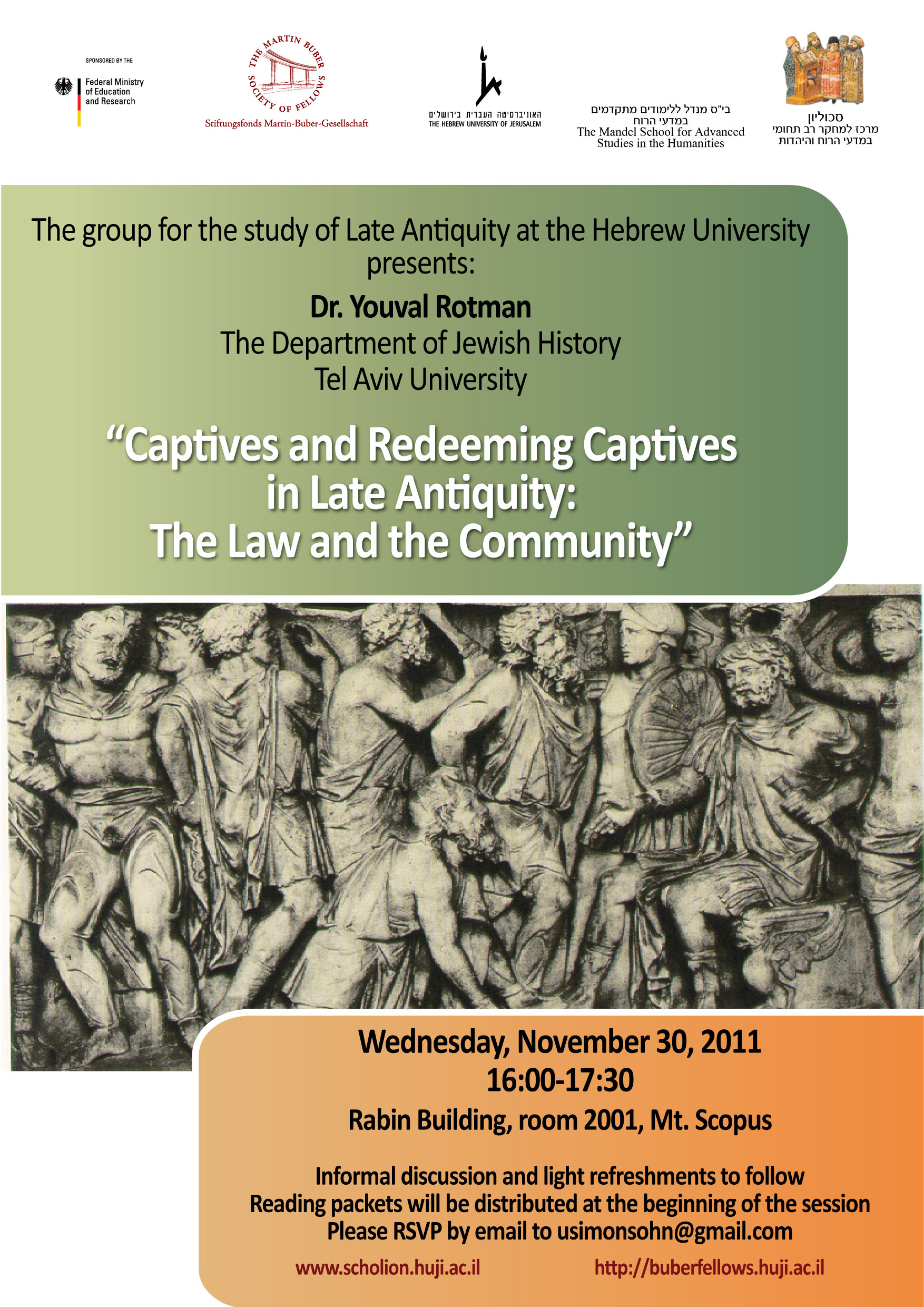
Last night, Dr. Youval Rotman of Tel Aviv University lead the inaugural discussion of Hebrew University’s  Group for the Study of Late Antiquity. The Group, which was started by Uriel Simonsohn and I in order to create an active scholarly community for researchers working on different corners of late antiquity, will be meeting monthly for group text-study and conversations, topped off by cheese, crackers, and Israeli wine as robust as the discussions.

Rotman’s topic was “Captives and Redeeming Captives in Late Antiquity: The Law and the Community,” and a crowd upwards of 30 (that’s in quantity, though I suppose also in age) read texts by Ambros, Tertullian (and more), along with rabbinic sources from the Mishna, Tosefta, and Babylonian Talmud (sources are available here).  A number of interesting trends were noted, included an apparent development in communal solidarity that turned captive redemption from a more private, family affair into a public,  community-based activity.  A connected issue that came up was the role of the state, or lack thereof, in redeeming captives.  Apparently, once you hit late antiquity Roman and Byzantine legislation forbids the state from redeeming prisoners of war.

I wonder whether the following, fascinating anecdote about Ifra Hormiz somehow reflects  those two points:

איפרהורמיז אימיה דשבור מלכא שדרה ארנקא דדינרי לקמיה דרב יוסף אמרה ליה ליהוי מצוה רבה יתיב רב יוסף וקא מעיין בה מאי ניהי מצוה רבה אמ’ ליה אביי מדתני רב שמואל בר יוסף אין פוסקין צדקה על היתומים ואפלו לפדיון שבוים שמע מינה פדיון שבוים מצוה רבה היא

Ifra Hormiz the mother of King Shapur sent a moneybag of dinars to Rav Yosef. She said to him: Let it be for a great mitzvah. Rav Yosef was sitting and looking into it –  what could be a great mitzvah?  Abaye said to him: Since Rav Shmuel b. Yosef taught that we do not levy money for charity from orphans even for the redemption of captives, it may be concluded that the redemption of captives is a great mitvah. (b. Bava Batra 8a-b; according to MS Hamburg).

The story is fascinating for a number of reasons. But in the meantime it is noteworthy that the talmudic storyteller has the queen-mother essentially delegating (and funding) rabbis to redeem (Jewish?) captives – as opposed to having the Sasanian state take care of it by itself. And it is the rabbis as a group who are in charge of captive redemption – as we also find at b. Taan 22a, where a case of captive redemption (apparently – though see the MSS) “visits upon” the rabbis, again apparently as a group.

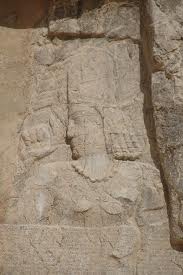
Next up is Prof. Shaul Shaked, who will be speaking on January 3rd on “Zoroastrianism: A Religion of the Book.” For that I leave you with the following, thought-provoking picture – courtesy of my friend Dan Sheffield who has been digitizing a treasure-trove of photograph’s by the late Mary Boyce.

Standard
Announcements, English

Pet Projects

I am involved in two new and exciting projects at Hebrew U that although at some distance from academic Talmud, may be of interest to some readers of this blog.  The first is the Group for the Study of Late Antiquity organized by Uriel Simonsohn and I.  This is a series of working seminars for late antiquists at Hebrew U and other Israeli universities to get together, read texts and discuss new research projects over wine and cheese.  Each meeting will be lead by a different scholar working on a different corner  of the field.  The first meeting will be held next week on Wednesday November 30.

With Domenico Agostini and Eva Kiesele I also have begun a project of reading and translating a fascinating Middle Persian text entitled Zand ­fragard ī jud-dēw-dād.  This text lay languishing in manuscript (and facsimile) until quite recently, when Goetz Koenig discussed it at an Iranian studies conference, and Yaakov Elman, P. Oktor Skjaervo, Mahnaz Moazami, Yishai Kiel, and I were drawn to it – mainly  on account of its legal sophistication. This is a work that bears some as yet undefined relationship to the Pahlavi Videvdad – a Zoroastrian Middle Persian translation and “midrash” on an Avestan book of that name largely concerned with the laws of ritual impurity. Aside from its rabbinic-like legal conceptualization and reasoning, I have already written about its great potential for illuminating the way in which Middle Persian texts were redacted during the Sasanian and early Islamic period, and perhaps even the Bavli. Before anything, however, we need to carefully read through all 250 pages of it.

Standard
English, Ruminations

Class Notes: Kirdir’s Persecutions

Historians, especially Jewish historians, love talking about religious persecutions. But what do we mean by religious persecutions of Jews?

The other day in class, I spent a bit of time discussing a few lines in a series of inscriptions commissioned by the powerful third century Zoroastrian priest’s, Kirdīr.  In the inscriptions, Kirdīr boasts of his many “good” deeds, including persecution of Jews, Shamans (Buddhists), Bramans (Hindus), Christians (perhaps Greek-speaking Christians), “Nāṣrā” (perhaps “indigenous” Aramaic-speaking Christians), “Makdags” (perhaps “Baptists” – and even Mandaeans), and “Zandīgs” (Manicheans).  Many Jewish historians have attempted to connect this line to references to “persecution” of the Jews at the hands of the magi preserved in the Talmud, including three decrees attributed to Zoroastrian priests against slaughtering meat, bathing (or perhaps also ritual immersion), and regular burial. More recently, Talmudists (like Richard Kalmin) have called into question the historicity or reliability of some of the talmudic parallels to the inscription. The relevant talmudic passages are heirs to supremely complex redactional histories that muddle their usability for straightforward historical reconstructions. On the other hand, as Oktor Skjaervo has pointed out, this part of Kirdīr’s inscriptions have perhaps been over-interpreted, since most of what Kirdīr writes is couched in traditional Zoroastrian terminology (including this passage’s use of the term zad – “struck down” – to describe what Kirdīr did to these different communities). This terminology is used more to convey an idealized, mythical image of the place of these other religions in the view of a third century Zoroastrian priest than to present an accurate historical picture of real persecution. In class we also juxtaposed the inscription to a passage from the Zoroastrian compilation Šāyest nē Šāyest and saw a similar attempt at creating a catalog of other religions that expressed a certain view of the world, not an historical reality.

Even if Zoroastrian priests did actually forbid Jews to ritually slaughter their meat, can this be understood as a religious persecution, that is an act directed at keeping Jews from performing their ancestral laws? Perhaps, as Geoffrey Herman has suggested, the decrees simply reflect a Zoroastrian problem with Jewish slaughter, since the latter casts blood upon the sacred earth. The same could be said in regards to burial which pollutes the earth, and as I suggested in my dissertation, in regards to immersion after menstruation which might be seen as contaminating water. In other words, how do I know Jewish persecution, and “antisemitism” when I see it in Sasanian Iran?

A friend of mine who works in the field of modern Jewish history recently sent me the following press-release about a consortium that researches antisemitism and racism:

An international research consortium to promote the study of antisemitism is launched today (Tuesday 8 November, 2011). The International Consortium for Research on Antisemitism and Racism (ICRAR) involves leading scholars from universities and institutes across Europe, Israel and the US, who share the common goal of revitalising and reshaping the study of antisemitism. The Consortium will promote rigorous, independent research that looks to related fields and other disciplines for insight and embraces new theoretical and methodological approaches.

Co-convened by David Feldman, Pears Institute for the study of Antisemitism, Birkbeck, University of London and Scott Ury, Stephen Roth Institute for the Study of Contemporary Antisemitism and Racism, Tel Aviv University, the formation of the Consortium has been driven by concern that the study of antisemitism lags behind other fields of scholarly enquiry.

To promote and foster new thinking on antisemitism the Consortium will hold annual workshops and summer schools and produce publications of the outcomes. Its first workshop will be Boycotts: Past and Present. This will be held in London in 2012, hosted by the Pears Institute for the study of Antisemitism.

For more information on the International Consortium for Research on Antisemitism and Racism please e-mail:  ICRAR@bbk.ac.uk.

For better or for worse, as students of antiquity we often keep our distance from these sorts of projects. I wonder, however, if the methodological findings of this consortium’s research centers will have what to teach us about antisemitism in antiquity, and for that matter in Sasanian Mesopotamia.

Standard