1) Given the quick-draw character of my notes upon which the following is based, I obviously do not claim to have represented accurately the views of the presenters or session participants themselves. These are merely my impressions of what was said. I have, on occasion, inserted my own views on various issues relating either directly or indirectly to the topic at hand. These instances have been noted.
2) On a related front, my notes are intended primarily for my personal records. I therefore focused, for the most part, on the portions of the presentations that most interested me. If something crucial seems to be missing from my summary of given lecture, please bear in mind that this may simply reflect my lack of interest rather than the speaker’s rank incompetence, or some such.
3) If anyone has any questions, please do not hesitate to get in touch. My email is arilamm@gmail.com
4) As noted, the views contained herein do not represent the views of the seminar participants, nor do they represent those of the Society of Biblical Literature. All errors are, of course, society’s fault.
Immediately upon entering the Franklin-Wilkins Building of the King’s College London Waterloo campus, I remembered that I left my Tanakh at home. Serves me right, I thought, for leaving minyan a bit early to get downtown in time for the first session. Fortunately, however, we live in a digitized age, and I have the Mechon Mamre software on my computer. As the day wore on, my trusty ol’ laptop would prove crucial in providing me with the tools to follow the wide variety of (usually) excellent presentations at this year’s International Meeting of S.B.L. Incidentally, it would also allow me to take copious notes on each and every lecture I attended. These notes, I have been informed, are too lengthy for the format of this blog, so they have been substantially distilled in what follows. For those interested in the full version, stay tuned. Information on accessing them will be forthcoming.
Initially I had planned only to attend sessions related as closely as possible to my discipline (Second Temple Judaism, Rabbinics, Talmud studies, Sasanian Iran, etc.). But as soon as I set foot in the King’s College lobby and had a chance to survey the spectrum of scholars that had converged on my adopted (at least for the year) hometown, I decided to indulge my curiosity by attending as broad a variety of sessions as time and energy allowed. Not every session I visited, therefore, related strictly to the ostensible interests of this blog’s readers. I have been instructed, accordingly, to confine my remarks as much as possible to those interests. Again, those interested in the other sessions I attended should await the posting (either here or elsewhere) of the full version of my notes.
I began my day in the “Bible and Empire Consultation.” I heard several excellent presentations, including a scintillating exegesis of Isaiah 31 by a former professor of mine, Yeshiva University’s Shawn Zelig Aster, and a fascinating reinterpretation of the talion laws in Exodus 21 by Sandra Jacobs, a student of Bernard Jackson (formerly of Manchester University).
After Aster’s talk, I made my way down the hall to the “Hellenistic Judaism Section” just in time for Daniel Barbu’s (Universite de Geneve) paper, “The Invention of Idolatry.” Barbu examined LXX’s employment of the term eidolon to translate a wide variety of terms relating to foreign cultic items and ideas. Barbu traced the history of the word, noting its evolution from a term denoting an illusory image (e.g. the vision of a goddess in a dream) in Homeric Greek, to a byword for useless delusions, including false sciences and false pleasures, in the Platonic dialogues. After surveying its appearances in the LXX, Barbu noted that while Hellenistic readers would certainly have understood eidolon as a reference to cult images or false divinities, the term would have sounded slightly awkward. Barbu concluded that while eidolon is not always used uniformly to translate a given word, the fact remains that in developing a lexicon of sorts for referring to prohibited images, the LXX used eidolon to refer specifically to images of false divinities. It does not, on the other hand, use the term to refer to images of the true God (the crafting of which are themselves prohibited). This may sharpen our sense of the Biblical distinction between images of false gods on the one hand, and images of the true God on the other that some have seen as latent in the Second Commandment.
As soon as Barbu finished up, I dashed back up the hall to the “Epigraphical and Paleological Studies Pertaining to the Biblical World Section.” I had intended to catch Meir Lubetski’s (Baruch College) paper seeking to adduce fresh perspectives on the name Dmlyhw. It seems, however, that the schedule for this section had been re-shuffled. I was treated instead to a lecture by the indomitable Wilfred Lambert (University of Birmingham) on Babylonian demons in the Moussaief Collection (MC).
The first thing I noticed about Lambert was his absolutely stellar accent – I imagine Sideshow Bob would sound like this had he been born in Britain – and the age-defying sense of excitement and energy with which this near-nonagenarian delivered his talk.
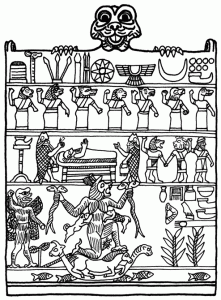
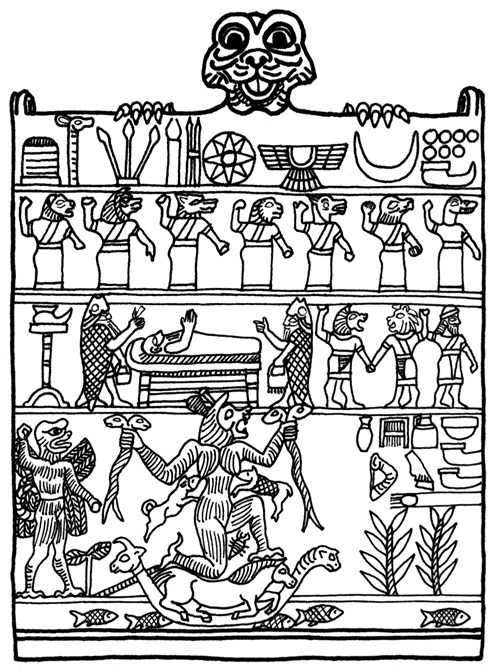
The Goddess Lamashtu, from Black and Green's Gods, Demons, and Symbols of Ancient Mesopotamia
The talk itself was, in fact, brilliant. He explored the variegated methods of depicting the demoness Lamashtu in ancient Babylonia, as exemplified by a slew of items from the MC. After explaining her identifying features – animal head, snakes held in hand, an accompanying dog and pig (whom she is sometimes suckling), etc. – Lambert pointed to what seems to be a very early depiction of Lamashtu from the 4th millennium BCE. Given that our knowledge of Lamashtu’s features are from the 1st millennium BCE, the fact that we might identify her via (some of) these very same features several thousand years earlier is quite remarkable. Lambert utilized this data to point to the Babylonian conservatism in preserving its demonological tradition. Later that day, however, one scholar at Lambert’s lecture expressed concern – apparently shared by some others at the session – over the provenance of the MC. There is much about the MC that we don’t know, he cautioned, and we should bear this in mind when discussing finds from its contents.
As the first session block came to a close, I trundled downstairs to pick up the kosher meal I had ordered when signing up for the conference, only to find that no such meals were being offered (at least at lunch). I never did find that kosher meal…
In any event, after a pleasant, if cibariously uninteresting lunch – during which I had the opportunity to meet Noah Hacham (and let him know that I used his article on III Maccabees and the Greek Additions to Esther as the basis for my dvar Torah at last year’s family Purim se’udah…) – I made my way to the “Qumran and the Dead Sea Scrolls Section.”
I only stayed for one talk: Hans Debel’s musings on the contributions of the Genesis Apocryphon and Joshua Apocryphon to our understanding of textual traditions in the Second Temple period. Debel made the point that even using the term “Apocryphon” to refer to these texts prejudices us in favor of what someone or other (I can’t recall his reference) called “the tyranny of canonical assumptions.” The rest of the lecture continued in this vein. His point struck me as either somewhat obvious, or exceedingly “meh”…depending on where you fall on the spectrum of scholars examining the role of canonicity in the Jewish textual tradition.
In any case, I took the opportunity of a five minute discussion period following Debel’s paper to hightail it for the “Assyriology and the Bible Consultation” – the first of its kind in the history of S.B.L. Space does not permit me to synopsize the many intriguing presentations delivered throughout this session, including a wonderful paper by another Yeshiva University faculty member, Shalom Holtz. Of greatest interest to me, however, was Sacha Stern’s (University College London) “bomb kashya” during the concluding discussion period.
After quietly imbibing the conclusions of a whole host of scholars seeking to explain the implications of Mesopotamian influence on Biblical traditions, Stern questioned the underlying narrative pervading these presentations, namely, that it makes sense to speak of influence between disparate ethno-cultural groups within some sort of area that we have termed “the Ancient Near East.” It is especially important, observed Stern, to be methodologically meticulous in this regard when one seeks – on the basis of some notion of “influence” – to establish a relative chronology for entire chunks of Biblical tradition, ranging from Leviticus, to Deuteronomy, to Ezekiel, and so on.
Chaos ensued as the room basically divided into two groups: those who thought that it’s, like, totally insane not to take “influence” for granted in the Biblical period (‘amiright folks?!’), and those who took the question a bit more seriously even if ultimately disagreeing. Among the latter group, Lester Grabbe led the charge in arguing that 1) there is nothing wrong with at least asking questions about similar phenomena that appear in different contexts, and 2) a sufficient number of parallels eventually make it appropriate to talk about “influence” even if we can’t show how it happened.
Stern responded by agreeing that, obviously, there is nothing wrong with asking questions. He noted, notwithstanding, that Grabbe’s criteria for positing a concept as methodologically fraught as “influence” seem particularly prone to abuse (e.g. parallelomania). My own sense is that while some scholars at this specific session – Holtz in particular – engaged admirably with the cross-cultural implications of his data set, scholars studying Rabbinics (understood broadly) have progressed way beyond Assyriologists in developing methodological safeguards for studying these sort of phenomena. And again, as far as this specific session was concerned, I had hoped – probably much like Sacha Stern – that at its inaugural event, participants would have spent at least a tiny portion of their time engaging these issues.
Eventually, we all began to shuffle out of the day’s final session. As I made my way up the Northern Line back to my apartment in Hendon, I could only smile in anticipation of tomorrow’s lectures, which promised to be even more exciting than those I attended today. On that note: stay tuned!
Ari Lamm is concluding a year as a Fulbright scholar based at University College, London and the School of Oriental and African Studies.






 The Talmud Blog
