Conferences, English, Guest Posts

SBL Conference, Day 2 Part 2- Guest Post by Ari Lamm

This is the last post in a three part series of guest posts by Ari Lamm. For prior installments see the Guest Contributors page.

During my back-and-forth with Paul Heger I had to make the trek from the back of the room, near the outlets sustaining my laptop, to the front where I could be better heard by my interlocutor. On my way back to my seat I passed Dr. Shani Tzoref (Israel Antiquities Authority), on account of whose upcoming presentation I had attended this section (“Nonbiblical Dead Sea Scrolls: Themes and Perspectives Consultation”) in the first place. Dr. Tzoref’s paper was absolutely fascinating, and I more than suspect that the following summary will not do it justice. In lieu of a proper report, in fact, I will simply point to what I considered to be the paper’s highlights.

Dr. Tzoref began by referring to Daniel Schwartz’s famous heuristic regarding early Jewish law, classifying the Qumranic approach as “realist” and the rabbinic approach as “nominalist.” Adding a further wrinkle to this distinction, Tzoref categorized the Josephan approach as “subjectivist.” In distinguishing between the three, Tzoref provided a helpful analogy to baseball umpiring (for those foreigners not familiar with the intricacies of America’s beloved national pastime, I’m sure the analogy works equally well for whatever heathen contest you happen to fancy…): a realist umpire says, “I call it like it is”; a subjectivist umpire says, “I call it like I see ‘em”; a nominalist umpire says, “They ain’t balls and strikes ‘till I say they are!”

A realist umpire says, “I call it like it is”; a subjectivist umpire says, “I call it like I see ‘em”; a nominalist umpire says, “They ain’t balls and strikes ‘till I say they are!”

Tzoref focused specifically on marriage at Qumran as a focal point for fine-tuning our conception of ancient Jewish perspectives on the operating structures of Biblical rules in a broader sense. According to Eyal Regev, Tzoref explained, CD’s view of marriage is highly idealized – and I would note, in addition, that Schwartz himself attempted to articulate the Qumran community’s “realist” construction of marriage, based on the principle of “yesod ha-beriah” – and is in fact diametrically opposed to the idea of celibate Essenes that we encounter in Josephus’ portrayal of the group. However, Joan Taylor’s recent re-reading of War 2 – containing Josephus’ seemingly contradictory reports of the Essenes as, on the one hand, disdainful of marriage (War 2.119), and, on the other, as valuing marriage and developing special rules to ensure its sanctity (War 2.160) – yields the conclusion that Josephus has two kinds of Essenes in mind all along. He certainly knows that not all do away with marriage, but he also knows of the popular conception (found in Philo as well) that the Essenes did away with marriage entirely. He thus employed this popular (but mistaken) view to make a general point about lust, faithfulness, and the basic unreliability of women in the sexual realm. (Tzoref did not cite Taylor’s essay – or if she did, I missed it – but I recall her making this point as early as 2007, in an article in Studia Philonica Annual; I’d appreciate anyone correcting the reference).

This fascinating reading is complicated somewhat by 4Q271, in which we read the instruction that a cadre of experienced, trustworthy women should examine a woman prior to marriage (rather than in the event of an accusation, as per Deuteronomy) to verify her virginity. Even given Taylor’s distinction between the various potential goals of Josephus’ presentation of the Essene view of women and marriage, we are still left to reconcile Josephus’ invocation of the Essene community as a model for his point about the untrustworthiness of women with 4Q271’s explicit reliance on female evaluations of an urgent matter of sexual purity.

In due course, Tzoref argued that while Qumran and Josephus are consistent in maintaining a general mistrust of women – manifested, in this instance, in a fear that a woman will sleep with someone else before marriage – this mistrust rises merely to the level of presumption. As such, it may be rebutted where and when appropriate. Indeed, in this case the Mevaqer selects specific women whom he knows to be trustworthy, and relies upon them for the inspection.

Tzoref’s resolution of this problem pointed eventually to a more general point about Josephus’ “subjectivist” perspective. Indeed, Josephus’ general mistrust of women is reflected in his subjectivist explication of the core issue at stake in this case, namely, marriage to a virgin. For Josephus, this is simply a good policy, as he writes, “men should be wise in the affairs of wedlock; and that it was profitable both to cities and families that children should be known to be genuine” (Ant. 3.276).

Over the course of the rest of her presentation, Tzoref identified a variety of realist-subjectivist-nominalist differences in perspective between Qumran, Josephus and the rabbis. She pointed specifically to priest-captive marriage, and the various rationales for the prohibition of mixed kinds.

In the discussion period I pointed to Jeffrey Rubenstein’s substantial critique of Schwartz’s position, wherein he notes several instances in which the bifurcation between Qumran realism and rabbinic nominalism does not withstand scrutiny. I conceded, however, that Rubenstein himself admits that Schwartz’s case is strongest with regard to marriage (although not uncle-niece marriage, where Rubenstein quite convincingly rebuts Schwartz’s claim).

As the section participants began to file out of the room with the conclusion of Tzoref’s presentation, a fire alarm began to sound. As King’s College staff began unceremoniously dumping various and sundry distinguished historians on the sidewalk in the back of the building, I somehow found myself conversing with Bernard Jackson (Liverpool Hope University). We just had time to set a date for tea (we were in England, after all) before I set out on an immensely enjoyable walk to Westminster station with a former teacher of mine (during which we discussed the relative merits and faults of the present British monarchy).

Upon my return to the conference building, I set out for the “Biblical and Ancient Near Eastern Law Section.” Yuval Sinai (Netanya Academic College School of Law) led off the section with a survey of ancient and medieval Jewish sources dealing with collective punishment. Sinai noted the tendency of some Israeli Supreme Court justices (especially Mishael Heshin) to invoke “the law of Moses, and…what is written in the Bible” in support of rejecting wholesale the legitimacy of the strategy of collective punishment. Sinai argued that Heshin has failed in this regard to take stock of the breadth and depth of Jewish tradition. Noting both counterexamples, and Jewish authorities from the medieval period onwards who have attempted to reconcile this data, Sinai hypothesized that, in the main, Jewish tradition has seen the prohibition on collective punishment as an ideal law, but one that either cannot be, or is not, always put into practice.

Commending Sinai on an extensive and erudite presentation, Bernard Jackson suggested that we delineate two separate issues addressed by Sinai: the internal tension within Biblical sources, and the use to which these (and other) sources have been put within the modern State of Israel. Jackson guessed that Heshin is not concerned with halakhahper se, but with establishing a general “moreshet Yisrael” (“Jewish tradition”) approach to (re)constructing Jewish values – what Jackson called the “Ahad Ha’am approach” after the great Hebrew essayist and founder of cultural Zionism. While expressing general agreement, Sinai cautioned that in endeavoring to build a tradition from scratch, one runs the risk of cherry-picking sources to fit an agenda.

After taking a break for tea (in my case, Diet Coke) with Drs. Bernard Jackson and Yuval Sinai, I returned for one more presentation in this section – by Andreas Kunz-Lubcke (Univeristy of Leipzig) on legal resonances within the Rape of Tamar narrative – before hurrying off to the Hellenistic Judaism Section just in time for Vincent Skemp’s (St. Catherine University) presentation entitled, “The Alleged Prohibtion on Pronouncing the Tetragrammaton, an Assessment of the Evidence in Second Temple Judaism.”

Skemp set out as his task to explore the available evidence concerning whether the Tetragrammaton could or should be pronounced, and by whom. Complicating this question is the matter of determining its spelling in antiquity. Indeed, sometimes it is spelled as a trigrammaton (as at Elephantine and in some of the Dead Sea Scrolls) or bigrammaton. Related to this issue is the question of how many letters or sounds composing the Divine Name constituted an utterance. With regard to its actual deployment in ancient sources, we find that it is at times written in paleo-Hebrew – even, on occasion, in Greek texts. Sometimes ancient sources record the Name in Assyrian text; sometimes it is written with different ink; sometimes with dots to mark it out; in one case it is written with an extrayod at the end. In any event, while rabbinic literature ends up prohibiting pronouncing the Name, some scholars argue that this represents a minority opinion and that the popular practice to pronounce the Name was dominant. In fact, there are some late rabbinic texts that seek historical explanations for the ban (see e.g. bR.H. 18b).

After surveying a variety of Biblical and post-Biblical (including rabbinic) sources that touch on the matter, Skemp concluded with an interesting note on contemporary scholarly practice. He specifically mentioned Emanuel Tov’s policy of refraining from writing the full Tetragrammaton, as well as Louis Feldman’s practice to omit the “O” of the word “God.”

During Skemp’s lecture I experienced a nagging feeling in the back of my head that a reference was missing from the presentation. By the time the discussion period arrived I finally recalled the source I was searching for: Ruth 2:4. As a sophomore in Yeshiva University I remember Professor Moshe Bernstein marveling at the stark employment of the Tetragrammaton in this verse; for some reason this observation always stuck with me, and I managed to put it to good use in the discussion period following Skemp’s lecture. I pointed out that Ruth 2:4 (which actually serves as the basis for mBer 9:5, a source Skemp cited) is actually an example of non-elites employing the Tetragrammaton as part of an everyday, non-Temple-related, greeting formula.

Ari Lamm is concluding a year as a Fulbright scholar based at University College, London and the School of Oriental and African Studies. 

Standard
English, Guest Posts, Postscripts

Haim Zalman Dimitrovsky ז”ל- Guest Post by Prof. Shamma Friedman

Haim Zalman Dimitrovsky ז”ל

Shamma Friedman

Haim Zalman Dimitrovsky (1920-2011) belonged to the first generation of academic Talmud scholars born and educated in Israel, and certainly one of the outstanding among them. His personality encompassed a unique blend of knowledge, talent, and devotion, a combination that was all his own.

A graduate of the prestigious Yeshivat Merkaz Ha-Rav, and before that Talmud Torah Etz Haim in Jerusalem, Dimitrovsky was loyally committed to the State of Israel in the making, and as a young man took up arms and served in the Hagana during the War of Independence. He was trained in the scholarly methods and high standards of the Talmud Department of the Hebrew University at the feet of J.N Epstein and Simha Asaf, whose methods he combined with the traditional learning and orientation he received through the tutelage of his father, Rabbi Yaakov Yosef Dimitrovsky.

His spoken Hebrew was that of a native speaker, and at the same time rich and flowing naturally out of the Talmudic sources. His written Hebrew style, was likewise enriched in both these directions: from his absolute mastery of the wealth of all strata of Hebrew, stemming from his command of Talmudic and other sources, and the natural control of a native speaker, it emerged as a creation of stylistic beauty few could match.

Similarly, his research and studies, in all the various fields he addressed, all reflect this one of a kind combination of Torah scholarship, scientific methods, and religious-Zionist conviction.

Professor Dimitrovsky’s profound understanding of the complexities of the vast Talmudic corpus, down to the most minute detail, cannot be acquired except by arduous devotion to Torah study from an early age. With these strengths, Dimitrovsky created a unique scholarly profile, based on a meticulous scientific method founded on the peshat of the text, accurate historical understanding, and overall – sound common sense. He integrated a deep-seated, natural grasp of the material with fierce devotion to the beauty of Jewish tradition, even when working in the broader, secular reality of the academic setting.

These were the same qualities that led to the dialogue of love between him and his students, all during his teaching career, and above all, his inherent modesty – genuine, personal, and special to Haim Zalman Dimitrovsky. Through his years as Professor of Talmud at the Jewish Theological Seminary of America, and later at the Hebrew University, Dimitrovsky trained generations of scholars of Talmud and Midrash.

These strengths mark his scholarship also: scholarly precision with loving mastery of his material persisted in his ongoing project of putting order into the texts and uncovering the depth level of correct meaning: “nahara nahara ufashtei“.

It is therefore not surprising that he gave preference to the literature of the rishonim – its profound depths require scholarly expertise as a sub-discipline in itself: “tzvat bi-tzvat asuya“. For example, Rashba, the chief disciple of the Nahmanidean school, as well as a decisor who wrote thousands of responsa – only a true scholar – astute, with the entire rabbinic corpus at his fingertips – is equal to the task of transmitting the Rashba to future generations. Dimitrovsky did so, from editing the Rashba’s novellae to compiling his responsa, with all their fragments. Every conversation with Prof. Dimitrovsky demonstrated that this was a labor of love.

Consider also the neglected, abstruse discipline of elucidating the writings of the early aharonim, namely, the masters of pilpul, who formed the link to the following generations while their own teachings were nearly forgotten, overshadowed by both rishonim and aharonim. Dimitrovsky stepped in, shed light, analyzed, and breathed new life into their words. His illumination of the semikha controversy likewise typifies his work which was devoted to the intermediate generation.

Another lost corpus restored by Dimitrovsky was the editions of the Talmud printed in Spain and Portugal before the expulsion. These disconnected dry bones were restored to their grandeur and provided with his fully innovative history of these little known prints.

Thus he was able to direct a concentrated in-depth focus to the commentarial and halakhic works of the Rashba; the printers of the forgotten edition of the Talmud dating from before the expulsion from Spain; of Y. Berav and Joseph Karo in the context the semikha controversy; and the entire genre of pilpul. Armed with profound powers of analysis on the one hand, and a restrained style, on the other, he has thereby enabled us to restore our own link to this almost-forgotten generation, and to hear – through his words – their muted majesty.

We were deeply gratified in 1994, when the unique achievements of our teacher, so well know to us, his students, were publicly recognized with the award of an Israel Prize in an official ceremony.

Shamma Friedman is the Benjamin and Minna Reeves Professor of Talmud and Rabbinics at The Jewish Theological Seminary teaching at The Schechter Institute of Jewish Studies, and Adjunct Professor in the Talmud Department at Bar Ilan University.

Standard
Conferences, English, Guest Posts

SBL Conference Day 2 – Guest Post by Ari Lamm

  continued from day 1

I got a bit of a later start on Tuesday than I had on Monday.  Busy packing up our London apartment for our move back to New York – my wife and daughter had already made their way home a week earlier – I ended up missing the first two lectures of Tuesday’s initial block of sessions.  Fortunately, I managed to attend several fantastic lectures over the course of the day.

As soon as my Northern Line train pulled into Waterloo Station I navigated my way through the complex maze of underpasses leading to the King’s College campus, and dashed upstairs to the “Non-biblical Dead Sea Scrolls: Themes and Perspectives” section. This session was convened specifically to address the topic, “Images of the Feminine in the Dead Sea Scrolls.” I arrived just in time to get my laptop ready for Claire Ruth Pfann’ (University of the Holy Land) presentation entitled, “Women at Qumran: Fact or Fiction?” Making use of what she referred to as a revised version of De Vaux’s chronology of the site, Pfann concluded that throughout the history of habitation at Qumran, finds that might indicate the presence of women (e.g. hairnets, feminine fabric patterns, jewelry, spindle whorls, etc.) are absent. During the period Pfann has designated IIb (66-68 CE), however, we begin to find in sealed loci possible indicators of female habitation of the site. These finds continue to appear in layer III (post-73 CE). Pfann thus sees evidence for Revolt-related female habitation at Qumran just prior to the revolt (during a period beginning in 66 CE), but not beforehand.

The discussion period following Pfann’s presentation produced the most heated exchange that I had seen at SBL to that point. Jodi Magness (University of North Carolina at Chapel Hill) questioned Pfann’s decision to posit a separate stage of habitation commencing in 66 CE, rather than a single period beginning some time early in the reign of Herod Archelaus (i.e. around 4 BCE). Pfann’s view, doggedly defended during the subsequent session break by Stephen Pfann (University of the Holy Land), is that an observable change in material culture before and after 66 CE – as well as the eventual presence at the site of Revolt-era coins (97 from Year 2, and 3 from Year 3) – is sufficient to suggest a separate habitation, which may be dated to 66 CE. Magness countered – as far as I could understand (and hear…things got pretty tense!) – that no “change in material culture” in fact occurred. Instead, the original inhabitants from approximately 4 BCE simply adapted to evolving tastes in dishware and the like. In other words, Magness strenuously insisted, no evidence exists that should force us to suggest a fresh habitation of the site in 66 CE.

Once presentations resumed following the break, I returned to the same section only to encounter my least favorite presentation of the conference: Paul Heger’s (University of Toronto) paper entitled, “The Status of Women in Scripture, Rabbinic and Qumran Literatures.” At the risk of oversimplifying things (although this tendency was precisely my problem with the paper itself), Heger argued that while the Bible, the Dead Sea Scrolls and rabbinic literature all more or less agree that women possess a subordinate legal status, the Rabbis venture even further in saddling women with a subordinate social status as well.

Paul Gaugin, "Eve - Don't Listen to the Liar.' 1889. Watecolor and paste. Marion Koogler McNay Art Museum, San Antonio, TX. courtesy of wikicommons.

Heger introduced his lecture by presenting what he saw as a simple, unbiased reading of the Fall from Eden narrative. In Heger’s view, the text does not fault Eden any more so than Adam for sinning against God; in fact, as Heger implied at several points during his talk, the biblical narrative may even skew against Adam on occasion.

Heger then seemed to assume that the soundness of his reading should be readily apparent to most, perhaps all those who engage the text. Given this, Heger employed his reading as the standard against which both Qumranic and rabbinic  interpretations should be measured. Heger then proceeded to highlight commentary on this narrative from various Dead Sea Scroll sources, which he noted tended to see this episode as a cautionary tale against man’s lustful and generally sinful nature. Eve, he noted, is not implicated as a villain in these readings.

In contrast, Heger pointed to a slew of rabbinic texts, culled from sources as diverse as the Tosefta, Genesis Rabbah, and the Bavli, that cast Eve, especially her feminine sexuality, as the primary culprit in humankind’s Fall. Although noting that exceptions exist, Heger viewed this as the dominant depiction of Eve within rabbinic literature, and as such an indicator that the Rabbis went further than other erstwhile Biblical interpreters in marginalizing women. Heger noted, however, that the Rabbis may not have been directly concerned – at least in this context – with women’s social status per se. Their excessive social demotion of women, therefore, may have been a mere byproduct of an earnest inquiry into the dangers of sexual temptation for males concerned to avoid transgression.

I found Heger’s paper deeply unsatisfying from both a methodological and interpretative perspective. During the discussion period I raised several points with respect to the former. First, I asked that we consider the hazards of attempting to create a coherent programmatic statement out of rabbinic texts drawn from a variety of disparate geographical and chronological contexts. On a related note, I pointed out the problematic nature of referring to “the Rabbis” – as if reducing several hundred years of complex and multivalent development into a single corporate identity somehow makes things simpler instead of vastly more complicated. Finally, I commented that some of the texts to which Heger pointed over the course of his analysis (BT Yoma 18b, in particular) have actually been noted for their reflection of a specifically Sasanian milieu, rather than as merely several points on a broad, rabbinic continuum.

Heger responded rather forcefully that by no means had he suggested that “the Rabbis” only had negative things to say about women. The denigration of Eve, however, is so pervasive throughout rabbinic thought that, in Heger’s view, we may deduce the rabbinic view of women (or some part of it) from the texts in which it appears as a theme. I did not feel at all that this answer addressed my question.

Following Heger’s paper, those who stayed until the end of the morning session were treated to a phenomenal paper by Shani Tzoref (listed as University of Sydney, but announced beforehand as affiliated with the Israel Antiquities Authority). This paper remained my favorite of the conference. Hopefully I’ll have a chance to cover this paper, along with the rest of the lectures I attended throughout the remainder of Day 2, in a subsequent post.

Ari Lamm is concluding a year as a Fulbright scholar based at University College, London and the School of Oriental and African Studies.

Standard
Conferences, English, Guest Posts

SBL Conference Day 1- Guest Post by Ari Lamm

1)     Given the quick-draw character of my notes upon which the following is based, I obviously do not claim to have represented accurately the views of the presenters or session participants themselves. These are merely my impressions of what was said. I have, on occasion, inserted my own views on various issues relating either directly or indirectly to the topic at hand. These instances have been noted.

2)     On a related front, my notes are intended primarily for my personal records. I therefore focused, for the most part, on the portions of the presentations that most interested me. If something crucial seems to be missing from my summary of given lecture, please bear in mind that this may simply reflect my lack of interest rather than the speaker’s rank incompetence, or some such.

3)     If anyone has any questions, please do not hesitate to get in touch. My email is arilamm@gmail.com

4)     As noted, the views contained herein do not represent the views of the seminar participants, nor do they represent those of the Society of Biblical Literature. All errors are, of course, society’s fault.

Immediately upon entering the Franklin-Wilkins Building of the King’s College London Waterloo campus, I remembered that I left my Tanakh at home. Serves me right, I thought, for leaving minyan a bit early to get downtown in time for the first session. Fortunately, however, we live in a digitized age, and I have the Mechon Mamre software on my computer. As the day wore on, my trusty ol’ laptop would prove crucial in providing me with the tools to follow the wide variety of (usually) excellent presentations at this year’s International Meeting of S.B.L. Incidentally, it would also allow me to take copious notes on each and every lecture I attended. These notes, I have been informed, are too lengthy for the format of this blog, so they have been substantially distilled in what follows. For those interested in the full version, stay tuned. Information on accessing them will be forthcoming.

Initially I had planned only to attend sessions related as closely as possible to my discipline (Second Temple Judaism, Rabbinics, Talmud studies, Sasanian Iran, etc.). But as soon as I set foot in the King’s College lobby and had a chance to survey the spectrum of scholars that had converged on my adopted (at least for the year) hometown, I decided to indulge my curiosity by attending as broad a variety of sessions as time and energy allowed. Not every session I visited, therefore, related strictly to the ostensible interests of this blog’s readers. I have been instructed, accordingly, to confine my remarks as much as possible to those interests. Again, those interested in the other sessions I attended should await the posting (either here or elsewhere) of the full version of my notes.

I began my day in the “Bible and Empire Consultation.” I heard several excellent presentations, including a scintillating exegesis of Isaiah 31 by a former professor of mine, Yeshiva University’s Shawn Zelig Aster, and a fascinating reinterpretation of the talion laws in Exodus 21 by Sandra Jacobs, a student of Bernard Jackson (formerly of Manchester University).

After Aster’s talk, I made my way down the hall to the “Hellenistic Judaism Section” just in time for Daniel Barbu’s (Universite de Geneve) paper, “The Invention of Idolatry.” Barbu examined LXX’s employment of the term eidolon to translate a wide variety of terms relating to foreign cultic items and ideas. Barbu traced the history of the word, noting its evolution from a term denoting an illusory image (e.g. the vision of a goddess in a dream) in Homeric Greek, to a byword for useless delusions, including false sciences and false pleasures, in the Platonic dialogues. After surveying its appearances in the LXX, Barbu noted that while Hellenistic readers would certainly have understood eidolon as a reference to cult images or false divinities, the term would have sounded slightly awkward. Barbu concluded that while eidolon is not always used uniformly to translate a given word, the fact remains that in developing a lexicon of sorts for referring to prohibited images, the LXX used eidolon to refer specifically to images of false divinities. It does not, on the other hand, use the term to refer to images of the true God (the crafting of which are themselves prohibited). This may sharpen our sense of the Biblical distinction between images of false gods on the one hand, and images of the true God on the other that some have seen as latent in the Second Commandment.

As soon as Barbu finished up, I dashed back up the hall to the “Epigraphical and Paleological Studies Pertaining to the Biblical World Section.” I had intended to catch Meir Lubetski’s (Baruch College) paper seeking to adduce fresh perspectives on the name Dmlyhw. It seems, however, that the schedule for this section had been re-shuffled. I was treated instead to a lecture by the indomitable Wilfred Lambert (University of Birmingham) on Babylonian demons in the Moussaief Collection (MC).

The first thing I noticed about Lambert was his absolutely stellar accent – I imagine Sideshow Bob would sound like this had he been born in Britain – and the age-defying sense of excitement and energy with which this near-nonagenarian delivered his talk.

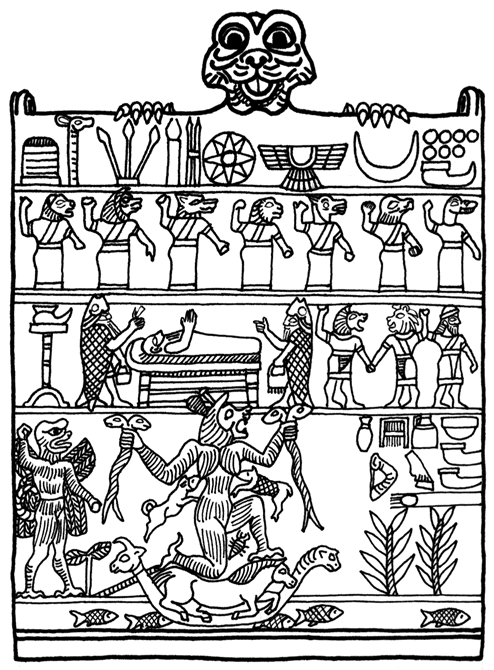
The Goddess Lamashtu, from Black and Green's Gods, Demons, and Symbols of Ancient Mesopotamia

The talk itself was, in fact, brilliant. He explored the variegated methods of depicting the demoness Lamashtu in ancient Babylonia, as exemplified by a slew of items from the MC. After explaining her identifying features – animal head, snakes held in hand, an accompanying dog and pig (whom she is sometimes suckling), etc. – Lambert pointed to what seems to be a very early depiction of Lamashtu from the 4th millennium BCE. Given that our knowledge of Lamashtu’s features are from the 1st millennium BCE, the fact that we might identify her via (some of) these very same features several thousand years earlier is quite remarkable. Lambert utilized this data to point to the Babylonian conservatism in preserving its demonological tradition. Later that day, however, one scholar at Lambert’s lecture expressed concern – apparently shared by some others at the session – over the provenance of the MC. There is much about the MC that we don’t know, he cautioned, and we should bear this in mind when discussing finds from its contents.

As the first session block came to a close, I trundled downstairs to pick up the kosher meal I had ordered when signing up for the conference, only to find that no such meals were being offered (at least at lunch). I never did find that kosher meal…

In any event, after a pleasant, if cibariously uninteresting lunch – during which I had the opportunity to meet Noah Hacham (and let him know that I used his article on III Maccabees and the Greek Additions to Esther as the basis for my dvar Torah at last year’s family Purim se’udah…) – I made my way to the “Qumran and the Dead Sea Scrolls Section.”

I only stayed for one talk: Hans Debel’s musings on the contributions of the Genesis Apocryphon and Joshua Apocryphon to our understanding of textual traditions in the Second Temple period. Debel made the point that even using the term “Apocryphon” to refer to these texts prejudices us in favor of what someone or other (I can’t recall his reference) called “the tyranny of canonical assumptions.” The rest of the lecture continued in this vein. His point struck me as either somewhat obvious, or exceedingly “meh”…depending on where you fall on the spectrum of scholars examining the role of canonicity in the Jewish textual tradition.

In any case, I took the opportunity of a five minute discussion period following Debel’s paper to hightail it for the “Assyriology and the Bible Consultation” – the first of its kind in the history of S.B.L. Space does not permit me to synopsize the many intriguing presentations delivered throughout this session, including a wonderful paper by another Yeshiva University faculty member, Shalom Holtz. Of greatest interest to me, however, was Sacha Stern’s (University College London) “bomb kashya” during the concluding discussion period.

After quietly imbibing the conclusions of a whole host of scholars seeking to explain the implications of Mesopotamian influence on Biblical traditions, Stern questioned the underlying narrative pervading these presentations, namely, that it makes sense to speak of influence between disparate ethno-cultural groups within some sort of area that we have termed “the Ancient Near East.” It is especially important, observed Stern, to be methodologically meticulous in this regard when one seeks – on the basis of some notion of “influence” – to establish a relative chronology for entire chunks of Biblical tradition, ranging from Leviticus, to Deuteronomy, to Ezekiel, and so on.

Chaos ensued as the room basically divided into two groups: those who thought that it’s, like, totally insane not to take “influence” for granted in the Biblical period (‘amiright folks?!’), and those who took the question a bit more seriously even if ultimately disagreeing. Among the latter group, Lester Grabbe led the charge in arguing that 1) there is nothing wrong with at least asking questions about similar phenomena that appear in different contexts, and 2) a sufficient number of parallels eventually make it appropriate to talk about “influence” even if we can’t show how it happened.

Stern responded by agreeing that, obviously, there is nothing wrong with asking questions. He noted, notwithstanding, that Grabbe’s criteria for positing a concept as methodologically fraught as “influence” seem particularly prone to abuse (e.g. parallelomania). My own sense is that while some scholars at this specific session – Holtz in particular – engaged admirably with the cross-cultural implications of his data set, scholars studying Rabbinics (understood broadly) have progressed way beyond Assyriologists in developing methodological safeguards for studying these sort of phenomena. And again, as far as this specific session was concerned, I had hoped – probably much like Sacha Stern – that at its inaugural event, participants would have spent at least a tiny portion of their time engaging these issues.

Eventually, we all began to shuffle out of the day’s final session. As I made my way up the Northern Line back to my apartment in Hendon, I could only smile in anticipation of tomorrow’s lectures, which promised to be even more exciting than those I attended today. On that note: stay tuned!

Ari Lamm is concluding a year as a Fulbright scholar based at University College, London and the School of Oriental and African Studies. 

Standard