
Shana Strauch-Schick, “Intention in the Babylonian Talmud: An Intellectual History,” Yeshiva University dissertation, August 04, 2011.
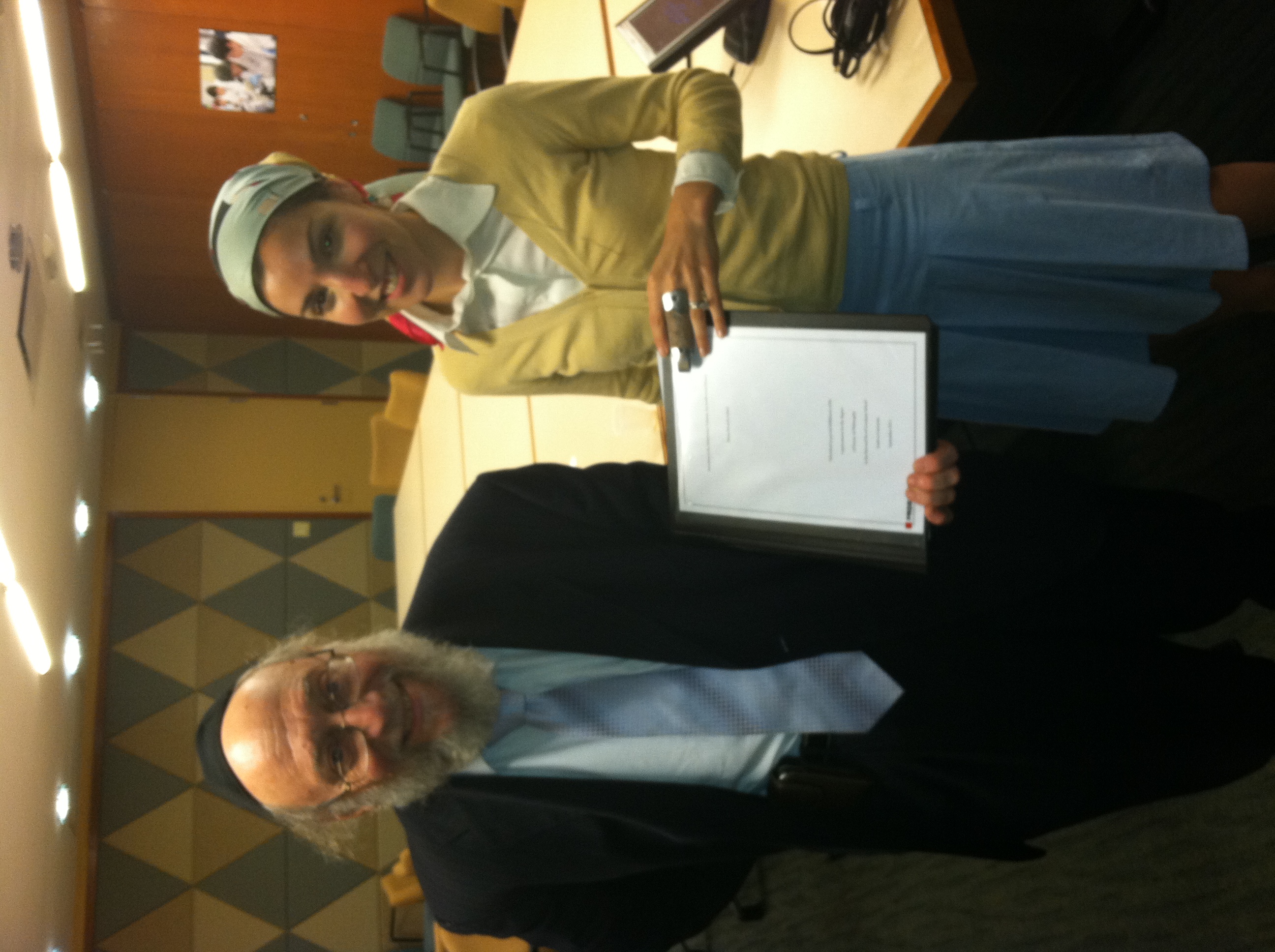 Congratulations!
Shana Strauch-Schick, “Intention in the Babylonian Talmud: An Intellectual History,” Yeshiva University dissertation, August 04, 2011.
Congratulations!
Over at The Immanent Frame, Lena Salaymeh (who has organized an AJS session that I’ll be participating in) posted about orality, religion, and secularism by way of the Talmud and law-school forms.
This may be old news for some, but I just saw Steven Notley and Ze’ev Safrai’s new collection of rabbinic parables reviewed at Biblioblog Library.
Since the dawn of academic Jewish studies, critical scholars had a few pet topics. Chief among these was Jesus of Nazareth and his relationship to Judaism, and Sectarianism. Indeed, everybody loves sects.
A recent volume, proceedings of a UCL conference, represents the most recent contribution to the study of sectarianism and Judaism – now from a historical perspective. The table of contents shows that the book has been divided into three sections: Ancient, Medieval-Modern, Theory and Practice. The section on Ancient is most germane to the readers of this blog:
Prologue: How Do We Know When We Are On To Something? (Albert I. Baumgarten)
Religious Variety and the Temple in the Late Second Temple Period and Its Aftermath (Martin Goodman)
The ‘Sectarian’ Calendar of Qumran (Sacha Stern)
Determining Sectarian by ‘Non-Sectarian’ Narratives in Qumran (Ida Fröhlich)
The Nazoraeans as a ‘Sect’ in ‘Sectarian’ Judaism? A Reconsideration of the Current View via the Narrative of Acts and the Meaning of Hairesis ( Joan E. Taylor)
Legal Realism and the Fashioning of Sectarians in Jewish Antiquity ( Christine Hayes)
Of these , the article of greatest interest is Hayes’. Here is the summary which appears at the end of the article:
The case I have argued is this: despite a surface appearance of great diversity, rabbinic representations of heretics (especially Sadducees and minim) for all their individual differences share a common element—a realist resistance to rabbinic legal nominalism and creative Scriptural exegesis. Ranging from skepticism to incredulity, from ridicule to outright hostility, the resistance of these non-rabbinic others leads ultimately to rejection of both the law and legal authority—either Pharisaic-rabbinic, as in the case of the Sadducees, or in the more extreme case of the min, both rabbinic and Scriptural. I have argued that the literary representation of heretics in classical rabbinic literature is rooted in a historic phenomenon: a divergence in legal epistemologies that can be traced to the late Second Temple period, involving (a) groups, often with a priestly orientation, who favored an approach to the law that placed a high value on epistemological certainty, and (b) a group or groups who were willing on occasion to set aside considerations of “the way things really are” in the determination of the law. The former viewed as absurd the nominalist tendency of the latter to overrule determinations of law that commanded a high degree of epistemological certainty, a tendency found in Pharisaic and later rabbinic law
It’s published by Brill, and we all know what that means, but you can still read the volume at your local, academic library.
This past Sunday, Professor Hayim Zalman Dimitrovsky was laid to rest in his hometown of Jerusalem. Professor Dimitrovsky was one of the greatest talmudic philologists of the previous century, and his research included pioneering talmudic higher criticism, scientific editions of medieval talmudic commentators, a collection of fragments of early Spanish talmudic prints accompanied by an indispensable guide to this phenomenon, and intellectual biographies of schools of talmudic study. Professor Dimitrovsky merited to learn with some of the greatest Talmudists of the early twentieth century, including J.N. Epstein and Simcha Assaf. More importantly, from his post at the Jewish Theological Seminary and later, at the Hebrew University Talmud department, he succeeded in raising generations of scholars who not only continued his work, but advanced the field in completely new (and different) directions. His death is a loss not only for his family, friends, students and colleagues, but for the field at large. He was the last of a generation.
In the coming days, the Talmud blog will be sharing brief remarks in memory of Prof. Dimitrovsky from those who knew him best. May his memory be a source of comfort to all who studied with him, and all who have studied his works.

parking ticket...avoided. Valuable Information...acquired.
The joys of New York City had me sitting in a car, waiting for a 9-10:30am spot to become legal on the Lower East Side of Manhattan. No matter, I had my laptop and the BBC playing, where I learned of an Oxford University project to outsource papyrological work to the public. They have built a simply incredible website to invite the general, non-scholarly, non-Greek reading public to help transcribe the cache of Greek papyri found at Oxyrhynchus over a century ago. The tools are impressive, though I still find it hard to believe that most fragments will be properly transcribed by people untrained in the papyrological arts. Could we use this for talmudic research?
In a recent review at the Review of Biblical Literature, Gail Streete looks at Ross Shepard Kraemer‘s newest book, Unreliable Witnesses: Religion, Gender, and History in the Greco-Roman Mediterranean. It is a fascinating take on how one of the foremost gender theorists working on Ancient Judaism has changed her views over the past few decades. In many ways, RSK’s (if you’ll pardon my French) evolution mirrors some of the debates still current among Talmudists, where feminists like Charlotte Fonrobert and, it seems to me, Daniel Boyarin, claim that female voices can be discovered in rabbinic works by reading closely for disturbances in the textual architecture, and scholars like Ishay Rosen-Zvi who have despaired of ever accomplishing such “recoveries.”
In other reviewing news, Josh Lambert over at Tablet Magazine, lists a number of interesting recent and forthcoming publications on identity and conversion, including Matthew Thiessen’s Contesting Conversion: Genealogy, Circumcision and Identity in Ancient Judaism and Christianity, and an edited volume entitled Sacrifice, Scripture and Substitution: Readings in Ancient Judaism and Christianity. Also of some interest is Yoel Finkelman’s forthcoming book on Artscroll (scroll down).
Back in 2007, I attended a Talmud conference at Bar Ilan University. It was an international meeting, and included a nice variety of scholars from both sides of the Atlantic, along with a “continental” Talmudist or two. The proceedings have recently been published by Bar Ilan University Press under the title Malekhet Mahshevet: Studies in the Redaction and Development of Talmudic Literature (eds. Aron Shemesh and Aron Amit). Although the volume does not include all of the original papers, I’ll quote Uriel Shklunik by saying that the volume is like finely sifted flour. Some highlights are the ongoing debate about the dating of the Stam between Robert Brody and Shamma Friedman, Yaakov Elman’s continued research of the introduction to talmudic tractates, and Steven Fraade’s preliminary probe: “Anonymity and Redaction in Legal Midrash.” For an English table of contents, see here.
Paula Fredriksen’s Augustine and the Jews (New Haven, 2010) is reviewed at length at Bryn Mawr.
How did a complete set of the Bomberg Talmud find its way into King Henry VIII’s? library?
A tehum marker dating from Roman/Byzantine times was found near the sea of Galilee. (Hat-tip Paleo-Judaica). Unlike the last time, this one is in Hebrew, not in Greek.

Miami Boys Choir's classic album "Torah Today"
In a previous incarnation, I mentioned a symposium entitled “Talmud Now?” held at the National Library. That tireless recorder of the Israeli-Jewish Renaissance, Menachem Mendel, has just noted that the the symposium was recorded and is now on-line. Watch it now, in all six parts.
Back in November when I posted the event, it generated a bit of discussion, particularly by mv who noted:
Two observations based on the identity of the panelists:
1. Two of the participants are rabbis, and the other two are also associated with institutions committed or associated with a religious form of Judaism (SHI, HUC). Casual Google prosopography (not serious research or personal acquaintance, so take this with a grain of salt) suggests that all come from the orthodox world.
I am not noting this to criticize the organizers or to complain against them: not every panel needs to be “representative” of the society it wishes to study or impact, but it is interesting that it includes no one from secular Israel, or at least from the institutions that identify themselves as secular (oh, one can think of Alma, a secular scholar from one of the universities, or even a poet or a novelist that is not connected with the religious institutions).
Even to the extent that this is somewhat undesirable, the blame must be shared with us secular Talmudists as well: for many years and with much resources, we have tried and failed to convince Israel’s cultural elite that the Talmud is a document worth engaging with. There are exception, of course; but Israeli culture largely ignores the Talmud, and when it does pay attention to it, it is mostly through “religious” mediators (think Kosman’s essays in one of the most prestigious fora of Israeli culture, Haaretz’s Tarbut we-Sifrut). In that sense, the panelists list itself epitomizes a problematic aspect of the issue it addresses.
Notice how Dr. Ruhama Weiss begins her remarks. After being introduced as someone who will describe Talmud study in non-religious institutions that do not feel bound by halakha, she rejects the distinction between “secular” and “religious” for her discussion.
And then, finally, listen to Dr. Yair Eldan who says precisely what was raised in the comments. We still essentially have no true Hiloni Talmud renaissance. And on the other hand, the religious community is largely incapable of fully appreciating talmudic discourse in its great variety.

Though not a Talmudist, few appreciated the dramatic potential of Summertime like Janis Joplin
It’s the summer, and some of you are swimming at the beach, hiking in the woods, and generally far away from the darkness of microfilm collections and poorly-lit reading rooms. Two upcoming events in Jerusalem will give your brain a chance to exercise and your pupils some time to readjust to the indoors.
First, tomorrow, Tuesday July 11 at 7:30pm at the Jerusalem theater, the Van Leer Institute and the Hebrew University of Jerusalem will be hosting a screening and discussion of Joseph Cedar’s Footnote – a film close to the heart of this blog and which I hope to write a review of (with Elli Fischer) for the Jewish Review of Books. Participants at the event will include Cedar himself, along with Hebrew U professors Israel Bartal, Shlomo Naeh, Avinoam Rosenak, and more.
Second, as Prof. David Halivni continues to push back the date of the redaction of the Babylonian Talmud, the renewed Jewish National Library will have Prof. Halivni give a talk next Sunday, July 17th at 1pm when he will finally ask “Was there a Redaction of the Babylonian Talmud?”
(You can submit events of interest to thetalmudblog[at]gmail[dot]com)
 The Talmud Blog
